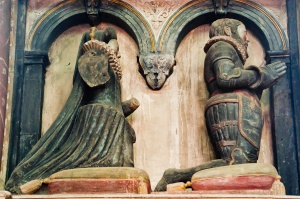
Burwell, Cambridgeshire
It has been estimated that in Queen Mary's reign 2/3 of the English people were Catholic, but it didn't matter because the leadership and the middle classes were not.At the beginning of the 16th century most priests were illiterate, knew little Latin and not much scripture.
Under Elizabeth standards improved and the clergy had to pass examinations. The church began to actively recruit educated men in the universities.
Church vandalism...
Elizabeth's reign also saw quite a bit of image vandalism in churches, which steadily increased as the more radical Puritan sects grew in influence. Paintings were whitewashed, chalices, roods, and stone altars were removed. However, screens without roods stayed, as did painted glass, tombs, fonts, and lecterns. Durham Cathedral in particular suffered from the defacement and removal of treasures.
... and greed
Sometimes there was more at work than religious zeal. In Chester, the canons removed glass from the cathedral to install in their own churches. The vicar of Islington melted down funerary brasses from the church and made coins from them.

Holme Lacy, Herefordshire
Pride goeth before...the sermon
Males and females were separated in the church, and seating was by social rank. This occasionally led to brawls in the church over who outranked who. Churches became the stage for family pride; often altars were pulled down and replaced by elaborate family tombs.
This was part of the great surge in social mobility, and hand in hand with it, a great class consciousness. Pretensions to nobility were insisted upon fanatically. Phillip Stubbs called it, "Every man crying with open mouth 'I am gentleman'".
These class concerns extended far beyond church; they found an outlet, for example, in heraldry which bedecked the new tombs. Before Tudor times coats of arms were generally simple affairs. Now they became crowded, full of reference to real or imagined family backgrounds.
Monastic buildings were adapted to become houses, hospitals, government stores, factories, tenements, and guild halls. After the Dissolution of the Monasteries there were far fewer people in religious orders and the influence of the church declined drastically. It was said that, "The church no longer ran the country, the country ran the church".