ARCHIVED ARTICLE
by Terry & Doris Michaud
If you are a devotee of early lace, you are probably familiar with Honiton Lace. It takes the name of the East Devon town of Honiton in the Southwest of England where the finest lace in all of Europe was produced.
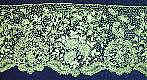
Honiton wedding flounce from the mid-19th century |
Records of early lace development are few and far between, but it is believed to have originated in Italy in the early 16th century and spread throughout Europe. Honiton, being a wool and flax area was perfectly suited to taking up this new craft.
Prior to lace making Honiton had a history of textile production, so when it became a highly desirable fashion accessory with Royalty and the wealthy, the textile workers were well suited to take up the trade.
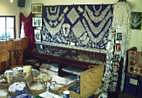
Lace display at the Honiton shop |
In the 19th century, lacemakers were paid very poorly, often paid by tokens that could only be spent in general stores owned by the merchants who sold the lace. They took orders for the product which was crafted by designers, lacemakers and finishers.
Honiton Lace refers to a technique for making a specific type of lace that took its name from the town of Honiton. In fact, it was also produced in other area towns and villages but retained the name, Honiton Lace.
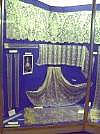
Display from the Honiton Lace museum |
In the 19th century, the lace industry experienced a decline, but it was revived by Queen Victoria because she ordered much ceremonial lace including the special designs used in her wedding dress. The Royal Family has used the Royal Honiton Lace for the christening gowns for all the Royal christenings through the years.
While the commercial trade for Honiton Lace has long since ceased to exist, there are still many craftspersons in the Honiton area that produce the lace in limited quantities. A visitor to Honiton has the opportunity to see rare examples of the lace at the Allhallows Museum located in the oldest building in town, which dates before 1327.
Lace makers come from around the world to see the magnificent collection of Honiton Lace. In 1698 over half the town's population earned a living from lace.
In the Nichol Gallery at the museum, there are displays of rare examples of lace, its history and tools used to craft it. There are also ongoing demonstrations of Honiton lacemaking given each day during the summer months.
LACE WEEKENDS
Beginning in the late 1980s regular get-togethers were undertaken for people interested in antique lace. These bi-annual events continue today and are attended by a worldwide audience of collectors, historians, dealers and lace lovers. Space is restricted to 24 participants and take place at The Deer Park, one of Devon's leading country hotels.
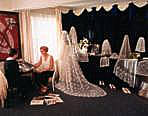
Wedding veil shop at the Honiton museum |
Past themes of this bi-annual conference included discussions on early origins of lace, the history of collecting, pitfalls of lace identification and many other varied and interesting topics. Anyone planning to attend is well advised to reserve a space well in advance. Details are available from the website www.honitonlace.com.
HONITON LACE SHOP
One of the world's leading outlets for fine antique lace is the Honiton Lace Shop, with a broad range of laces from throughout Europe as well as local examples dating from the 16th century. Pieces range in size from samples to larger complete pieces. If you are truly interested in rare and beautiful lacework, a visit to Honiton should be high on your list of places to visit in England.
TRAVEL TIPS
One of the handiest items we have discovered to carry along are mesh shopping bags. They fold down nicely and can be carried in a purse or pocket, yet they can be used to hold a number of parcels when shopping, particularly at antique and flea markets.
NEVER leave your passport in your hotel room. It can be carried conveniently in a small cloth bag with a cord to hang it over your head and carry it inside a sweater or shirt. It is also wise to make a Xerox copy of your passport pages and keep them in a separate location. They can be a lifesaver if you do lose your passport and need the copy for identification.
Note: all photos courtesy of Honiton Lace
Britain for Collectors is written by Terry & Doris Michaud, internationally known in the world of teddy bear collectors. They have authored 5 books on collecting and regularly write features for magazines in the U.S. and abroad. In a partnership with Bill & Rosemary Hayes, they conduct annual collector's tours to Great Britain.