Summary
A small country church near Stow on the Wold, famous for its superb medieval 'Doom' wall painting, possibly the largest such medieval painting in the country.
About the church
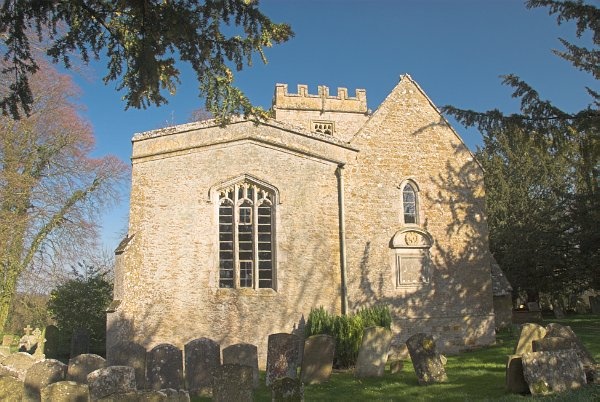
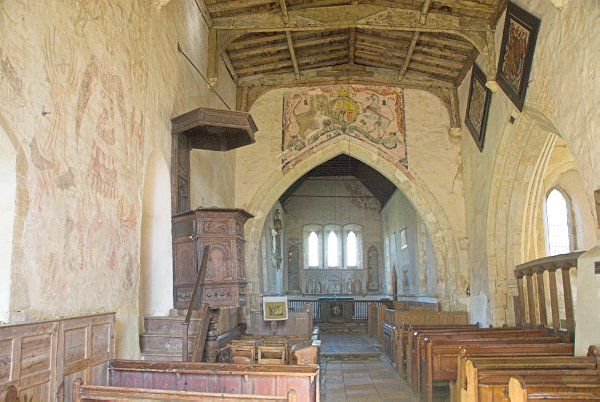
The church of St Nicholas is located at the end of a small lane some 1/4 mile from the centre of Lower Oddington village. The church is composed of a very high, flat-ceilinged nave, a large south aisle, a south chapel and porch, and a central tower. It originally had a north door as well, but this has been partially bricked up to form a window. The church was begun sometime in the 12th century and is very simply adorned, with a three-arch nave arcade and Early English chancel arch.

The Doom Painting
St Nicholas is a very attractive church in a lovely rural setting, but there is nothing strikingly compelling about the exterior architecture to attract visitors (unless you are a real medieval church fanatic, as I am!). But as soon as you enter the church, you see the real reason why it is worth making a special trip to Oddington. Against the north wall of the nave is a superb medieval wall painting, perhaps the largest 'Doom' painting in Britain.
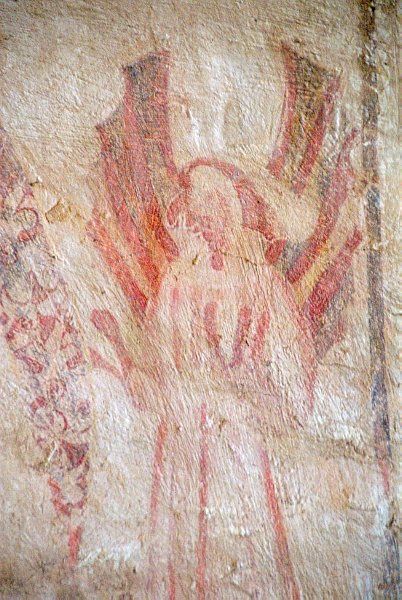
Medieval churches were generally brightly painted, adorned with colourful images that were used as a way to communicate religious ideas to a largely illiterate population. The Biblical 'Last Judgement', or 'Doom', was a popular subject for wall paintings.
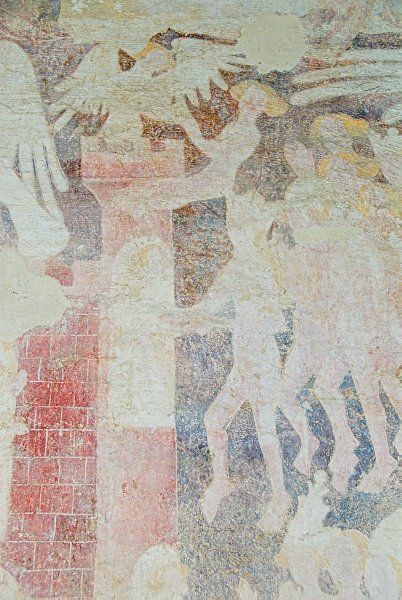
The Oddington Doom painting was created about 1340, probably by an itinerant artist. It occupies the entire north-west wall of St Nicholas church and reaches 32 feet long by 15 feet high. It begins about 6 feet off the floor, above a section of wooden panelling, but it would originally have stretched to the floor.
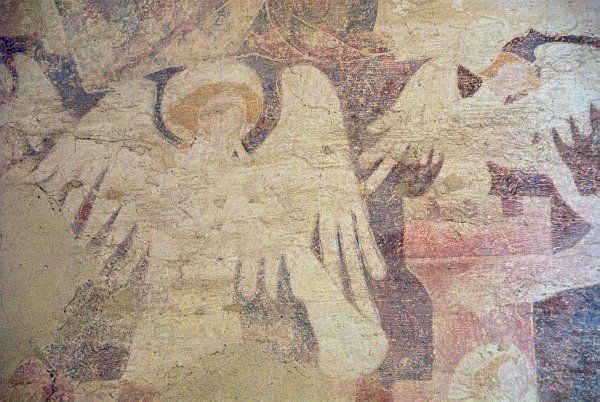
At the top centre of the painting is a figure of Jesus, flanked by apostles and saints, and below this are two angels sounding a trumpet to waken the dead.
The bottom of the image shows the dead rising from their graves to be judged. Some are awaiting admittance at the gates of heaven, while others are being dragged into hell, where a fearsome figure of Satan surrounded by his imps awaits them.

The Magnificence (Wolsey) Painting
Immediately to the east of the Doom painting is another, equally tall painting. This can be reliably dated to 1520. It depicts a very tall central figure in a gown surrounded by much smaller secondary figures in a variety of costumes, some of which are quite obviously of contemporary Tudor style.
One possible explanation of this painting is that it depicts characters from the morality play 'Magnificence', which was a pointed satire on the high-living Cardinal Wolsey.
It seems odd that a painting referring to a courtly play would appear in a rural church, where the audience would have little understanding of its subject, but there is a tie between Wolsey and Oddington, for between the years 1512 - 1529 Wolsey, in his capacity of Archbishop of York, was also Lord of the Manor of Oddington. So we are left with the possibility that the large figure in the Magnificence painting is meant to represent Cardinal Wolsey himself.
Elsewhere in the Church
The striking Doom is not the earliest wall painting in St Nicholas church; that honour is reserved for a small 13th, or possibly 14th, century image in the south chapel, thought to represent a nativity scene or a life of the Virgin Mary.
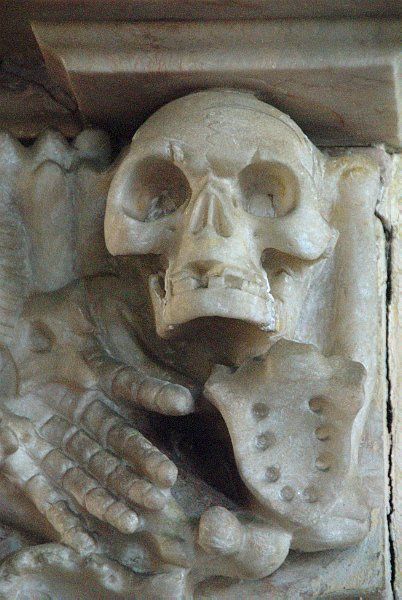
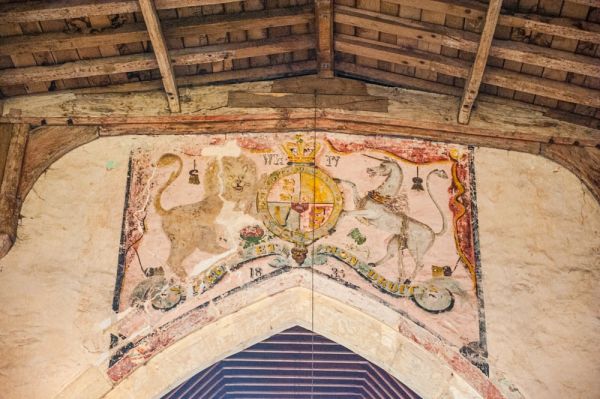
There are also some interesting carved stone corbel heads in the nave, and faded traces of colourful paint on the 12th-century arches. Over the chancel arch is a painted rendition of the royal coat of arms of William IV, superimposed on a medieval painting. It is unusual to find William's arms; the only other Gloucestershire church to contain them is at Painswick.
Visiting
Though St Nicholas is a very simple church, the wonderful wall paintings make it well worth a visit.
Heritage Highlights- 12th-century Doom wall painting
- 16th-century 'Magnificence' painting
More Photos
About Lower Oddington
Address: Church Road,
Lower Oddington,
Cotswolds,
Gloucestershire,
England
Attraction Type: Historic Church
Location: At the end of Church Road, signposted from the village centre. Parking on the verge. Do not mistake St Nicholas for the modern parish church located on the High Street.
Website: Lower Oddington
Location map
OS: SP235253
Photo Credit: David Ross and Britain Express
HERITAGE
 We've 'tagged' this attraction information to help you find related historic attractions and learn more about major time periods mentioned.
Historic Time Periods:
Find other attractions tagged with:
Medieval (Time Period) - wall painting (Historical Reference) -
NEARBY HISTORIC ATTRACTIONS
Heritage Rated from 1- 5 (low to exceptional) on historic interest
Adlestrop, St Mary Magdalene - 0.5 miles (Historic Church) 
Bledington, St Leonards - 1.8 miles (Historic Church)
Chastleton House - 2.5 miles (Historic House) 
Churchill and Sarsden Heritage Centre - 2.7 miles (Museum)
Stow-on-the-Wold, St Edward's Church - 2.8 miles (Historic Church)
Churchill, All Saints Church - 3 miles (Historic Church)
Salford, St Mary's Church - 3.6 miles (Historic Church)
Four Shire Stone - 4.3 miles (Historic Building)
Nearest Holiday Cottages to Lower Oddington:

Lower Oddington, Gloucestershire
Sleeps: 4
Stay from: £534.00
Stow-on-the-Wold, Gloucestershire
Sleeps: 6
Stay from: £1128.00 - 4823.00
More self catering near Lower Oddington