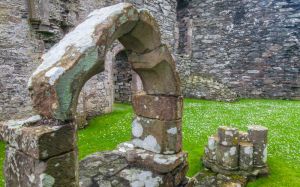
A wonderfully scenic Cistercian abbey, dating to the late 12th century. There seems to be some doubt as to the origins of Glenluce. The abbey was probably founded sometime between 1190 and 1192, by monks from either Melrose or Dundrennan, depending on which historian you listen to. The patron was probably Roland, the Lord of Galloway. The abbey was no sttranger to royaltty, being visited at various times by Robert the Bruce, James IV, and Mary, Queen of Scots.
Glenluce,
Dumfries and Galloway,
Scotland
Attraction Type:
Abbey Heritage Highlight: Very well preserved 15th century chapter house Heritage Rating:? Location: On a minor road 2 miles north west of Glenluce village, off the A75. Well signposted.
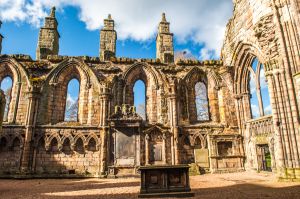
One of the most popular historic attractions in Edinburgh, Holyrood Abbey was founded by David I around 1128 and was sacked several times by the English throughout its long and turbulent history. The roofless nave is all that remains of the medieval abbey buildings. Some sculpted details survive, and a royal burial vault with the remains of David II, James II, James V and Lord Darnley. The abbey is attached to the Palace of Holyrood House, the official residence of the British monarch in Scotland.
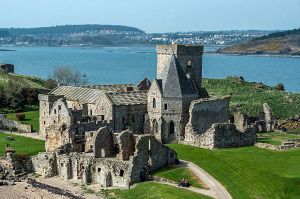
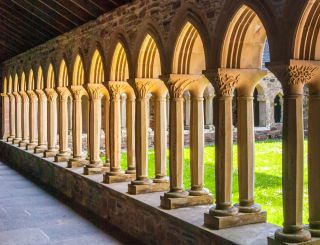
Alexander I was stormbound on the island in 1123, and a hermit looked after his needs. In appreciation, Alexander founded an Augustinian abbey on the site. Well-preserved buildings include 13th century octagonal chapter houses, 14th century cloisters and parts of the church.
Inchcolm Island,
Fife,
Scotland
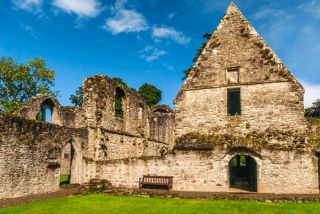
A lovely monastic settlement on an island in the middle of Lake Menteith, Inchmahome was briefly the home of Mary, Queen of Scots. Inchmahome was built in 1238 by Walter Comyn, the earl of Menteith, for a group of Augustinian friars.
Lake of Menteith,
Stirling Aberfoyle,
Stirlingshire,
Trossachs,
Central Scotland,
Scotland,
FK8 3RA
Broken up during the reformation, the abbey has been reconstructed using traditional materials. In 563AD St Columba, an Irish missionary, established a monastery on the island which became a center of Celtic Christianity. St. Aidan set out from here in 636AD to establish Christianity in Northumbria, and the island's religious significance spread throughout Scotland. After 200 years of tranquility, Norse raids put an end to the settlement and destroyed many of the buildings. A Benedictine abbey was founded in the 13th century and was made a cathedral in 1500.
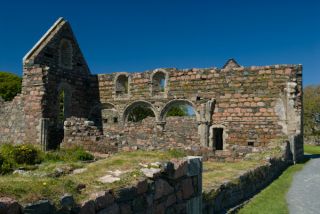
Most visitors to Iona come to see the historic abbey, founded around 1200 and restored in the 20th century. However, just a short stroll from the ferry quay at Baile Mòr stands the ruins of one of the best-preserved medieval nunneries in Britain. The nunnery stands beside the main pilgrim's route from the landing place at Baile Mòr along the 'street of the dead' to St Columba's shrine and the abbey.
Baile Mòr,
Iona,
Strathclyde,
Scotland
The priory of St Adrian on the Isle of May is traditionally thought to have been founded by David I for monks of Reading Abbey, sometime around 1135. Henry I, David's brother-in-law, was buried at Reading, so the association seems plausible. The priory was established on a site where St Ethernan (who later became known as St Adrian) and several of his followers settled and established a monastery sometime before 669 AD. Ethernan was probably trained on Iona, and also established a monastery at Kilrenny, on the Fife mainland.
Isle of May,
Anstruther,
Fife,
Scotland