Historic churches in Scotland Travel and destination information for Scotland
- churches with a particular historic, architectural, or scenic interest.
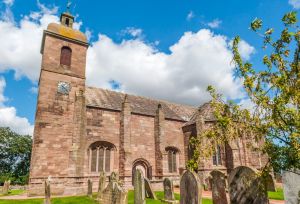
The Lauderdale Aisle is the former sacristy of the great medieval church of Haddington St Mary's. The parish church of Haddington was one of the largest and finest churches erected in Scotland during the late 14th century, equalling Edinburgh's St Giles in size and easily the equal of most Scottish cathedrals. There was a church on the site since at least 1139, when it was granted by David I to St Andrews. That Norman building stood where the choir of the present church now stands.
St Mary's Church,
Sidegate Haddington,
Lothian,
Scotland
Attraction Type:
Church Heritage Rating:? Location: On the B6368 in the centre of Haddington, south of the A1/A6093 junction.
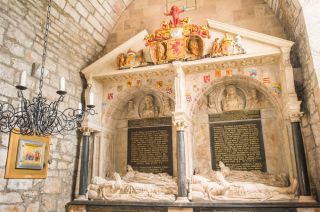
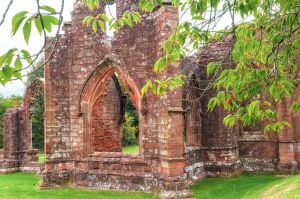
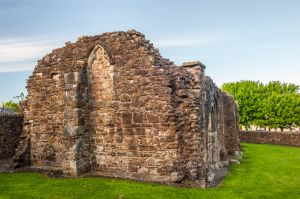
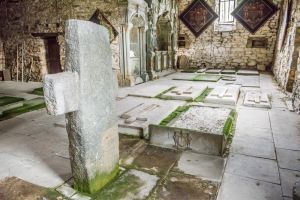
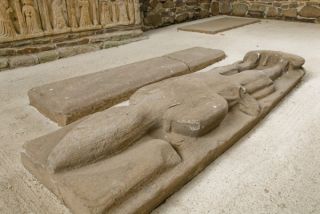
In 1389 the 3rd Earl of Douglas, known to history as Archibald the Grim, founded a collegiate church here, beside Cluden Water and the River Nith, on the site of a 12th century Benedictine nunnery. The purpose of the Lincluden foundation was to say prayers for Archibald's soul and those of his immediate family members. Archibald's son, also named Archibald, created a fabulous chancel within which stands a marvellous monument to his wife, Princess Margaret, daughter of King Robert III.
Abbey Lane,
Dumfries,
Dumfries and Galloway,
Scotland
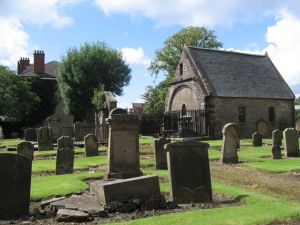
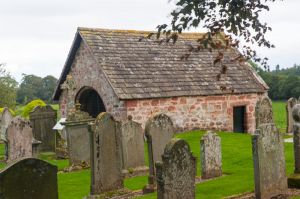
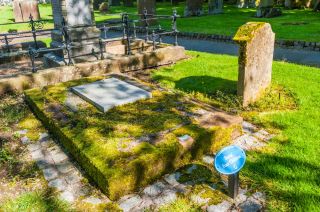
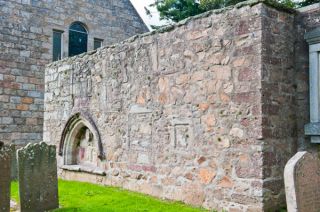
All that remains of the 14th century church at Edzel is a small burial aisle, built in the 16th century by the local Lindsay family as a chantry chapel. It was later used as burial vault for the family, but the church itself fell out of use when a new parish church was erected in 1818. Stone from the old church was scavenged for the new building, leaving behind the burial aisle as the only reminder of the medieval church.
Edzell,
Angus and Dundee,
Tayside,
Scotland
Attraction Type:
Church Heritage Rating:? Location: In Edzell graveyard off the B966, 6 miles north of Brechin. No tourist signage
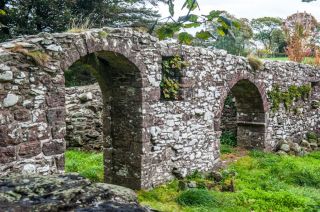
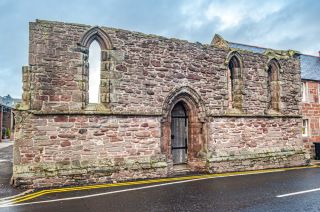
Only one wall survives of a 13th century hospital founded by William de Brechin. The hospital was founded in 1267 as a home for the poor, under a master and chaplains. The hospital remained in operation until at least 1636 when the office of master was merged with the role of headmaster at the nearby grammar school.
Maison Dieu Lane,
Brechin,
Angus and Dundee,
Tayside,
Scotland,
DD9 6JA
A late 14th century collegiate chapel founded by John Kennedy of Dunure on the site of an early 13th century chapel. In 1371 Kennedy and his family furnished the funds for the Chapel of St Mary at Maybole, and in 1382 they founded a college of priests to pray for their souls.
Abbot Street,
Maybole,
Strathclyde,
Scotland
Attraction Type:
Church Heritage Rating:? Location: In the town centre, off the B7023 to Crosshill, and then take the first right.
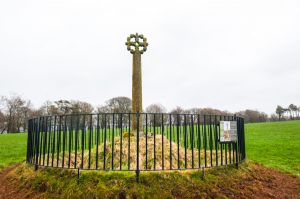
A medieval wayside cross crafted in a floriated design, standing beside the main medieval road to Annandale. Today the presence of the A74(M) overshadows the cross, which stands on the course of the Roman road north from Gretna into southern Scotland. The cross stands over 3 metres high, on a slender shaft.
Woodhouse Farm,
Kirtlebridge,
Dumfries and Galloway,
Scotland
Attraction Type:
Church Heritage Rating:? Location: At Woodhouse Farm, 1 mile north of Kirkpatrick Fleming on the B7076, immediately beside the southboound lane of the A74(M). Nearest motorway exits are 20/21
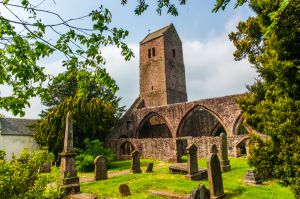
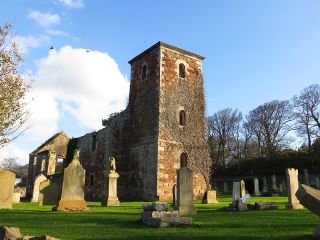
12th century ruins of important medieval parish church with tall Romanesque tower. Late medieval remains from 15th century.
Muthill,
Crieff,
Tayside,
Scotland
One of the most important ecclesiastical sites in the southern isles, Nunton chapel stands in the burial ground near Nunton Steadings cultural centre, just south of Balivanich. It is the only early Christian site on Benbecula still in use. Persistent legend suggests that there was an early Christian presence here associated with the Celtic monastery established by St Columba at Iona.
B892,
Nunton,
Benbecula,
Highlands and Islands,
Scotland
This 1500's church is noted for the 1591 gathering of "witches", supposedly addressed by the devil, who were plotting to kill James VI.
North Berwick,
Lothian,
Scotland
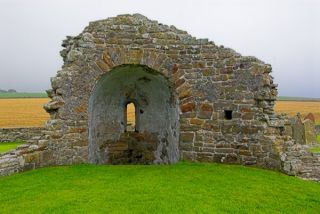
Remains of only surviving medieval circular church in Scotland, built in first half of 12th century. Dedicated to St. Nicholas.
Orphir,
Mainland,
Orkney,
Highlands and Islands,
Scotland
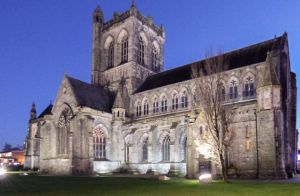
Paisley Abbey was founded as a priory by Walter Fitzalan, the High Steward of Scotland, around 1161, on a site near Renfrew where a 6th century Celtic church founded by St Mirin had stood. In 1169 it was moved to its current site in Paisley. Fitzalan's priory was to follow the Cluniac rule, and the first 13 monks came from the Cluniac monastery at Much Wenlock, in Shropshire. In 1245 Paisley Priory was elevated to the status of an abbey, and dedicated to four saints; St Mary, St James, St Mirin, and St Milburga of Wenlock.
Abbey Close,
Paisley,
Strathclyde,
Scotland
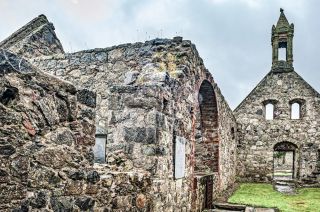
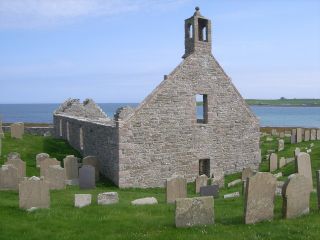
A ruined and roofless medieval church looking out to sea. The major historic interest here are a small collection of finely carved medieval tombstones. The church, also known as Lady Kirk, was built in the 13th century, but much of what we can see today is the result of rebuilding in the 17th century. The simple layout consists of a rectagular nave and chancel angled slightly off-centre towards the south. The church is built of rubble with freestone dressing, and the nave is 14.5 metres long and just over 6 metres wide. The oldest stonework is set in clay, while the newer work uses lime mortar. The church was in use as the parish church of Pierowall until sometime after 1879.
Pierowall,
Westray,
Orkney,
Highlands and Islands,
Scotland
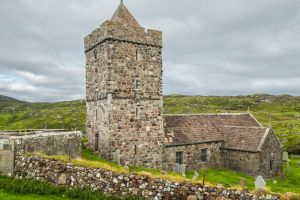
The church of St Clements at Rodel is probably the finest late medieval church in the West of Scotland. Rodel is famous for the superbly carved tomb of Alexander MacLeod of Harris (d. 1547), depicting hunting, sailing, and religious figures. There are also three tombs of knights and 16th century grave slabs carved from gneiss.
Rodel,
Western Isles,
Highlands and Islands,
Scotland
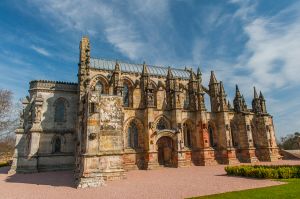
Also known as St Matthew's Collegiate Church, but more commonly simply called Rosslyn Chapel. The chapel was founded by Sir William St Clair, the last Prince of Orkney and lord of Rosslyn Castle in 1446. It was heavily damaged in 1592 and restored in 1861. The main feature of this extraordinary building are the intricate and elaborate carvings that seem to adorn every surface. There is simply no medieval building in Britain like Rosslyn.
Roslin,
Lothian,
Scotland,
EH25 9PU
The old parish church of Rothesay has a long and complex history. The church stands on the site of the Cathedral of Sodor (Cathedral of the Isles). In 1692 the church was moved to its current location, leaving behind a 13th century chapel which may have been the chancel or choir of the main building. The chapel is dedicated to St Mary, and is often called Lady Kirk, but an old tradition also associates the chapel with St Brioc, or Brieuc. Around 1315 it was converted to become a mortuary chapel for the Stewards of Scotland.
High Street,
Rothesay,
Bute,
Argyll and Bute,
Strathclyde,
Scotland
Attraction Type:
Church Heritage Rating:? Location: On the B881 on the south edge of Rothesay. Parking along the street.
It is hard to find words adequate to describe the Ruthwell Cross; it is without doubt one of the finest early Christian monuments in Europe, and one of the historical highlights of a visit to south west Scotland. The Cross is a freestanding monument, dating from the late 7th or early 8th century, and is carved on all four sides with a wonderful variety of runes, animal figures, humans, and religious symbols.
Ruthwell,
Dumfries and Galloway,
Scotland