What to See
There is much more to Braemar than the Highland Gathering, however; it's a gem of a village, set in wonderful scenery beside the River Dee.
Braemar Castle
On the eastern outskirts of the village stands Braemar Castle, a lovely Jacobean fortress.
The castle was built in 1628 for the Earl of Mar. It was burned in the 1689 Jacobite rebellion, and like so many Scottish baronial homes, Braemar Castle lapsed into decay. It was thankfully rescued, restored, and is now open to visitors during the main tourist season.

Kindrochit Castle
Just over the bridge across Clunie Water are the ruins of medieval Kindrochit Castle. The castle was built in the 14th century, though tradition says that an earlier wooden fortress was built there by Malcolm Canmore in the 11th century.
Kindrochit was built mainly as a centre for royal hunts, but it also served as a defensive structure guarding the main route to Perthshire across the Cairnwell Pass, and north towards Angus.

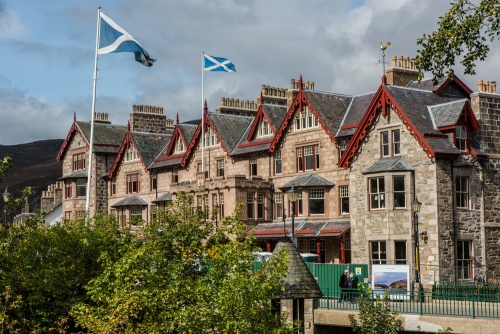
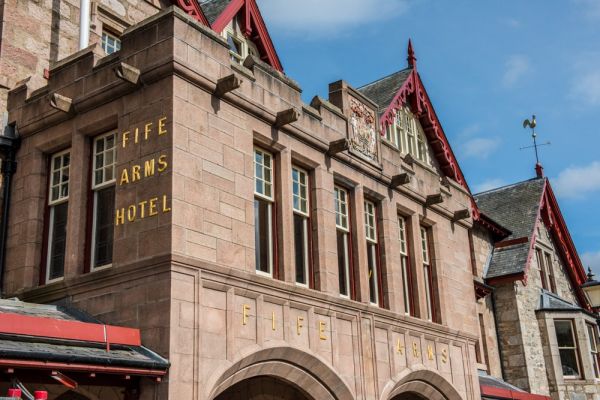
In 1715 the Earl of Mar raised the standard for James Stuart (The Old Pretender) on the site where the Invercauld Hotel now stands.
There are wonderful walks into the hills above Braemar; to the west is the nature reserve of Morrone Birkwood, which afford fantastic views north towards the Cairngorms.
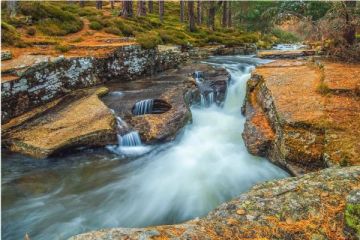
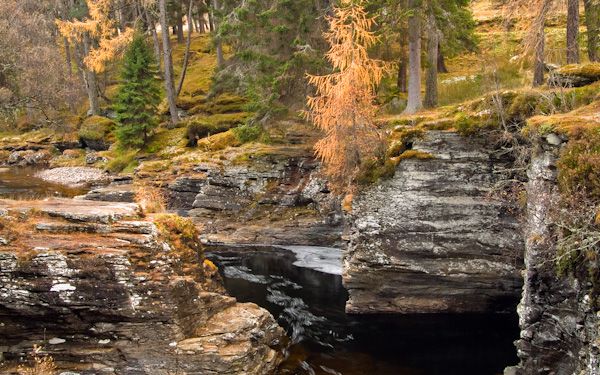
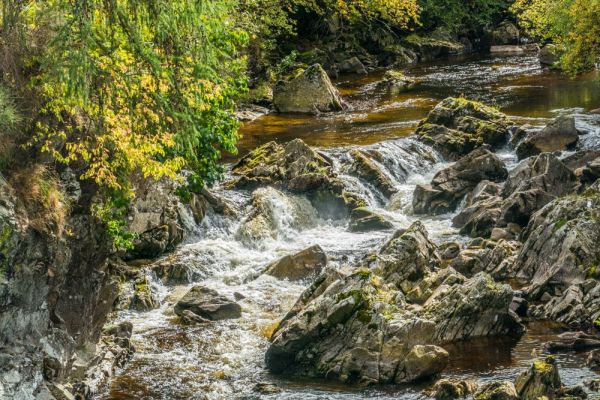
A short drive west along the River Dee brings you to the Linn o' Dee, a famous beauty spot favoured by Queen Victoria, where the river drops down precipitously between steep-sided cliffs.
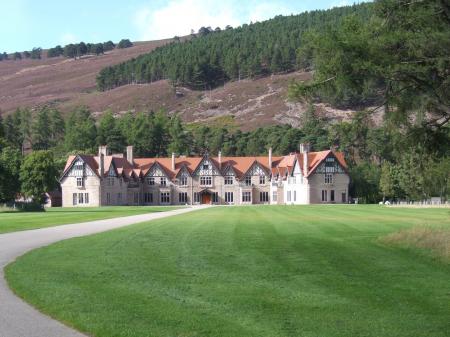
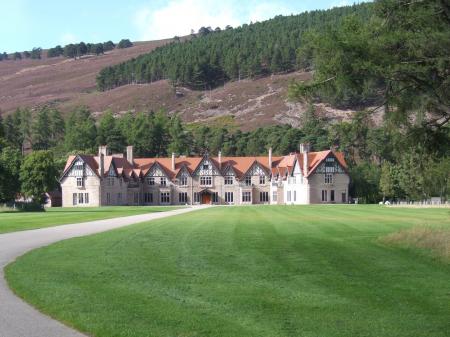
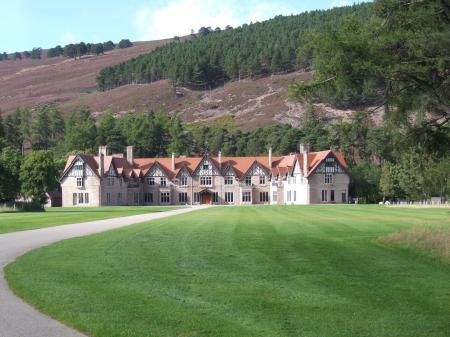
The road continues on, looping back to follow the Dee eastward, ending at the Linn o' Quoich, another lovely waterfall with footpaths going up into the surrounding hills, much of which is part of the Mar Lodge estate, now cared for by the National Trust for Scotland.
Braemar is the highest and most mountainous parish in all of the UK.
Just how mountainous is it?
Braemar lies close to over a quarter of all the Munros (mountains over 3,000 feet high) in all of Scotland.
Old Graveyard
Between the village and Braemar Castle lies the site of the first church in Scotland dedicated to St Andrew. That first church, more properly a chapel, was established in the 8th century. Several churches dedicated to Scotland's patron saint were later erected on the site.
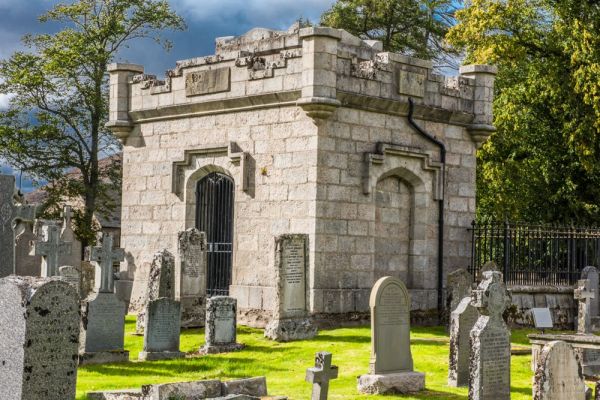
The last of these churches was pulled down in the 19h century when the present church was built in the centre of the village. There is no evidence of the earlier churches to see, and an ornate burial vault built by the Farquharson family of Invercauld now stands on the spot.
Within the burial vault are memorials to James Farquharson, who fought for the government in the 1745 Jacobite Rebellion, and his wife Anne (known popularly as 'Colonel Anne') who supported Bonnie Prince Charlie in the conflict.

The Last Jacobite
Tucked up against the mausoleum on the west side is the grave of Peter Grant, the last surviving soldier of the 1745 Jacobite Rebellion, who died in 1824 at the age of 110. Grant was born in 1724 at Dubrach, a croft in Glen De. He was taken prisoner at the Battle of Culloden but managed to escape from imprisonment in Carlisle Castle where he was being held for trial, and make his way home to Scotland on foot.
In later years he was known as Auld Dubrach. When George IV visited Scotland in 1822 he heard the story of auld Dubrach, his 'oldest subject and oldest rebel'. Far from holding a grudge, King George granted Auld Dubrach a sizeable pension.
East of the Invercauld burial vault is a 1708 table tomb marking the grave of five Roman Catholic clergymen, while in the southwest corner of the site is a gravestone erected by Queen Victoria in honour of Francis Clark, her attendant for 25 years. Beside the graveyard is the Toll House, where travellers paid a 'safe passage' fee.
Invercauld Fountain
Directly beside the Invercauld Arms Hotel is a richly carved water fountain given by Lt. Col. James Ross Farquharson, more popularly known as Piccadilly Jim, to commemorate his wife, Louise Oswald, who tragically died in childbirth in 1870 at just 24 years old.

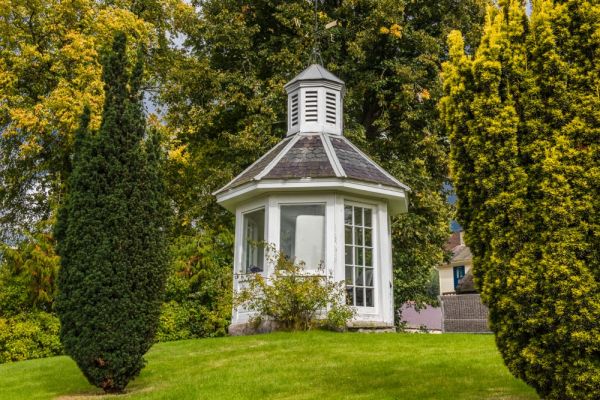
Victorian Weather Station
Near the Invercauld Arms Hotel stands a peculiar whitewashed structure that looks something like a gazebo, or perhaps a wooden dovecote. It is actually the village's first weather station, a gift to the inhabitants of Braemar from Prince Albert in 1855.
St Margaret's Episcopal Church
This intriguing building was designed by Sir John Ninian Comper and finished in 1907. It is now cared for by the Scottish Redundant Churches Trust. We were fortunate enough to visit on a Heritage Open Day and got to explore the church interior, which is light and airy. As you would expect from a Comper church, it features a large, ornately carved rood screen and rood.

The Ringing Stone
On the small green below St Margaret's Church lies a circular stone - looking rather like a millstone - used by the village blacksmith to fit iron rims onto wooden cart wheels.
Robert Louis Stevenson's Cottage
A few steps from the churchyard at 3 Glenshee Road, is the cottage where author Robert Louis Stevenson lived for a brief period. It was during his stay in Braemar the Stevenson began to write one of his most popular novels, Treasure Island.
He almost certainly drew inspiration for several of his characters from people he met in Braemar, including Long John Silver, modelled after a very real Braemar resident. A plaque on the outside of the cottage commemorates the Stevenson connection, but it is very much a private home and not open to the public.

Castleton Hall
Almost across from the Stevenson Cottage is Castleton Hall, built by the Farquharson family of Invercauld for the inhabitants of the Castleton area of the village.
War Memorial
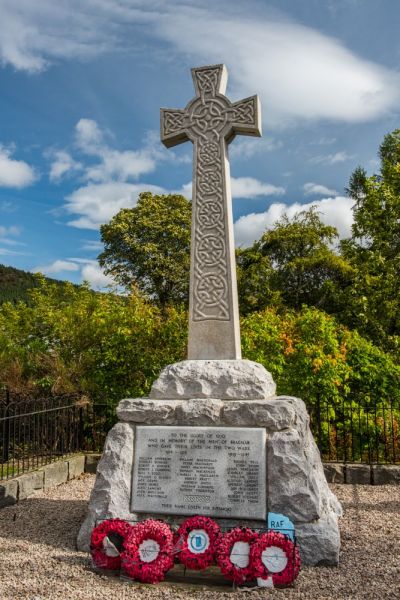
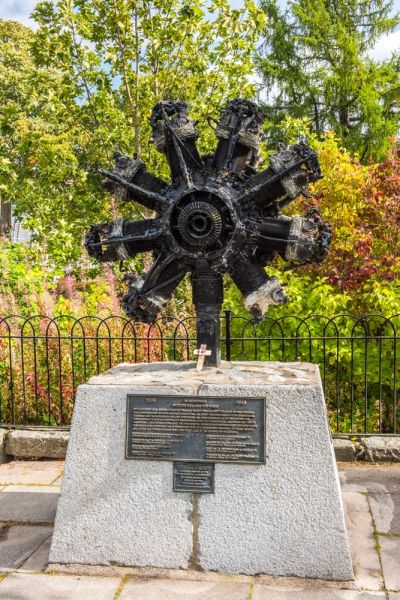
On the far side of Clunie Water, facing the ruins of Kindrochit Castle, is the village war memorial, unveiled in 1921 by the Princess Royal. Beside it is a striking memorial to the eight men who died in 1942 when their Vickers Wellington R1646 crashed on a routine training flight from their base at RAF Lossiemouth. The memorial is based around one of the Bristol Pegasus XVIII engines recovered from the crash site.
Braemar Church
The church with a striking spire was built to replace an earlier church, also dedicated to St Andrew, which stood in what is now the old graveyard (see above). It was begun in 1870 as a Free Church by Rev Hugh Cobban. Rev Cobban is, unusually, buried within the church he built, just behind the pulpit. On the wall is a memorial plaque to four men of Braemar who died in the First World War.
The church is Gothic in style, to a cruciform plan, with a tall, slender spire that is visible for quite some distance away. The church is usually open to visitors and features some very good Victorian woodwork and stained glass.

The Old Military Road
Behind St Andrew's Church and running parallel to the Cluny is the road built by General Wade following the 1715 Jacobite Rebellion. Wade was given the task of improving roads and bridges to enable efficient troop movements in case there was a second Jacobite rebellion (which, indeed, there was).
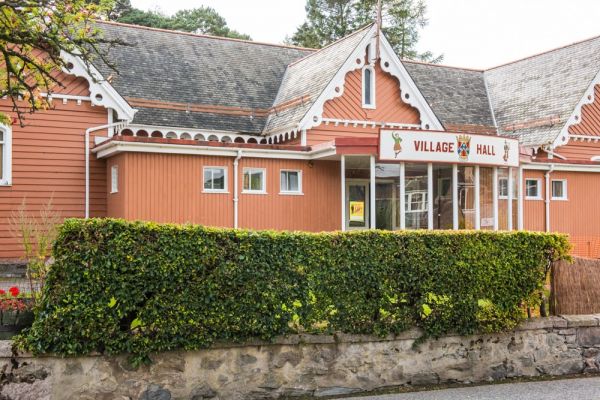
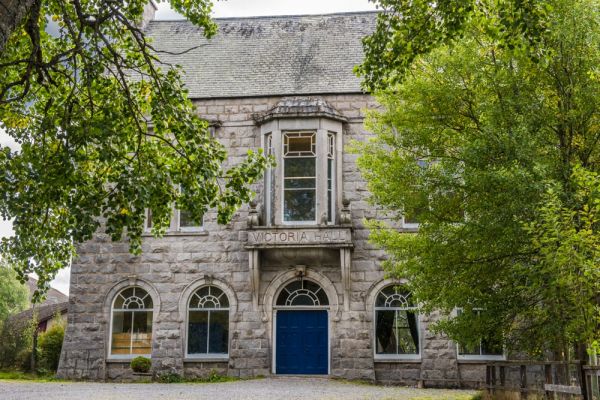
Village Hall
This eye-catching building is made of timber and was built by the Duke of Fife as a community centre for the inhabitants of Auchendryne.
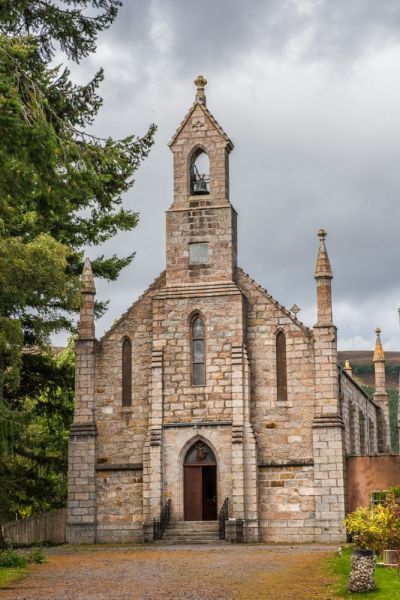
St Andrew's Roman Catholic Church
Near the village hall is a striking Catholic church built in Gothic Revival style. It was paid for by Lady Carmarthen, the wife of the 7th Duke of Leeds, who rented Old Mar Lodge from the Earl of Mar. The church was built in 1839 to replace an earlier 1795 building on Chapel Brae. It is built of granite quarried just 15m from the building site.
Jubilee Drinking Fountain
Just west of the village hall is an ornate drinking fountain erected in 1897 to mark Queen Victoria's Diamond Jubilee.

Five miles to the east of Braemar is Balmoral Castle, the country home of the Royal family since the days of Queen Victoria and Prince Albert, while a drive north brings you to enigmatic Corgarff Castle, a brooding tower house set in a stunning landscape below steep hills.
Braemar is one of the prettiest and most beautifully situated villages in Royal Deeside, and though it can be a touch touristy at busy times of the year, it makes a wonderful centre to enjoy the area.

 We've 'tagged' this attraction information to help you find related historic attractions and learn more about major time periods mentioned.