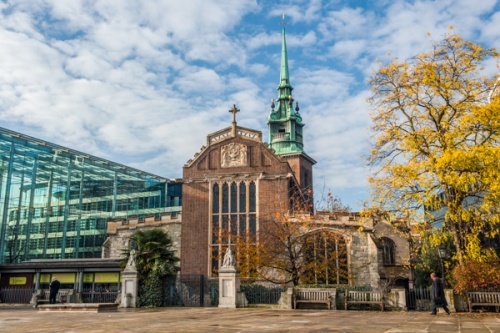
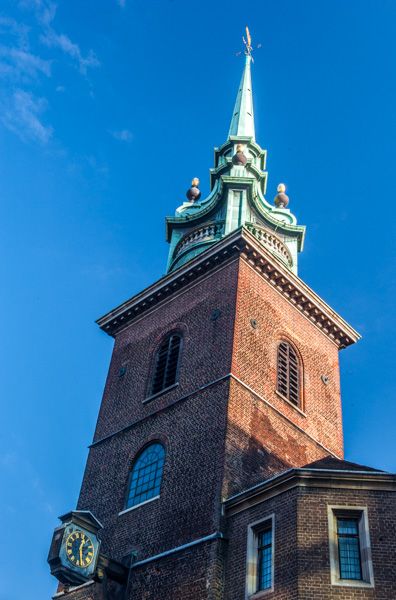
All Hallows greatest claim to fame is its association with famed diarist Samuel Pepys. When the Great Fire of London raged in 1666, Pepys climbed the brick tower of All Hallows to watch the progress of the fire across London. Pepys lived in Seething Lane, across the road from All Hallows.

But there is more to this historic church than its use as an observation post! All Hallows-by-the-Tower lays claim to being the oldest church in London. The original church was founded by the Abbey of Barking in 675, and an arch from that first church still survives. Beneath the Saxon arch, traces of Roman pavement can be seen, evidence that this site was in use as far back as 2000 years ago.
All Hallows has a bloody history; due to its close proximity to the Tower of London, the church received the bodies of many of those unfortunates executed in that spot, including Archbishop Laud (1645), Bishop Fisher (1535), and Sir Thomas More (1535).
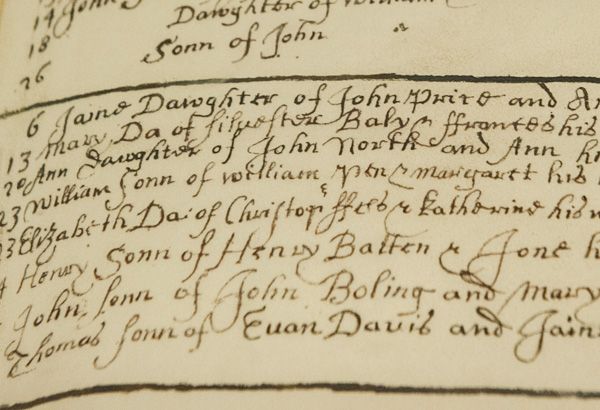
The church has strong associations with the United States; In 1644 William Penn, founder of Pennsylvania, was christened here, and the sixth president of the USA, John Quincy Adams, was married in All Hallows while ambassador to the Court of St James. In the undercroft museum, you can see the entry in the church records for Penn's baptism and Adam's marriage, and other pages in the records, including the entry for Laud's death.
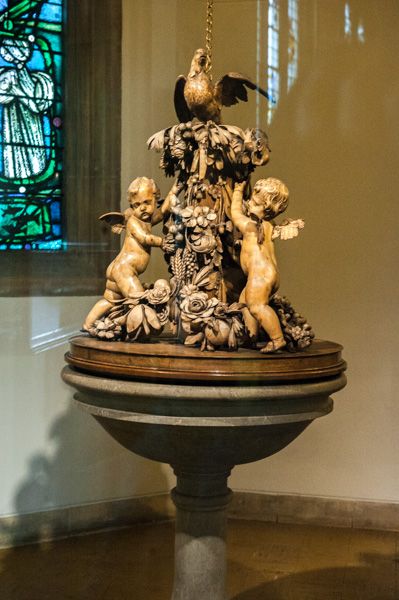
The undercroft museum is utterly fascinating. There is a model showing London at the time of the Romans, the Roman mosaic, still in place, Saxon crosses discovered ion the site, church plate, a barrel used as a crows nest by Sir Ernest Shackleton on his last Arctic voyage, and a huge metal hoist used to lift the Grinling Gibbons font cover off the font.

and organ gallery
A History of Hidden Records
One fascinating object is a beautifully carved lead-lined cistern, dated to 1705. Sometime in the early 18th century one of the vicars must have decided that he wouldn't risk the sort of damage that the Great Fire of London caused. Or perhaps he was wary of the religious turmoil of the day. Whatever the reason, he hid all the parish registers and vestry minutes inside the cistern and placed the cistern in the tower.
There it stood, untouched, for over 200 years until the documents were discovered by chance in 1923. And that is why we can now read the entries for Adam's marriage, Penn's baptism, and so on.
In the crypt is an altar believed to have been carried on the Second Crusade by King Richard II. Beside the crypt is a small barrel-vaulted chapel dedicated to St Francis of Assisi. The chapel was built as a crypt in 1280 and became a Lady Chapel in the 15th century. For over 300 years it was walled up and lay undiscovered until repair work in 1925 opened it once more.
The church was badly damaged in the Blitz, and though the font cover carved by Grinling Gibbons was untouched, only the tower and walls survived the bombing. The Queen Mother laid a new foundation stone for the church in 1948, signalling the rebuilding of the historic edifice.
The church is normally open daylight hours. I can highly recommend a visit; it is within a few steps of the Tower of London, and well worth a detour to enjoy.
More Photos
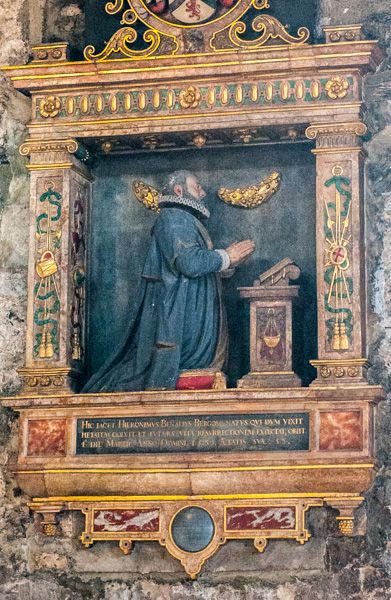


About All Hallows-by-the-Tower
Address: Byward Street,
London,
Greater London,
England, EC3R 5BJ
Attraction Type: Historic Church
Website: All Hallows-by-the-Tower
Location
map
OS: TQ333806
Photo Credit: David Ross and Britain Express
Nearest station:  Tower Hill - 0.1 miles (straight line) - Zone: 1
HERITAGE
 We've 'tagged' this attraction information to help you find related historic attractions and learn more about major time periods mentioned.
Historic Time Periods:
Find other attractions tagged with:
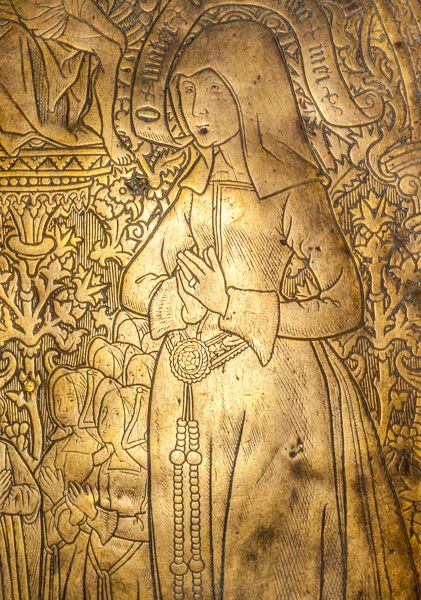
7th century (Time Period) - brass (Historical Reference) - Medieval (Time Period) - Richard II (Person) - Roman (Time Period) - Saxon (Time Period) -
NEARBY HISTORIC ATTRACTIONS
Heritage Rated from 1- 5 (low to exceptional) on historic interest
St Olave, Hart Street - 0.1 miles (Historic Church) 
All Hallows Staining - 0.1 miles (Historic Church)
Tower of London - 0.2 miles (Castle) 
HMS Belfast - 0.2 miles (Museum) 
Leadenhall Market - 0.3 miles (Historic Building) 
London Monument - 0.3 miles (Historic Building)
St Magnus the Martyr Church - 0.3 miles (Historic Church)
St Clement Eastcheap - 0.3 miles (Historic Church) 
Nearest Holiday Cottages to All Hallows-by-the-Tower:
Waltham Abbey, Essex
Sleeps: 6
Stay from: £946.00 - 4358.00
Loughton, Essex
Sleeps: 5
Stay from: £800.00 - 3670.00

Leaves Green, Greater London
Sleeps: 6
Stay from: £847.00 - 3941.00
More self catering near All Hallows-by-the-Tower