Orkney is a fascinating melting pot of historical influences; from Norse to Viking to Picts to Scottish. Over the centuries some fascinating dramas have been played out within these shores. We can loosely divide the history of Orkney into several main eras:
Prehistory
We don't know for certain when the first human's settled in Orkney, but archaeological evidence shows that there were settlements in the islands by about 3900 BCE. These first settlers were hunter gatherers.
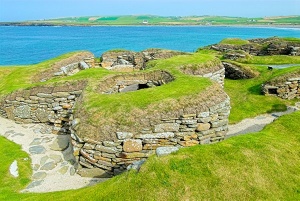
The first known evidence of settlement in Orkney is from the Knap of Howar, on Papa Westray, where excavations show stone houses with nearby chambered tombs. (See what is a chambered tomb?) This early type of settlement evolved into a grouped cluster of houses, forming a village linked by stone covered passages, as at Skara Brae, on Mainland.

These Neolithic settlers of Orkney left an indelible mark on the landscape, primarily through chambered tombs, standing stones, and stone circles. For a look at these types of ancient monuments see our History section. The most famous of these monuments are Maes Howe passage grave, the stone circles of Stenness and the Ring of Brodgar, and Midhowe chambered cairn. These sites are part of the Heart of Neolithic Orkney World Heritage Site.
In addition to these sites, there are hundreds of other ancient monuments in various stages of repair scattered throughout the Orkneys. The Ring of Brodgar is worth special note; this circle of 60 stones, of which 27 remain, was one of the primary circles whose study led to the now generally accepted theory that the need for accurate astronomical observation was one of the main factors that led Neolithic peoples to construct these enigmatic monuments.
Skara Brae
The ancient village of Skara Brae sits on the coast at Sandwick, Mainland. Here, beginning in about 3600 BCE, humans built a village of stone houses connected by underground passages. Over the ensuing centuries the settlement grew and the huts became more elaborate. Skara Brae was inhabited for over 700 years, finally falling out of use about 2500 BCE.The site was gradually covered by sand, and for centuries remained hidden from human view. In 1850 a fierce storm tore off the covering sand, and, in so doing, peeled back the curtain of time to reveal a site of worldwide archaeological importance.
Read more about Skara Brae >>

Iron age and early medieval period
The predominant feature of the Iron Age in Orkney was the broch, or round fortified tower house. Most brochs were built on the shores of lochs, or overlooking the coast, and would have served as a dwelling place and defensive structure for several families or an extended family group. Some impressive brochs remain on Orkney, the most imposing being Gurness, on Mainland, and Midhowe, on Rousay.
Before the coming of the Norse, the inhabitants are known to have used Latin and Old Gaelic. The Romans were well aware of the islands, though they made no attempt to conquer them, and there is some suggestion that they traded with the inhabitants.
Around the beginning of the 6th century, the Dál Riata Gaels briefly settled here. They were followed by Celtic Christian missionaries, who put considerable effort into establishing Christianity in the islands. A cursory study of an atlas shows the legacy of the Celtic missionaries; the name 'Papa' applied to several of the Orkney islands (e.g. Papa Westray), indicates the presence of an early Christian settlement. The Gaels did not last long, however; they were pushed out by the Picts, who held sway until the 9th century when the might of the Norse seafarers proved too much for them in turn.
Norwegian rule
Now we enter into the period of Norse rule, which left such a strong impression on the culture and heritage of the Orkney isles. The Vikings saw the Orkneys as an ideal base for their swashbuckling expeditions around the North Sea. But they made too many raids against their homeland, and the Norse leader Harold Hårfagre ("Fair Hair") defeated them and took over both Orkney and Shetland in 875. The islands were ruled by a succession of Norwegian 'jarls', or earls, until 1231. It is estimated that nearly 1/3 of current Orcadians are descended from Norse stock. The tale of this turbulent period is told in The Orkneyinga Saga >>
Orkney becomes Scottish
In the year 1468 Margaret, daughter of Christian I of Denmark, was betrothed to James III of Scotland. Orkney and Shetland, both Danish territories, were pledged as collateral for Margaret's dowry. The dowry was never paid, and the islands became Scottish territory.
James further established the crown power in Orkney by essentially trading the Ravenscraig estates in Fife in exchange for the earldom of Orkney.

The Stewart Earls
Now we come to two of the most interesting characters in Orkney history - the Stewart Earls.
Robert Stewart, 1st Earl Orkney
Robert Stewart was an illegitimate son of James V of Scotland. In 1564 he was given the post of sheriff of Orkney and Shetland, and received estates in Orkney from his half-sister Mary, Queen of Scots.
James Douglas, Regent of Scotland, had Stewart imprisoned for treason, but Stewart gained his release and helped bring about the downfall of Douglas. James VI rewarded him by granting him the earldom of Orkney, despite protests from Orcadians. Robert Stewart had a reputation for harsh treatment of his tenants. He used forced labour to build his palace at Birsay, and throughout his life managed to alienate practically everyone he met. But Earl Robert was a gentle soul compared to his son, Patrick.
Patrick Stewart, 2nd Earl Orkney
b. c1569 – d. 1614
Patrick Stewart came to the earldom of Orkney on the death of his father in 1593. And like his father, Earl Patrick was infamous for his cruel treatment of the Orkney population. In 1607 Patrick Stewart began construction of his most ambitious project, the Earl's Palace in Kirkwall. This grandiose fortified house was built beside the old medieval Bishop's Palace, opposite St Magnus Cathedral.
Like his father before him, Earl Patrick used forced labour to complete his new house, but he did not have long to enjoy it; he was convicted of treason and beheaded in 1614. His son, Robert, rebelled against the crown and he too was executed. The short-lived Stewart earldom reverted to the crown.
In 1707 Orkney and Shetland were granted to the Earl of Morton and in 1766 they passed to Sir Lawrence Dundas, ancestor of the Earls of Zetland (Shetland).

Twentieth Century
The islands of the southern Orkneys form a rough circle around Scapa Flow. The British navy used this natural deep-sea anchorage as a base of operations in both the First and Second World Wars. At the end of WWI the entire German High Seas fleet was sailed to Scapa Flow while plans for its future were finalized.
The German sailors took matters into their own hands and scuttled the ships. Some were salved, but the rest remain as evocative wrecks, poking up through the waters of Scapa Flow as reminders of the past. These wrecks and be explored, either by tour boat, or for a much more up-close experience you can dive in amongst the wreckage.
During WWII the British navy again used Scapa Flow as a base. Very early in the war, a German U-boat snuck past the outer defences and sank the HMS Royal Oak, with the loss of over 800 men. Within a month of this disaster, Winston Churchill gave the orders for a series of barriers to be built across the eastern channels into Scapa Flow. These barriers, which became known as the Churchill Barriers, were one of the largest civil engineering accomplishments of the 20th century. Today they act as causeways joining South Ronaldsay to Mainland.
During WWII Italian prisoners of war were held in the Orkneys. Some of the prisoners pooled their meagre resources, and using mainly found materials and scraps of metal, built and decorated a chapel from a quonset hut. The beautiful wrought iron and superlative painting of the interior decoration makes this small chapel one of the Orkney's most attractive places to visit. The Italian Chapel is a poignant and moving memorial to the power of faith.
Related:
Famous Orcadians
| A Brief Timeline of Orkney History | |
| 1940 | Building of the Churchill Barriers begun |
| 1919 | German fleet scuttled in Scapa Flow |
| 1916 | HMS Hampshire sunk off Birsay |
| 1850 | Skara Brae rediscovered |
| 1813 | The last auk killed on Papa Westray |
| 1486 | Kirkwall named a Royal Burgh |
| 1468 | Orkney’s ceded to Scotland |
| 1290 | Margaret, the Maid of Norway dies off Orkney |
| 1231 | Death of John Harraldson, the last Viking Earl |
| 1137 | St Magnus Cathedral begun |
| 1115 | St Magnus martyred |
| 600 | Norsemen arrive in Orkney |
| Viking raids begin | |
| 300 - 800 | Pictish culture arrives in Orkney |
| BC | |
| 100 BC | Broch of Gurness built |
| 600 BC | The first brochs appear |
| c. 2500 BC | Skara Brae abandoned |
| 2750 BC | Maeshowe tomb constructed |
| 3000 BC | The Ring of Brodgar built |
| 3200 BC | Skara Brae occupied |
| 3600 BC | Oldest remains at the Knap of Howar |
| 3900 BC | The first human settlers are present |