CONTENT
1. Great British Web Sites
2. Scottish Countryside Guide
3. Nine Ladies Stone Circle
4. Travel news and tips
Welcome friends, its time to put the kettle on, settle into a comfortable armchair, and enjoy the best of Britain with Britain Update. But before you do, please take the time to forward this newsletter to someone who loves Britain as much as you do.
David Ross, Publisher
********************
Great British Web Sites
********************
Keighley and Worth Heritage Railway
This super site is a treasure trove of information on an old steam railway that rolls through some of the finest countryside in Yorkshire, and about the countryside itself. The K&W was featured in the popular television series "The Railway Children", and there is plenty of information on the film here. In addition, there is an excellent guidebook, plenty of regional travel information and links, an events calendar, how to get there, information on the railway stock, walks near the railway, and lots more. Well laid out, easy to navigate design makes this site a pleasure. If you enjoy railways, or you're planning a trip to Yorkshire, take a good look at this online resource.
*********************
New at Britain Express
*********************
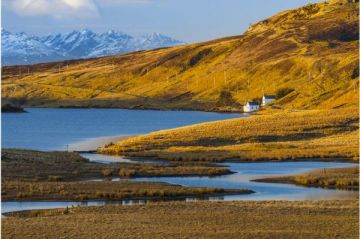
I mentioned in the last issue of Britain Update that we'd soon be adding our gazetteer of the Scottish countryside to our Scotland Guide. Well, the deed is done! Our directory of places to go and see off the beaten track in Scotland is online at /scotland/countryside/ As a new feature you can now click on the thumbnail photographs and see a full-sized version of the image. Take a look and let us know what you think!
******************************
Nine Ladies Stone Circle: Heritage under threat
******************************
Andy Burnham, webmaster of Megalithic Mysteries (http://www.megalith.co.uk ) has passed along information about threats to the popular Nine Ladies stone circle in the Peak District. What follows is a short excerpt of Andy's account. You can read the full article here.
"Nine Ladies Stone Circle (grid reference SK 249635 ) is one of several prehistoric stone circles and dozens of cairns and mounds that make Stanton Moor in Derbyshire's Peak District an archaeologically important area, recognised as an SSSI (Site of Special Scientific Interest)....
The Nine Ladies is a well-known and much visited site. English Heritage has recently announced a scheme for an emergency excavation of parts of the site due to the damage being caused by thousands of boots and dozens of camp-fires. Each year around 40,000 people visit the circa 4000-year-old Stone Circle which is causing a rapid increase in erosion of this fragile site. Recent soil erosion has revealed evidence of a tenth stone and today approximately 20cm is exposed. Damage has also been caused by visitors digging holes for campfires and even chipping off pieces of stone as souvenirs.
Jon Humble, English Heritage's Inspector of Ancient Monuments for the East Midlands said: "Nine Ladies Stone Circle is a site of beauty and tranquillity for visitors, from near and far, and to many who believe the Stone Circle is of special spiritual significance. It is this popularity that has significantly accelerated the processes of decay. We must act quickly if we are to protect this mysterious and ancient site for future generations."
******************************
UK Travel Tips
******************************
SOMERSET HOUSE:
LONDON'S GRAND NEW ATTRACTION
Much of Somerset House, one of London's grandest 18th century buildings, opens to the public for the first time on May 26. Following a £48 million investment, 9,500 square metres of space will be opened up around the vast fountain-filled central courtyard, with art galleries, museums, restaurants and shops.
Built between the Strand and the River Thames on the site of a royal palace, to accommodate government departments, including the Navy Office, and several learned societies, it was the masterpiece of Sir William Chambers, architectural advisor to King George III.
In the South Building, with its 120-metre river frontage, a series of galleries will display the gold, silver and mosaic objects of the Gilbert Collection of decorative arts. The Courtauld Institute Galleries in the north block, with its great collection of Impressionist and Post-Impressionist paintings, will expand into the South Building, with a new department of digital and video art. In the autumn, another suite of rooms in the building becomes the home of rotating displays from the Hermitage Museum of St. Petersburg. The first will be "The Treasures of Catherine the Great", with jewellery, contemporary portraits and miniatures, and Russian, European and Chinese works of art. The 3,700 square metre courtyard becomes a new public space for London. In the evenings and weekends it will be a venue for theatre, opera, concerts, dance and open-air cinema, with a capacity for 3,500 people. A central fountain will have 55 vertical jets, illuminated by fibre-optic light.
A new Somerset House Web site, www.somerset-house.org.uk includes an on-line tour: there are also Web sites for the Courtauld, www.courtauld.ac.uk and the Gilbert Collection, www.gilbert-collection.org.uk. Entrance to the courtyard, river terrace and Seaman's Waiting Hall (with warship models, and portraits of Nelson and other naval figures) is free. There are admission charges for the Courtauld and Gilbert Collection (joint ticket £7 adults, £5 senior citizens), and there will be for Hermitage displays.
SLOW BOAT FROM NEWBURY
In an age when everyone seems to want to travel further, faster and more frequently, it is heartening to know that some things never change. Like the horse-drawn narrow-boats that take trippers along the tranquil Kennet and Avon Canal near Newbury, southern England, pulled by sturdy crossed-shires Hannah and Bonny. The horses, mother and daughter, agree that three miles-per-hour is quite fast enough. It is the Kennet Horse Boat Company's 30th anniversary - early days for a form of transport popular 200 years ago.
SEE SCOTLAND BY CANOE
Explore some of Scotland's finest lochs and rivers in a sturdy trade canoe, with overnight stops in a tepee - this is the invitation from Scottish Voyageurs, from May to September. The trips, for individuals, families or groups, last from two to five days, and most start at Fort William or Fort Augustus in the Highlands. Previous experience or special fitness is unnecessary, and the prices include all meals, canoeing, safety and camping equipment, except sleeping bags. Prices range from £139 for two days to £369 for five days, and for details contact Scottish Voyageurs, Upper Wharf, Canalside, Fort Augustus, Inverness-shire PH32 4AU. Web site www.scottish-voyageurs.co.uk
That's all for now. Until next issue, let me remind you that laughter is contagious. Be a carrier.
David Ross, Publisher, Britain Express