|
Britain
Update newsletter archives
|
|||
|
|
Britain
Update #45 Welcome friends, its time to put the kettle on, settle into a comfortable armchair, and enjoy the best of Britain with Britain Update. But before you do, please take the time to forward this newsletter to someone who loves Britain as much as you do. *******************
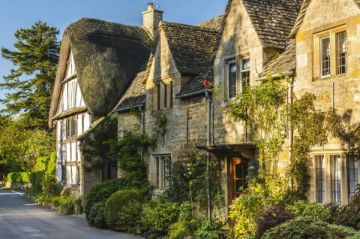
******************** The Domesday Book listed the town as "Elmodesham" with six manors, one belonging to Edith, the wife of Edward the Confessor. In 1200 King John granted to the town a market and fair to be held every year which is still an annual event. The Reformation had some roots in the town as several Lollards were condemned to death and burned at the stake - hence the memorial on the hill. More on this later on. Walking up High Street from the bus depot at the edge of town, you will immediately see a large hill across the road to your left. This is called Gore Hill, named for a battle against the Danes. Just to the side of the road that leads over the hill is Bury Farm, dating from the 1660's. This was the Quaker home of the Isaac and Mary Pennington and it was here William Penn, founder of Pennsylvania, came courting his future wife, Gulielma Springett, Mary's daughter. Notice the sign at No.60 London Road. It threatens "dire penalties to ballad mongers and other vagrants". Shortly you come to the Griffin Hotel, once an important staging post. It is older than it looks from the front as it was altered late in the l7th century. It was here that some of Cromwell's troops were stationed during the Civil War. Walk to the back to see the earlier Elizabethan structure. Turn up Whielden Street and you will notice a large building on the left. This is part of a 17th century workhouse where forty inmates were engaged in, among other occupations, lacemaking and spinning, the rate of pay for which was "a farthing (1/4 of a penny) for every 100 turns of the wheel". Go back to the High Street, turn left and continue on noticing the Market Hall in the middle of the road. This building was given to the town in 1682 by Sir William Drake. The market was held beneath the structure with town meetings upstairs, which continues to this day. Just up from this is the Crown Hotel which was another important staging post. Go inside for refreshment in its pub and look around. The restaurant offers some good English dishes as well. The front of the hotel is Georgian but the inside is Elizabethan with rich panelling, large beams and snug inglenooks. The wall paintings are Elizabethan and the lounge shows the Royal Arms commemorating Queen Elizabeth I's visit to the town. There is a ghost, of course. It has been seen several times, when the pub is empty, leaning against one of the old posts. Some people have felt the presence of a spirit while sitting in one of the booths and the wall pictures were seen to move. Outside again and continuing on notice No. 42, the Elmodesham House, the name being in the Domesday Book of 1086. This is the largest house in town. It was used as a boarding school in the last century and today it houses Council offices. Take a moment from here to look across the street and notice the rooflines of the different architectural styles. Next of importance are six small houses called Drake's Almshouses, erected in 1657 by William Drake to house six poor women of the parish, widows over fifty years of age. Among their benefits were "a gown of London brown at Christmas each year for the first three years and alternate years thereafter; a pair of shoes, a pair of stockings and a shift twice a year at Christmas and Easter; and a load of billets four feet in length each year for firings". Next you will see a pathway called Cherry Lane. Take this to the top of the hill and turn left, walking down the road for a short distance enjoying the pretty homes until suddenly appearing on your left will be a tiny black and white half-timbered cottage called Chimney Cottage. It dates from the 17th century and if it seems a little familiar to you it's because it has been pictured on many calendars as it is considered the most picturesque dwelling in Amersham, especially when its garden is in bloom. It consists of two rooms with a chimney at either end. Now go back the way you came to the High Street and continue left. Another large house is Little Shardeloes, Tudor in origin, but now altered. It is believed to be the Amersham Manor before 1637 when William Drake purchased it for the family as the Dower House. Crossing the street again, you will see the building called the Town Mill, operating early in the 17th century as a corn mill until about 60 years ago. Next of interest are several houses called Turpin's Row and dating from 1678. Many years ago this section would be full of straw-plaiting by the women and children to help out with the meagre wages of the men. Further down the street is a little house which seems squeezed between its neighbours. This is just big enough inside for one person to live comfortably with a pretty garden of some size out back. Now look across the street at the rooflines of the buildings on the other side to notice the difference in styles. Walking back past the Market Hall turn left onto Church Street. On your right will be the church of St. Mary's. Hopefully, it will be open and you can go inside for a look around. There are some interesting monuments, especially in the Drake Chapel, and notice the east window. Parts of the church date back to the 13th century. Outside again continue on up the street and you will pass what used to be the brewery for 150 years which gave employment to many of the town's men. It closed in 1929 and is now a cosmetics factory. Going on up the hill at the top is a large home known as the Rectory. It was built about 1725. Take the little road to your right that leads to the graveyard and follow the footpath around the low end and up onto the hill walking to the right and on to the Martyrs' Memorial. This commemorates the six Amersham men and one woman who, in the early years of the 16th century, were burned at the stake for their faith as Lollards. This also gives excellent views of the town that you have just walked through. As you face the town, notice to the right, off some distance, is a large manor home called Shardeloes. This was the ancestral home of the Tyrwhitt Drake family. Sadly, now the house has been converted into flats. An interesting bit of history about the place concerns the Tyrwhitt Drake family and "the curse put on the family where by the inheritance would never be inherited by a direct heir". The curse was made by the family of a boy murdered at sea when in the employ of one of the Drakes. "Their coat of arms is surmounted by an axe dripping with blood and the wheels of their carriage had to be painted red! (Later red rims on their cars.)" It is assumed this was so everyone who saw them knew who they were. "To break the curse, a member of the family was to spend a certain length of time in an underground tunnel that runs under Shardeloes lake."Many years ago a family member tried to break the curse and spent a period of time in the tunnel, but gave up and came out mad! Retrace your steps down the hill from the graveyard and go into the Memorial Gardens just below the church. These were laid out by the local council to commemorate those who died in the two world wars. Exit by the wall and you are now back on the High Street. Take time to go into the various shops in this area. Surely there is something in the pottery shop that you can take home as a momento of your trip to Amersham. Then before returning to the car park, take a few minutes to enjoy a delicious cup of tea and sweets in the nearby tea shop. Amersham
on the web: http://www.knap.demon.co.uk/amersham.htm
******************************
If you'd like to stay well off the beaten track on your next excursion to Britain, perhaps a stay on a working farm is for you. The Farm Holiday Bureau is a central registry for farms offering accommodation to single visitors and families throughout Britain. Details are available from The Farm Holiday Bureau, NAC, Stonely, Kenilworth, Warwickshire, CV8 2LZ Most farms are inexpensive - by British standards - and many occupy centuries-old listed buildings. Some also offer self-catering options. The Bureau's website at http://www.farm-holidays.co.uk/ is an excellent place to start planning your farm stay. I found that it provided very clear browsing and search capabilities with extremely good maps and extensive details of each property. Photos of the farms would have been nice, but that's a minor quibble. Its definitely a site worth checking out if you prefer independent travel. ******************************
There's no denying that The "if it's Tuesday it must be Belgium" approach gets the job done in a fast and efficient manner. Perhaps this way of travelling can be justified for the first time traveller with limited time and budget. But after one whirlwind tour it's time to settle down to something more satisfying, something that can bring valuable, lasting memories rather than a quickly forgotten jumble. Lets imagine that we have six weeks to spend exploring. Picking just one European country, England for instance, seems a good idea, but if you really want to absorb the atmosphere and gain a little insight then choosing an even smaller area is a better idea. Lets imagine that we have six weeks to spend exploring. Picking just one European country, England for instance, seems a good idea, but if you really want to absorb the atmosphere and gain a little insight then choosing an even smaller area is a better idea. What better plan could their be than to take the advice of Thomas Hardy and visit the land he loved and knew so well, the land that gave him the framework on which to hang his novels, short stories, and poems: The County of Dorset on England's southern coast Dorset is the ideal choice because the county is the country in miniature. Dorset was invaded by the Celts, the Romans, the Saxons, and the Normans. They all have left their mark. Within the borders of Dorset - a small county measuring about 60 miles by 40 miles - there is a representative selection of most of England's landscapes. The conflicts are represented by Maiden Castle where Roman met Celt, by the Bloody Assizes where authority met the Monmouth rebels, and Tolpuddle with its martyrs to social justice. England's art forms are represented by the Cerne Abbas Giant, the Abbey Church at Sherborne, and of course, the writing of Thomas Hardy. In all of these categories Dorset is a mirror of England. The conflicts are represented by Maiden Castle where Roman met Celt, by the Bloody Assizes where authority met the Monmouth rebels, and Tolpuddle with its martyrs to social justice. England's art forms are represented by the Cerne Abbas Giant, the Abbey Church at Sherborne, and of course, the writing of Thomas Hardy. In all of these categories Dorset is a mirror of England I don't mean to suggest that Dorset today looks just as it did in Hardy's day but the wonder is not that so much has gone but that so much remains. Tourist offices throughout the county can provide guides for those wishing to recapture Hardy's Wessex. The intrepid traveller can visit Marnhull, which Hardy called Marlott, a small village near Shaftsbury. There is a meadow there that would be perfect to illustrate the May Day dance where Tess of the D'Urbervilles danced with the village girls in their white dresses. In Evershot, Hardy's Evershead, one can still see the cottage known as "Tess's Cottage" because it can be identified as the one where she stopped and took breakfast on her walk to Angel Clare's house. There is a spot near Frampton, Hardy's Scrimpton, in the Frome Valley where cattle grazing in the cool, clean light of early spring with everything softened by misty morning haze, makes the observer expect to see Tess, when she was a milkmaid, emerge from the mist. The cows are Friesians which they would not have been in Tess's day but it makes no difference, Hardy's countryside is still there. I think Hardy would approve of the towns and villages of Dorset today. Dorchester would be a good place to start exploring. It can be easily reached by train from Waterloo Station in London or by National Express Coach from Victoria Station. Dorchester is the Casterbridge of Hardy's novels. He lived there for the last half of his life and his home, Max Gate, is nearby on the Wareham Road. His study has been recreated in the County Museum on High Street. Just across from the museum is the house where the infamous Judge Jeffreys stayed when he sat in judgement on the remains of the Duke of Monmouth's army. Today it's a cozy restaurant. Just a short walk down the Roman Road is Maiden Castle, the most massively defended prehistoric earthwork in Britain. Archaeologists have found evidence dating back to the Iron Age. One can walk on its grassy ramparts lush with wild flowers and consider what it must have been like to have lived there before the Roman invasion. To the south of the town lies Maumbury Rings, an amphitheatre centuries old when the Romans took it over for games, contests, and gladiatorial combats. Later it was used for public hangings; the last in 1705 was that of Mary Channing who had been found guilty of poisoning her husband. The town is steeped in historical atmosphere but there is much to appreciate in the Dorchester of today. It's not all tarted up for tourists; its citizens are too busy going about their daily business to pay any attention to visitors. It has all of the necessities: supermarkets, department stores, (a Marks & Spencer of course) banks, and restaurants all conveniently arranged on its main streets. It's just as Hardy said "as compact as a box of dominoes." It may not win "Most Beautiful" contests but it has character and charm. These pleasing qualities seemed to have happened naturally rather than by calculated plan. From Dorchester it's easy to reach dozens of villages in a matter of minutes, villages with intriguing names like Sydling St. Nicholas, Evershot, Ryme Intrinsica, Maiden Newton, Melbury Osmond and Cerne Abbas. Dorchester has limitless possibilities, one could easily spend six weeks based in this town alone but there are other towns just as rewarding. Sherborne with it's two castles and beautiful Abbey Church, Swanage with its lovely beach, Poole with its busy harbour, and Wimborne with its fine minister and stylish shops would all make good bases. In Lyme Regis it is possible to walk out on the Cobb with the wind dramatically lashing the waves in the background and pretend to be Meryl Streep or Jeremy Irons as they appeared in the movie version of John Fowles' "The French Lieutenant's Woman". John Fowles own house can be seen from the Cobb. If Abbotsbury is used as a base one can visit the swannery where at nesting time in April over 300 nests cover the meadow at the head of Chesil Beach like a flock of snow white sheep. The swans were introduced by Benedictine monks when they created a monastery in the eleventh century. In Wareham one can stay at a little inn by the Frome River and watch the sailboats on their way to Poole Harbor. Breakfast can be eaten on the terrace so close to the water it is possible to shake hands with the skippers as they sail by. There is a Lawrence of Arabia exhibit in the town museum. Clouds Hill where Lawrence was living when he was so tragically killed in a motorcycle accident is just a few miles from town. The National Trust owns it now. From Wareham it is just a ten minute drive to Corfe Castle. This village of stone is among the most beautiful in England but its history is dominated by cruelty and bloodshed. The castle stands on a conical hill in the centre in the only gap in the ridge of the Purbeck Hills that separate Purbeck from the heathlands to the north. During the Civil War it withstood two different sieges but was finally delivered into the hands of the Parliamentarians because of treachery within. Parliament voted to destroy the castle in 1646 but although it was mined and blasted the massive towers did not fall but sank into the mines where they still remain, ruined but upright. It's an awe-inspiring sight, one of many to be found in Dorset. Surprisingly the things in Dorset that are the most fun are either free or cost very little. Things like following the coastal footpath, a tour of Lyme Regis with the town crier, a walk to St. Catherines's Chapel overlooking Chesil Beach, and strolling through country towns on market day. Just breathing the sparkling, fresh air in places like Melbury Park with its five lakes, its deer park, and its fairylike forest thickly covered with oak, chestnut, and lime trees will make a journey to Dorset worth while. They say London isn't what it used to be and the romantic visitor to England is bound to be disappointed. Well maybe so in some parts of England but not in Dorset. Dorset is alive and well with the perfect blend of the old and the new. No visitor to Dorset will be disappointed. This
article - with photos - is also online at www.britainexpress.com/countryside/dorset/dorset.htm ******************************************** Our Scotland and Villages Editor Barbara Ballard just returned from a lengthy visit to the UK with a batch of recommendations for our B&B listings at www.britainexpress.com/accommodation/bblist.htm This seems like a good excuse to remind readers that we welcome your suggestions for our list. All the bed and breakfasts on our list have been recommended by YOU, our readers (and by Barbara!). If you're looking for a place to stay, or you want to let the world know about a really special B&B that you've stayed at, visit the page above. Every B&B has been personally submitted by happy travellers. ****************************** CANOES
AND PUNTS IN EASTERN ENGLAND Complementing the Broads Authority's popular Bike Hire network, the eco-friendly canoes enable visitors to get close to the water and the wide variety of wildlife in and around it. The Broads, east of the historic city of Norwich, 115 miles north-east of London, are one of Europe's most important wetland areas, a haven for bird, plant and insect life. Further information on canoe hire, tel 01603 610734. Themed punting - cruising in a flat-bottomed boat propelled by a pole - has been launched in Stamford, Lincolnshire. Up to four people at a time can be steered, with options ranging from Victorian or 1920s costume, to a champagne picnic or jazz cruise. A 48-hour punting break costs from £125, or a short excursion from £25. Details tel. 01476 406162. ****************************** David
Ross
Contents © 2001 David Ross and Britain Express |
|
||||||||||||||||||||||||||||||||||||||||||||||||||||||||||||||||||||||||||||||||||||||||||||||||||||||||||||||||||||