CONTENT
1. UK Destinations: Denbigh Castle
2. UK Online
3. New at Britain Express
4. UK Destinations: Chester Cathedral
5. Travel news and notes
Welcome friends, its time to put the kettle on, settle into a comfortable armchair, and enjoy the best of Britain with Britain Update. But before you do, please take the time to forward this newsletter to someone who loves Britain as much as you do.
David Ross, Publisher
******************************
UK Destinations: Denbigh Castle
******************************
Denbigh Castle, Denbigh, Denbighshire, Wales
Denbigh Castle was begun in 1282 by Henry de Lacy for Edward I during Edward's great push to subdue Wales. De Lacy, perhaps symbolically, built his fortress on top of an earlier Welsh castle occupied by the Welsh prince Dafydd ap Gruffudd. Every trace of the Welsh castle was destroyed, and the walls of the new Norman English building were extended to include a new English settlement, the town of Denbigh. Long sections of the town walls still remain.
[Note: That first town of Denbigh at the foot of the castle was burned during the Wars of the Roses, and Denbigh was rebuilt in an entirely new location]
Read more about Denbigh Castle
*************************
UK Online: Lakeland Cam
*************************
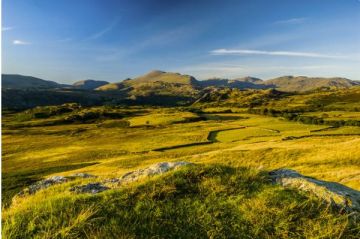
Today's pick of UK travel web sites is Lakeland Cam at http://www.lakelandcam.co.uk/ At first glance Tony Richard's site doesn't seem like much. Tony is just a bloke with a digital camera. But what he has chosen to do with that camera is take daily (well, almost daily) photos of the area around his Lake District home and post them on the web. Doesn't sound too exciting yet? Well, perhaps not, but Tony's photos are generally excellent, and give great views of Lake District scenery. I found myself feeling homesick for the Lakes, and I've never lived there! If you're really struck by Tony's photos you can order a CD with over 100 of his best images. The real appeal of Lakeland Cam is that the photos are updated almost daily, so you always have an up-to-date feel for the scenery and the weather.
******************************
New at Britain Express
******************************
Here's a few articles added since the last Update
History:
Biographies of Anglo-Saxon Saints Cuthbert and Dunstan: /History/saxon/dunstan.htm
/History/saxon/cuthbert.htm
Regency architecture /History/regency/regency-architecture.htm
Georgian architecture /architecture/georgian.htm
****************************
UK Destinations: Chester Cathedral
****************************
Chester Cathedral
Here is a church which suffers much from the well-intentioned efforts of Victorian restorers. Chester was originally built by Saxon canons in the name of Saint Werburgh, a lady whose claim to sainthood was not harmed by having three Saxon kings as relatives.
The second church on the site was built by Hugh "Lupus" (the Wolf), Earl of Chester, in 1092, perhaps as expiation for his worldly excesses. Anselm of Bec, later Archbishop of Canterbury, helped found Hugh's monastic settlement at Chester. Beginning in 1250 yet a third church was begun, this time in Norman Gothic style. The monks of Chester built the new church over the top of the old church, which they dismantled from the inside!
Read more about Chester Cathedral from our visit.
******************************
UK Travel Tips and News
******************************
FESTIVAL OF THE SEA
The biggest maritime event ever held in Britain will take place next summer. The International Festival of the Sea will be held August 24-27 at the Naval Dockyard in Portsmouth. The event will feature over 1000 ships, including 50 naval vessels and 30 "tall ships", historical tableau, and over 2000 entertainers.
NEW DOCKLANDS MUSEUM
The story of London's river, port, and people will be told in the new Museum in Docklands, to open in September 2001. The museum will boast 12 galleries of exhibits housed in a converted Georgian warehouse located on West India Dock, opposite Canary Wharf, in London's Docklands. The museum's website is not yet operational, but should soon be online at http://www.museumindocklands.org.uk
THE FROGMORE MAUSOLEUM
The Mausoleum, in the Home Park at Windsor Castle, is the final resting place of Queen Victoria and her beloved Prince Albert. The building is only open on selected days throughout the year, and the next free opening days are February 4 and May 23.
ANTARCTIC HEROES
"South: The Race to the Pole" is an exhibition featuring the story of three early 20th century heroes of Antarctic exploration, Robert Scott, Ernest Shackleton and Roald Amundsen. This special event at the National Maritime Museum showcases many original artefacts from the expeditions of the three men. The exhibition is on until September 25. National Maritime Museum, Greenwich, London SE10 9NF.
That's all for now. Until next issue, let me remind you that laughter is contagious. Be a carrier.
David Ross, Publisher, Britain Express