CONTENT
- New: Rail Planner
- UK Destinations: Lulworth Castle & Cove
- Book Review
- UK Travel tips and news
Welcome friends, its time to put the kettle on, settle into a comfortable armchair, and enjoy the best of Britain with Britain Update. But before you do, please take the time to forward this newsletter to someone who loves Britain as much as you do.
David Ross, Publisher
NEW AT BRITAIN EXPRESS
UK Travel Ticker - Travel news and noteworthy happenings across the UK. The Travel Ticker will keep you informed of what's happening where, free brochures and special offers from recognized attractions, new tour offerings, events with a heritage theme, or those related to historic properties, travel promotions, discounts, and announcements of interest to travellers, both those from abroad and those within the UK.
Rail Planner
Use our new Rail Planner service to access train timetables for the UK and book tickets online. You can find train times and, if you wish, pre-book tickets for a maximum of 8 people. Tickets can be delivered by first class post to any UK address or collected from a range of stations.
UK Destinations
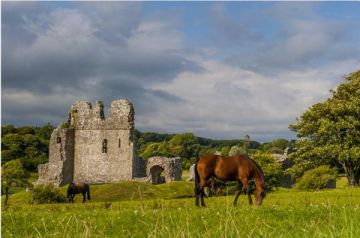
Lulworth Castle
near Wareham, Dorset, England
The castle was begun in 1608 as a hunting lodge by Thomas Howard, 3rd Viscount Blindon. Howard was a favourite of James I, and it is rumoured that he hoped to build a grand lodge modelled on a medieval castle so that he could invite that monarch to come hunting on the Isle of Purbeck.
In 1641 the estate of Lulworth was purchased by Humphrey Weld, and the Weld family has lived there ever since. During the 18th and 19th centuries the interior of the house was remodelled several times, turning it into an ornate country home.
The exterior of the castle is plain, and bereft of decorative touches, as befits a mock medieval castle. The round towers at the corners of the straightforward square building rise to four stories, providing excellent views of the surrounding countryside and coast.
More about Lulworth Castle ...
Book Review
The Amateur Historian's Guide to Medieval and Tudor England: Day Trips South of London
by Sarah Valente Kettler and Carole Trimble
The Amateur Historians enjoy their work, and it shows. This volume, the second in the series, describes a wide variety of historic places to visit within a short journey of London, focussing on the counties of Surrey, Sussex, and Kent.
The book begins with a timeline of the medieval period in England, which offers handy details not normally found in a straightforward list of monarchs. Following this is a section of travel tips, all good advice, and worth noting for foreign visitors. A short but enjoyable account of the early history of the South East follows, but then the Amateur Historians get down to the task at hand; exploring their favourite nooks and crannies of south-eastern England.
Some these locations are well-known, such as Canterbury Cathedral and Dover Castle. Other locations are well-of the beaten tourist track, such as Watts' Charity, a 16th-century hostel for impoverished travellers in Rochester, Kent, or The Old Cloth Hall, an inn in Cranbrook, Kent, where Queen Elizabeth I ate in 1573. It is in these excursions into the relative backwaters of the region that the book shines, uncovering out of the way, fascinating places to visit, places with a historical tale to tell.
The book is liberally strewn with "Did you know" sidebars; little snippets of historical trivia that help make this much more lively and full of interest than a run-of-the-mill travel guide.
The Amateur Historian's Guide to Medieval and Tudor England: Day Trips South of London is a fascinating excursion into the past, and deserves a place on the bookshelf of anyone planning to venture beyond the boundaries of London. The book is available in North America through Amazon.com
Travel Tips and News
Bennett Trail in Stoke
The centenary of Arnold Bennett's novel, Anna of the Five Towns, is being marked in Stoke-on-Trent with a leaflet, Bennett's Bursley Trail, from the local tourist office (tel. 01782 236000). Many of the places he wrote about in The Potteries, Central England, are still to be seen. Web site: http://www.stoke.gov.uk/tourism.
Museums month extended
More than 700 special events are planned as part of Museums and Galleries Month in Britain, held throughout May. Half of them relate to Queen Elizabeth's Golden Jubilee, or royal history, and this annual festival has been extended until June 4 to include the Jubilee weekend. 1,500 museums will take part nation-wide. Web site: http://www.may2002.org.uk.
Snail Derby in Jamers Herriot Country
"All Creatures Great and Small" author, the late James Herriot, would approve. Watching snails racing in the Snail Derby is just one of the less energetic activities on offer in North Yorkshire this spring. From June 1-9 a week of special events is planned to celebrate the countryside and attractions around James Herriot's town of Thirsk.
Activities include:
- An animal fun day and dog show
- 1950's Garden party
- Snail derby at Falconry UK
- Scarecrow making and a scarecrow trail
James Herriot was the pen-name of the late author and vet Alf Wright whose semi-autobiographical stories are set around the town of Thirsk, 224 miles north of London. Website: http://www.herriotdaysout.co.uk
100 British Arts Festivals
If you travel in Britain at any time between late April and early November, there will be at least one arts festival in progress somewhere in the country.
Arts Festival 2002, a website, and a leaflet produced by the British Arts Festivals Association lists more than 100 of them. They include many long-established festivals, such as:
- Brighton (May 4-26),
- Bath International Music (May 17 - June 3),
- Aldeburgh (June 7-23),
- Edinburgh International (Aug.11-31)
- The Three Choirs Festival (Aug.17-23) which celebrates its 275th anniversary in Worcester.
Some festivals concentrate mainly on one aspect of the arts:
- Buxton (July 9-21) stages five full-scale operas in the refurbished Opera House;
- Ludlow (June 22 - July 7) centres on open-air performances of "The Merry Wives of Windsor" at the castle.
- Winchester Hat Fair (July 5-7) claims to be Britain's longest-running festival of street theatre, this year with over 40 companies from many countries.
Website: http://www.artsfestivals.co.uk
150 Years of Royal Balmoral
Balmoral has been in the news of late, due to its association with the late Queen Mother, but there is more reason to visit this Scottish castle. As well as being the Golden Jubilee of Queen Elizabeth II, 2002 is also the 150th anniversary of Queen Victoria's husband, Prince Albert, buying the Balmoral estate beside Scotland's River Dee. Since then, six British monarchs, as well as various foreign royalty and dignitaries, have stayed at Balmoral Castle.
It immediately became a favourite royal holiday home. "Every year my heart becomes more fixed in this dear paradise" wrote Victoria in 1856. Balmoral Castle's grounds are open to the public annually from April to July, and visitors can see an exhibition of royal items in the Ballroom.
Now visitors can explore the area with the aid of a new sign-posted Victorian Heritage Trail and Guide published by Aberdeen and Grampian Tourist Board and available at local tourist information centres. The 100-mile trail around the Dee valley passes a variety of places with royal links.
Other places on the trail include:
- Crathie Church, where the Royal Family attends services
- Royal Lochnagar Distillery, which was visited by Victoria and Albert
- The Old Royal Station, Ballater, used by the Royal Family for nearly a century until the closure of the line from Aberdeen
- 13th century Drum Castle
- Braemar, famed for its Royal Highland Gathering, held on the first Saturday in September.
Victorian Heritage is one of four trails, which can be followed in this part of Scotland - the others cover castles, whisky, and the coastline. Website: http://www.castlesandwhisky.com
That's all for now. Until next issue, let me remind you that laughter is contagious. Be a carrier.
David Ross, Publisher, Britain Express