CONTENT
- Lanercost Priory, Cumbria
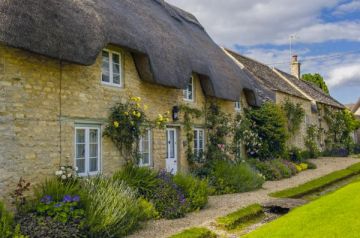
- Kimbolton, Cambridgeshire
- Worlds Largest online British History resource
- UK Travel tips and news
Welcome friends, its time to put the kettle on, settle into a comfortable armchair, and enjoy the best of Britain with Britain Update. But before you do, please take the time to forward this newsletter to someone who loves Britain as much as you do.
David Ross, Publisher
UK Destinations
Lanercost Priory
Brampton, Cumbria, England
Augustinian canons founded this priory in 1166 under the patronage of Robert de Vaux, Lord of Gilsland. The chancel and transepts are in ruins, but the 13th-century nave lives on as the parish church.
When the priory was disbanded in the Dissolution of the Monasteries the north aisle became the parish church, but in 1740 the entire nave was roofed and became part of the church. In the 19th century Rosalind, Countess of Carlisle, donated the pews, organ case, and the current roof.
More about Lanercost Priory ...
Destinations
Kimbolton
Cambridgeshire, England
Kimbolton is a large village with an attractive High Street, but most people visit to see Kimbolton Castle.
The site was settled at least as far back as the Roman era, and at the time of the Norman invasion, the manor was held by King Harold himself. After the Conquest, a castle was built at Kimbolton, under the control of the powerful de Bohun family.
Kimbolton is most famous for its associations with Katherine of Aragon. In 1536 the unhappy former queen died in Kimbolton Castle after 4 years of imprisonment. The room where Katherine died is fittingly called "the Queen's Room".
More about Kimbolton ...
Resources
World's Largest Online British History Resource
Everyone from amateur historians, genealogists, students and teachers through to tourists and parents will be able to gain something a new website dedicated to British history, http://www.history.uk.com. History.uk.com has a dedicated editorial team ensuring that the site is updated daily and showcases regular online features.
Travel Tips and News
Birmingham's Jewellery Event
Birmingham, England's second city, will 'sparkle' during November and December, thanks to a two-month celebration of contemporary jewellery. The event, "Brilliantly Birmingham", includes exhibitions, tours and workshops and takes place in the Jewellery Quarter. Details at http://www.birmingham.org.uk
New Look for Historic London Market
Work has started on the reconstruction of the magnificent glass portico of the Floral Hall, which once stood in London's Covent Garden. The building will serve as the focal point of a new-look Borough Market, located on a new site near Southwark Cathedral on the other side of the River Thames.
When complete in May 2003 it will contain market stalls and a restaurant. The whole of Borough Market - one of the capital's oldest, on its present site since 1756 - is being refurbished to create a combination of wholesale and retail food markets. It is full of history: the market has existed for 20 centuries and became known as 'London's larder'. Most imported food arrived by ship at wharves alongside in Victorian times.
Earlier this year, the retail farmers' market reopened and is attracting large crowds each weekend. It has been described as one of London's top three locations to buy good quality gourmet produce. There are 50 stands selling produce including fresh fish, meats, pies, cheeses, organic vegetables, freshly baked bread and wines. In the surrounding streets are speciality food shops, pubs, and restaurants.
Open on Fridays (noon until 6.00 pm) and Saturdays (9.00 am until 4.00 pm) The nearest Underground is London Bridge. Website: http://www.boroughmarket.org.uk.
Autumn Fire Festivals in Somerset
Somerset towns stage a series of spectacular Guy Fawkes carnivals each November. The celebrations start this year with a firework display at Bridgwater on Nov.7 (two days after the actual anniversary of the discovery of Fawkes and the Gunpowder Plot of 1605) followed by Bridgwater Carnival the next evening. This is usually the biggest of the carnivals, with over 120 entries including dozens of vast colourful floats. Many go on to compete for trophies at the other carnivals. These are at the nearby village of North Petherton (Nov.9), Burnham-on-Sea (Nov.11), Shepton Mallet (Nov.13), Wells (Nov.15), Glastonbury Nov.16), and the resort of Weston-super-Mare (Nov.18).
Websites:
http://www.somersetbythesea.co.uk
http://www.mendip.gov.uk
http://www.somersetcoast.com
Queen's Gallery at Holyroodhouse opens
As part of Her Majesty's Golden Jubilee celebrations, the new Queen's Gallery will open at her Edinburgh residence, the Palace of Holyroodhouse, on 30 November 2002. The Gallery will provide purpose-built facilities and state-of-the-art environmental controls to enable the most delicate works of art to be shown. It has been designed in such a way as to incorporate the original 19th-century interior. The inaugural exhibition, Leonardo da Vinci: The Divine and The Grotesque, will present some 75 examples of his work, focusing on his pursuit of beauty and its opposite. It is the largest exhibition to be devoted to the artist in Scotland. For more information visit: http://www.royal.gov.uk.
Dorset's Jurassic Coastline Guide
A new free mini-guide to the southern England coastline of Dorset and East Devon - designated a World Heritage Site last December - is now available at tourist information centres, visitor centres and museums throughout the area. Now known as the Jurassic Coast, the 95-mile stretch from Poole in the east to Exmouth in the west received the accolade because of its remarkable geology, representing 185 million years of earth history.
Visitors can see not only superb Jurassic, but older Triassic and younger Cretaceous rocks as well. Parts of the coast, particularly near Lyme Regis, are world-famous for fossils. The Jurassic Coast is England's first natural World Heritage Site: the country has a variety of man-made sites, from Stonehenge to Durham Cathedral. The beautiful and often dramatic coastline is dotted with attractive, mainly small resorts, and much of the inland scenery was the setting for Thomas Hardy's novels. For geological information, visit the websites http://www.dorsetrigs.com and http://www.devon-cc.gov.uk/geology.
Glasgow's Rennie Mackintosh Weekends
Two Glasgow weekends offering the chance to explore the genius of local architect and designer Charles Rennie Mackintosh (1868-1928) are available this autumn. The luxurious 65-room Carlton George Hotel in the heart of the city has teamed up with the Charles Rennie Mackintosh Society: "Mackintosh is Style" (Nov.8-10) and "A Glimpse of Mackintosh" (Nov.22-24) each cost £260 per person per double room.
Both include full-day coach tours, with an expert guide, to places linked with Mackintosh, including Glasgow School of Art, the Mackintosh House, House for an Art Lover, and the Hill House. For reservations, contact the Charles Rennie Mackintosh Society. Website: http://www.carltonhotels.co.uk.
Historic Welsh Stronghold is Unearthed
Dolforwyn Castle, near Newtown, Powys, was constructed in 1272 as a symbol of Welsh defiance against England, but soon fell to the English. After a short period of English control, it fell into ruin and eventually lay buried and undisturbed for centuries. Now, after 19 summers of excavations, the ruined castle, built by Prince Llywelyn ap Gruffydd, is open to the public. When archaeologists from York University began excavations, only a few pieces of masonry and the round tower were visible on the hill overlooking Abermule and the Severn Valley. The excavation began in has exposed an 80m by 30m enclosure surrounded by a curtain wall - much of which survives. A square keep and round tower have been completely excavated.
Artefacts found included catapult balls from the siege, part of a bone crucifix, harp pegs, pottery from France, Spain and England and lead pay tokens used by the English for workers. A string of beads of polished shale, amber and elephant ivory from an ornament was also uncovered. Archaeologists also found extensive evidence of animals, which had been killed and eaten, including oysters from Essex and mussels from the Conwy estuary. The cannonballs and missile shells have been retained at the site. Other artefacts will go on display later at the National Museum of Wales in Cardiff.
That's all for now. Until next issue, let me remind you that laughter is contagious. Be a carrier.
David Ross, Publisher, Britain Express