In 1939 archaeologists unearthed an astonishing Anglo-Saxon ship burial in Woodbridge, Suffolk; astonishing both for the state of preservation of the objects within the tomb, but also astonishing for the sheer rich quality of the artefacts.
The burial goods from Sutton Hoo are remarkable - gold weapons and armour, inlaid ornaments, silver and tableware. Also found within the ship was a purse containing 37 gold Merovingian (Gaulish) gold coins dating from the 620s.
No body was found, leading to a theory that the ship burial was intended as a cenotaph, but recent analysis revealed that the body had simply been destroyed by the acidic soil.
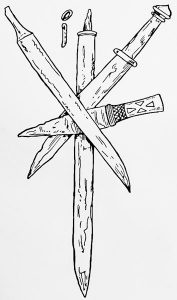
The armour at Sutton Hoo appears to be Swedish, or at least it is made in the Swedish style. Certainly the custom of ship burials is a Nordic one - there are many similar Viking remains in Denmark and Sweden. There is also a large silver dish made in Byzantium about 500 AD and a set of 10 silver bowls from the Mediterranean.
Who was buried at Sutton Hoo? Who was so powerful in his lifetime to be interred with ceremony in a ship nearly 90 feet in length surrounded by so much golden splendour? Conjecture focuses on Raedwald, a Saxon "bretwalda", or king, of East Anglia.
According to the Venerable Bede in his "Ecclesiastical History", Raedwald ruled East Anglia in 616, although his power may have stretched as far north as the Humber. Raedwald was the first East Anglian king to pay any heed to Christianity. He may have converted to the new religion - certainly, his successors were Christian.
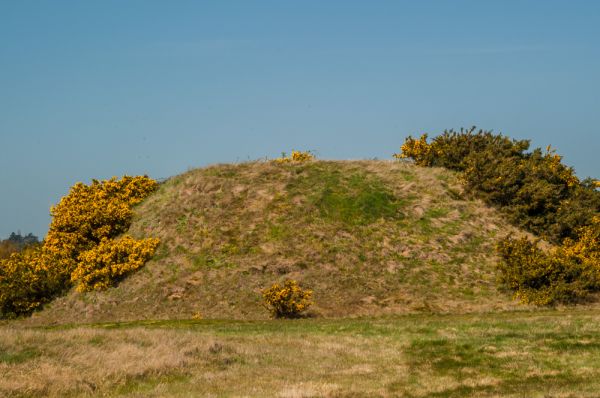
Archaeologists have reconstructed how the burial at Sutton Hoo must have taken place. A long trench was dug atop a 100 ft. high cliff above the river Deben. The ship was dragged up from the river and set in the trench. A hut was built in the centre of the ship, and there was placed a large coffin and the grave goods. The trench was then filled in and a large mound erected over the top.
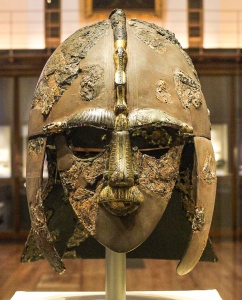
(c) geni
When the ship was uncovered the timbers had rotted away. However, the rivets still remained, and the rotting timbers had stained the sand, so the pattern of boat construction could be determined, and a good picture of the boat emerged. It was about 90 feet long and 14 feet wide, with a high bow and stern. It is easily the largest Anglo-Saxon ship ever discovered.
The importance of Sutton Hoo cannot be overstated. From the grave goods, we can learn a lot about the pattern of life in this darkest part of the Dark Ages in Britain. Even the style of the craftsmanship lets us draw conclusions about how strong were Saxon connections with the rest of Europe.
In this case, it seems clear that there was a strong Norse influence in East Anglia, but also ties to Gaul and the Mediterranean. Clearly, trade with those areas was maintained throughout these troubled times. The goods discovered at Sutton Hoo are on display at the British Museum in London.
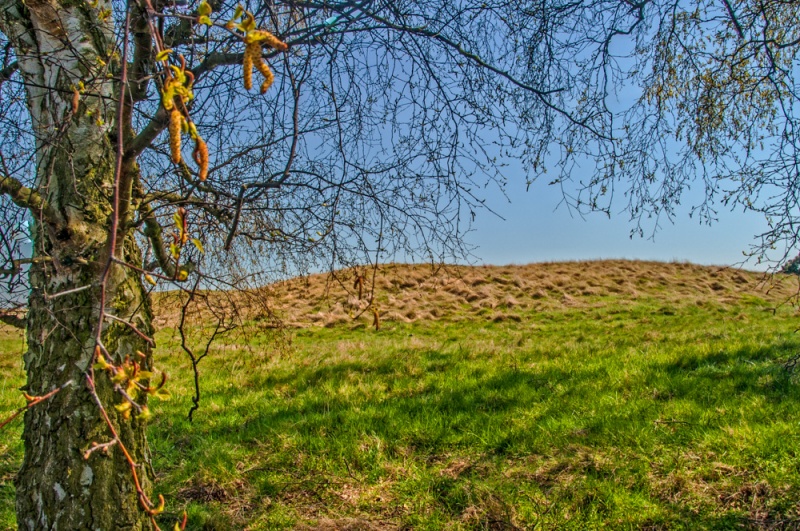
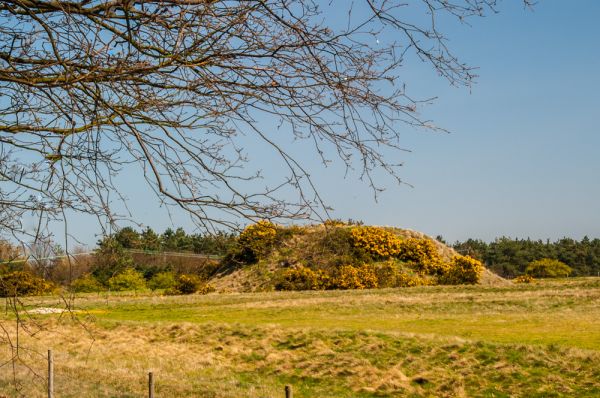
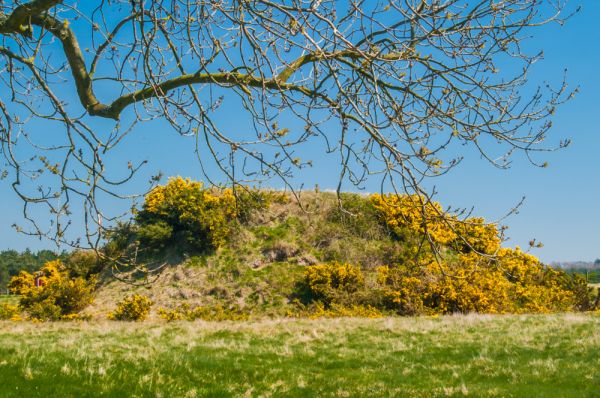
Visitors can see finds from the site, and take a lovely walk through woodlands and along field boundaries to the burial mounds. Unfortunately, the mounds themselves cannot usually be accessed so that they are not worn away by the feet of thousands of visitors each year. The footpath makes a circuit of the site so that you can get a good look at the burial mounds from every angle, and you can get quite close on the southwest side.
Why did archaeologists dig at Suton Hoo?
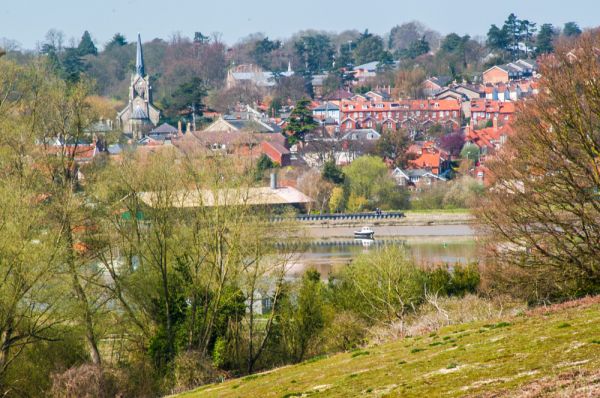
A peculiar tale attaches to the investigation of the Sutton Hoo site. In the late 1930s, Mrs Edith Pretty owned Tranmer House, formerly known as Sutton Hoo House, an elegant Edwardian house on the east bank of the River Deben, opposite the town of Woodbridge.
Mrs Pretty had a friend who was interested in spiritualism, and one day her friend looked out towards the ancient burial mounds south of the house and saw a ghostly vision. That vision prompted Mrs Pretty to begin investigating the mounds, and the result was one of the great archaeological discoveries of the 20th century.
In World War Two the house was used as a station for Land Army girls. In 1997 Tranmer House was given to the National Trust, who have turned it into a fascinating exhibition area. The house has been refurbished as it would have looked in the 1930s, with period magazines available to read, a gramophone to play popular pre-war music, and authentic board games to enjoy.
A visit to Tranmer House is like a step back into the 1930s, when the world was in the brink of WWII, and the remarkable finds from the Sutton Hoo burial mounds were about to be unearthed.
More
Dark Ages
The image of the Sutton Hoo helmet is (c) geni and is republished with gratitude under a Creative Commons license
More Photos


About Sutton Hoo
Address: Tranmer House, Sutton Hoo, Woodbridge, East Anglia, Suffolk, England, IP12 3DJ
Attraction Type: Prehistoric Site
Location: On B1083 between Melton and Bawdsey.
Website: Sutton Hoo
Email: suttonhoo@nationaltrust.org.uk
Location map
OS: TM288491
Photo Credit: David Ross and Britain Express
HERITAGE
 We've 'tagged' this attraction information to help you find related historic attractions
and learn more about major time periods mentioned.
We've 'tagged' this attraction information to help you find related historic attractions
and learn more about major time periods mentioned.
Historic Time Periods:
Find other attractions tagged with:
Saxon (Time Period)
NEARBY HISTORIC ATTRACTIONS
Heritage Rated from 1- 5 (low to exceptional) on historic interest
Ufford, St Mary of the Assumption Church - 2 miles (Historic Church) 
Rendlesham, St Gregory's Church - 3.2 miles (Historic Church) 
Shottisham, St Margaret of Antioch Church - 3.4 miles (Historic Church)
Grundisburgh, St Mary's Church - 4.2 miles (Historic Church) 
Bentwaters Cold War Museum - 4.6 miles (Museum)
Butley, St John the Baptist Church - 5.3 miles (Historic Church)
Alderton, St Andrew's Church - 5.7 miles (Historic Church)
Tunstall, St Michael's Church - 5.9 miles (Historic Church)
Nearest Holiday Cottages to Sutton Hoo:


Campsea Ashe, Suffolk
Sleeps: 13
Stay from:£1,495 - £9,633