Historic Churches in Suffolk
- Map of Historic Churches in Suffolk
- Map of ALL Historic Churches in England
- Map of all attractions in Suffolk
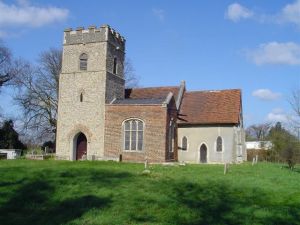
Only four miles from the centre of Ipswich, yet centuries away in terms of atmosphere, the little church of St Mary's in Akenham seems like the sort of place where nothing has changed for hundreds of years, and nothing ever will. The church is very simple, even plain, with a nave, chancel, south chapel, and tower inserted in the south wall.
Akenham, Suffolk, England, IP1 6TQ
Heritage Rating:  ?
?
Nearest Self Catering Cottages
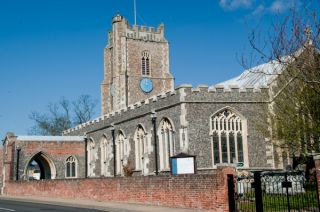
There was a church here at the time of the Domesday Book, but the current church of St Peter and St Paul is largely an early 16th-century building, with an earlier 14th-century tower. There may have been an even earlier Saxon church at Aldeburgh, but if so, only limited traces of that building now remains in the altered roofline of the current church.
Victoria Road, Aldeburgh, Suffolk, England, IP15 5DY
Heritage Rating:  ?
?
Nearest Self Catering Cottages

Alderton is an attractive village south of Orford, on the Bawdsey Peninsula, near the mouth of the River Deben. There's not a lot to the village beyond some cottages, a country inn, and the partially ruined church of St Andrew, set in an odd position tucked away behind the pub.
The Street, Alderton, Suffolk, England, IP12 3BS
Heritage Rating: ?
Nearest Self Catering Cottages

The village of Bacton lies some five miles north of Stowmarket, off the B1113. The parish church of St Mary the Virgin is a lovely flint rubble building dating to the 14th century. It has a clerestoried nave with aisles, a chancel, west tower, and north vestry.
Church Road, Bacton, Suffolk, England, IP14 4LN
Heritage Rating: ?
Heritage Highlight: 15th-century Doom wall painting
Nearest Self Catering Cottages

St John the Baptist at Badingham is a fascinating country church, dating mostly to the 13th century, but with enough surviving bits and pieces to suggest that there was an earlier Norman church on the site.
Low Street, Badingham, Suffolk, England, IP13 8JX
Heritage Rating: ?
Heritage Highlight: Superb late 15th-century Seven Sacrament font
Nearest Self Catering Cottages
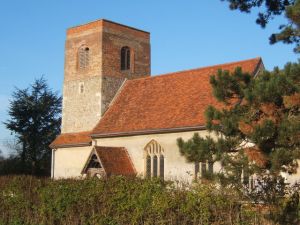
A medieval church with many Georgian features, St Mary's is located in an isolated rural setting up a long track far from a major road. Though the church is medieval in origin, the main interest here is the unaltered Georgian interior, essentially unchanged for the last several centuries.
Badley, Suffolk, England, IP6 8RU
Heritage Rating: ?
Nearest Self Catering Cottages

St Peter & St Paul's is a 15th-century church with a restored angel roof, 14th-century wall paintings, and elaborate memorials to the Reade and Croft families. Look for four traceried panels from a late medieval screen.
Church Road, Bardwell, Suffolk, England, IP31 1AH
Heritage Rating: ?
Heritage Highlight: 14th-century wall paintings
Nearest Self Catering Cottages

Bawdsey is almost literally 'the end of the road'. The little village lies on the north side of the River Deben, at the end of the Bawdsey peninsula. From here the road carries on to the old manor house of Bawdsey Manor, where radar was developed.
The Street, Bawdsey, Suffolk, England, IP12 3AH
Heritage Rating: ?
Heritage Highlight: 13th century altar frontal
Nearest Self Catering Cottages

The church of St Mary Magdalene stands high on a hill, overlooking the village itself a good half-mile away on the valley bottom. Why is St Mary's so far from the rest of Bildeston? The usual (and usually erroneous) answer in cases like this is to blame a distant village on the Black Death of 1348-9. But the more practical and less romantic answer is simply a gradual move to be near the site of a market, which a 13th-century lord of the manor established near the crossroads in the valley below.
Church Lane, Bildeston, Suffolk, England, IP7 7SB
Heritage Rating: ?
Heritage Highlight: Late 16th century Wade memorial brass
Nearest Self Catering Cottages

All Saints church at Blyford seems like a little child that has wandered off and got lost. There is no village to speak of, just an attractive 16th-century country pub and a few scattered farmhouses. The church was originally owned by Blythburgh Abbey and retains many Norman features, including two Norman doorways and a 13th-century font.
B1123, Blyford, Suffolk, England, IP19 9JY
Heritage Rating: ?
Nearest Self Catering Cottages