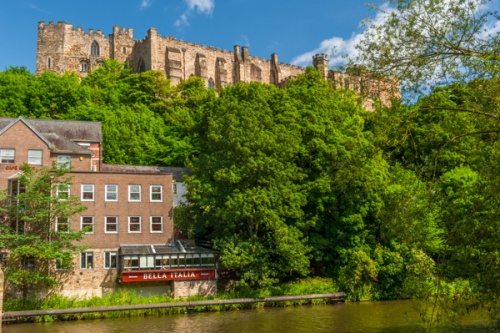
Nestled onto the same peninsula of land overlooking the leafy River Wear as is Durham Cathedral, Durham Castle was one of the first fortified castles built by William the Conqueror during his ferocious "harrying of the north" (i.e. putting down rebellions among the Anglo-Saxon inhabitants of the North.
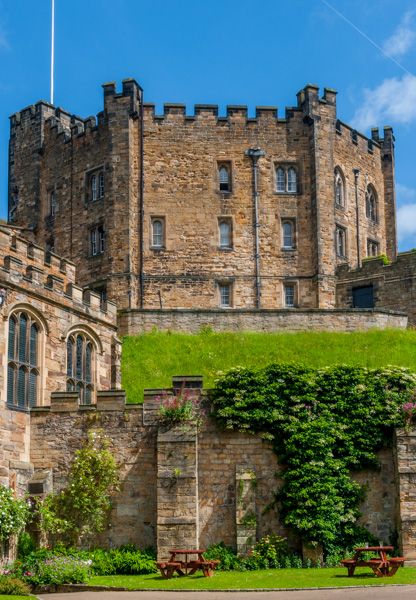
Begun in 1072 as a part of William's plan to pacify the north of his new realm, the castle is an excellent early example of the Norman "motte and bailey" style of fortification.
In plain English, that means the central tower, or keep, was built atop a high mound (the motte), and surrounded by a walled enclosure (the bailey).
During the Middle Ages the castle served as a centre of power to counter the threat from the Scots, but then it was taken over as the principal residence of the Prince Bishops of Durham - a sort of half-ecclesiastical, half-royal title given to the bishops of Durham, who ruled both the souls and the bodies of their flock.
In 1837 the castle changed hands once more, becoming part of the new University of Durham where it now serves as a residence for students and dons.
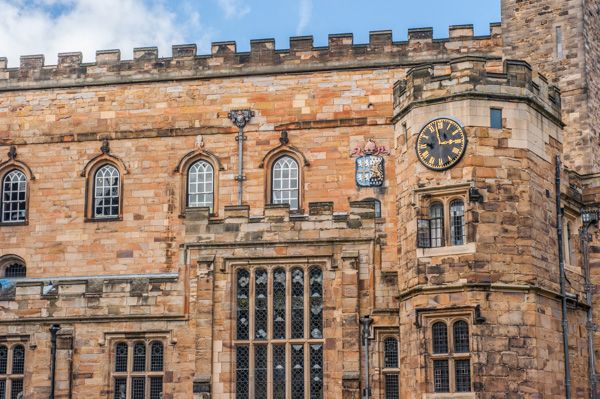
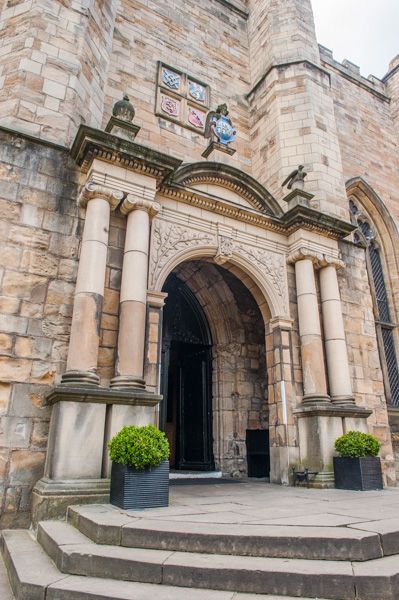
The castle covers three sides of a courtyard - the old inner bailey - and you can trace the additions made by various bishops over time, as each bishop placed his coat of arms on the bit of wall he had rebuilt.

To the west of the Gatehouse is the Great Hall, a relic of the 13th and 14th centuries, and now serving much the same purpose as the dining hall for the University. The basement of the hall now houses the wine cellars. Opposite the Gatehouse is one of the oldest parts of the castle, built by Bishop Pudsey (1153-1195).
The gallery of the Great Hall is stuffed with military memorabilia, including relics from the Civil War and the Napoleonic Wars, and portraits of bishops past.
One of the most memorable moments of a visit to Durham Castle is your first sight of The Black Staircase, which is situated between the Great Hall and Bishop Pudsey's building, The Black Staircase, named for the dark oak of which it was made, reaches 57 feet high. It was originally freestanding; relying on the walls for support, but now it is braced by plain, rounded columns.
The oldest part of the castle still largely intact is the Norman Chapel, built in 1080. There is wonderful stonework here, especially in the carved capitals of the columns. Look for the fascinating scene of a hunt in progress carved upon the northwest column.

One word of caution. The castle keep is not what it seems. It is a copy, built in 1840 by Anthony Salvin to the same floor plan as the original Norman keep. So it can provide little more than a glimpse of what was once one of the most important castles in all of Britain.
Visiting Durham Castle
The castle can be visited only by joining a tour group, and tours can be booked at the University Library on the Cathedral green, just outside the castle gates (facing the cathedral). Tours are usually only available when the university is not in session, and when we visited in June there were three tours in an afternoon. Numbers of participants are limited and the tours do fill up fast, so it is well worth booking a day ahead if you can. We were fortunate enough to find space on a tour that same day.
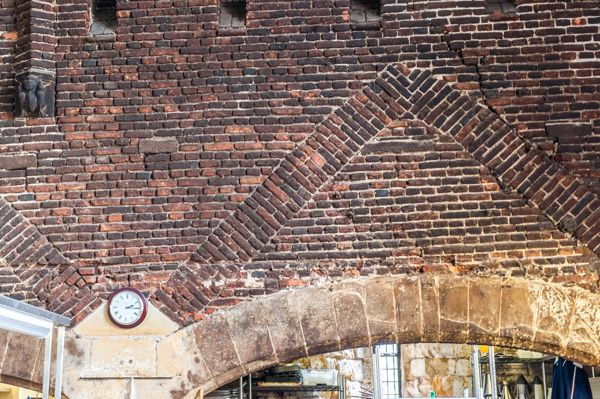
Our tour group was led by a wonderfully enthusiastic young Scottish student, who gave us some of the historical background, and took our group through the major historic locations within the castle. We began with a look at the castle courtyard (the inner bailey), and an overview of the castle's foundation. Then we went through into the buttery, where we could catch a glimpse of the very early brickwork inserted by Bishop Fox in the busy kitchens beyond.
Hot food for the Bishop
Above the arched openings leading to the kitchens were carved a Latin blessing and the Bishop's arms. Our guide related the amusing story behind these symbols; when food from the kitchens was brought to the hall for meals, the bishop was served first, then other officials according to rank.
By the time everyone had been served and the meal was ready to be blessed, the Bishop's food was cold. To solve this, the wily Bishop had a blessing carved over the hatchways leading into the kitchen, so that when food was handed through the hatch it was considered to blessed at that moment, and could, therefore, be eaten as soon as it arrived in the hall!
The great hall was our next destination, where meals were held in the medieval period, and where students and staff still gather regularly for formal meals. Though much of what we see today is later rebuilding, the core of the hall is medieval.
From the hall we passed along the gallery, past cases stuffed with historic artefacts, to the Black Staircase.
Oh, how I wished I was allowed to take photos of the staircase! The carving was exquisite. You could see how the original cantilevered stair had begun to slope with the load of passing students, and necessitated the insertion of supports. We were not allowed to walk up the stairs due to its age, but simply seeing the wonderful carving detail was a treat.
From there our tour went on to the Tudor chapel, a marvellous building with carved misericords and an ancient organ. Leaving the Tudor chapel, we descended the stairs to the original Norman chapel at the base of the castle.
This was the highlight of the tour; an atmospheric, dimly-lit space supported on huge Norman columns, the sort of place that invites you to simply sit and soak up the sense of mystery and age. The column capitals were wonderfully carved with figures, including one of the earliest known depictions of a mermaid in Britain.
And that was the end of the tour, though we were gently invited to leave a voluntary tip for our guide in a strategically placed coffee-cup by the exit, 'to help out a poor student' as she put it. I was happy to leave a tip, for the tour was well worth taking.
It is a shame that there are so many parts of the castle that you can't normally see because it is in full-time use by university students and staff, but the parts you can see make it a real delight to visit, and it added a great deal to our enjoyment of visiting Durham and appreciating the interlinked history of the castle and cathedral.
More Photos

About Durham Castle
Address: Palace Green,
Durham,
County Durham,
England, DH1 3RW
Attraction Type: Castle
Website: Durham Castle
Email: castle.tours@durham.ac.uk
University College, Durham University
Location
map
OS: NZ273 424
Photo Credit: David Ross and Britain Express
HERITAGE
 We've 'tagged' this attraction information to help you find related historic attractions and learn more about major time periods mentioned.
Historic Time Periods:
Find other attractions tagged with:
castle (Architecture) - motte and bailey (Historical Reference) - Norman (Architecture) - Saxon (Time Period) - William the Conqueror (Person) -
NEARBY HISTORIC ATTRACTIONS
Heritage Rated from 1- 5 (low to exceptional) on historic interest
Durham Cathedral - 0 miles (Cathedral) 
Durham Town Hall - 0.1 miles (Historic Building) 
Durham Museum and Heritage Centre - 0.2 miles (Museum)
Crook Hall - 0.5 miles (Historic Building) 
Finchale Priory - 3.3 miles (Abbey)
Brancepeth Castle - 4.2 miles (Castle)
Houghton-le-Spring, St Michael and All Angels - 6.3 miles (Historic Church)
Binchester Roman Fort - 7.9 miles (Roman Site)