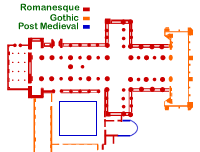
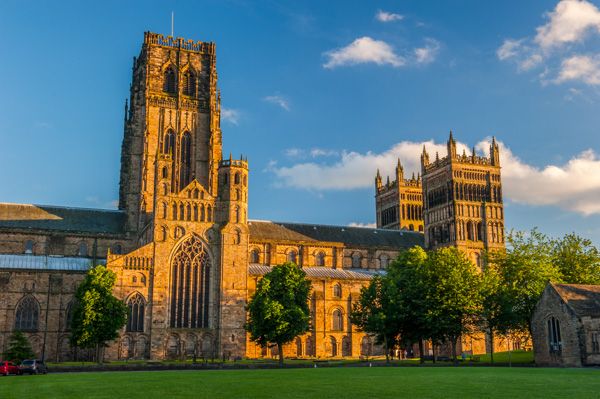
Durham Cathedral is a wonderful reminder of the age of the Prince Bishops. In this building the three main innovations of the revolutionary Gothic style come together; pointed arches, ribbed vaults, and flying buttresses (hidden above the aisle vaults).
The majority of the interior work was completed in only 40 years, with the result that the cathedral shows a remarkable unity of style not often found with large building projects from the medieval period. Durham is one of the high points of cathedral architecture in this or any other land.
The cathedral was founded in AD 995 by monks from Lindisfarne who had fled their island home when the Danish Vikings came calling. The monks needed a home for the relics of St. Cuthbert, and they built a superb church on a rise above a bend of the River Wear.
The church built by Cuthbert's followers was pulled down by William of St. Carileph, the second bishop of Durham, when the present building was begun in 1093.
The choir begun by William was finished in 1099, and the nave was rebuilt under the reign of his successor as Bishop, Ranulf Flambard. The nave is astonishing; the relatively slender composite piers alternate with massive drum columns, and the stone vaulting is the finest Romanesque example in Europe.
1093-1133 - Nave, Transepts and Choir
1173-1189 - Galilee Chapel
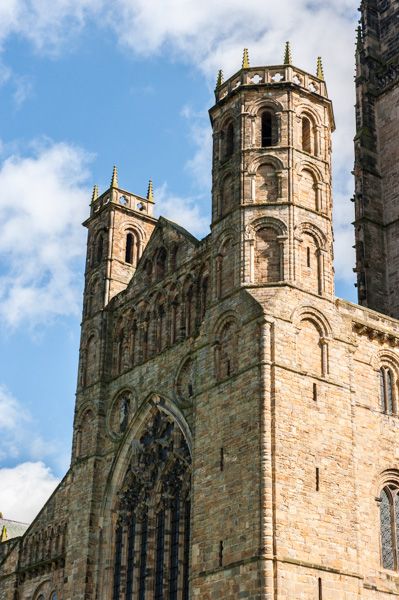
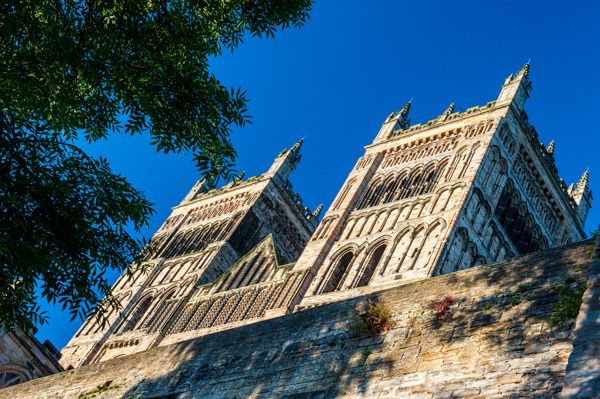
1217-1226 - Western Towers
1242 - Chapel of the Nine Altars completed
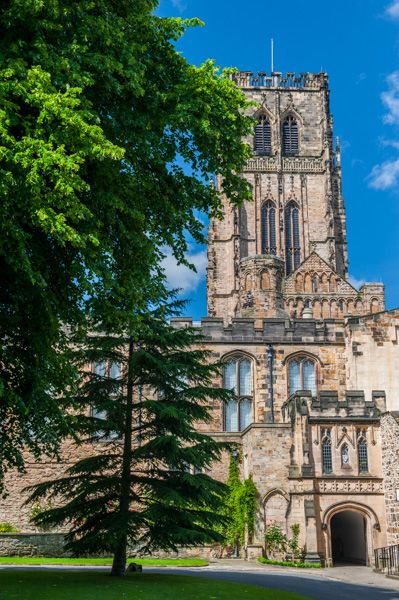
1465-1490 - Central Tower rebuilt
Ranulf Flambard, Bishop of Durham, 1099-1128
Flambard was a fascinating character, an advisor to William II who was widely reviled for his acquisitive nature (much like William himself). As a reward for increasing William's revenue, Flambard was awarded the bishopric of Durham in 1099. In 1100 Flambard was imprisoned in the Tower of London by Henry I, but the bishop managed to escape by climbing down a rope from a high window. It is possible that the "escape" was encouraged by Henry, but Flambard never regained the influence he had held under William II.
His actions were not all self-centred; Flambard was responsible for building the hospital of Kepier in Durham, and founding several churches. He granted St. Godric the land used to build Finchale Priory and constructed Framwellgate Bridge across the Wear.
In 1121 he found time to invade Scotland. At his death in 1128 Flambard tried to mend a few fences by restoring privileges he had taken from the monks of Durham, but his lasting impression is of a man driven by greed and power.
In 1104 the body of St. Cuthbert was finally laid to rest in the Cathedral proper. It had been kept in a nearby chapel until the church was being built. The monks inspected the body and found it in a state of perfect preservation (possibly due to embalming).

A Succession Controversy
Controversy did not die with Ranulf Flambard (see above)! When Ranulf's successor, Geoffrey Rufus, died in 1141, the bishop's chaplain, William Cumin, seized the Bishop's Castle, claiming to be the new bishop. Cumin had forged documents, purporting to be from the pope, naming him as the next bishop.
The monks refused to accept Cumin, despite support for him from King David of Scotland. Several monks escaped and fled to Rome to ask the pope for clarification. The pope denounced Cumin and ordered the monks to elect a new bishop. This they did in 1145, choosing William of St Barbara, Dean of York. Cumin was captured in the following year by a force of nobles under the Earl of Northumberland.
In 1173 the Galilee Chapel was begun at the western end of the cathedral. This chapel was a "Lady Chapel", intended for the use of women, who were not allowed to enter the cathedral proper. Abortive attempts were made to erect a lady chapel at the eastern end of the building, but the foundations kept collapsing. Some [males] interpreted this as a sign that St Cuthbert objected to the presence of women so close to his tomb behind the high altar at the eastern end.
Whatever the reason, once the Galilee Chapel was moved to the west, work was able to proceed without further problems. The result is a wonderful piece of ecclesiastical architecture, a low rectangle that is essentially a church in its own right, with zigzag arches supported on shafts of dark Purbeck marble.
St Cuthbert's alleged dislike of women surfaced again in 1333 when Queen Philippa, accompanying her husband Edward III on his way north to fight the Scots, was asked to leave the cathedral and stay at the nearby Castle of Durham to avoid upsetting the saint.
More Controversy
In 1183 the Archbishop of York attempted to inspect the treasury of the monks of Durham, who were at that time awaiting the appointment of a new Bishop. The monks were angered at the intrusion, and they clipped the tail of the Archbishop's horse and chased him out of the city's market place.
As soon as Anthony Bek was named Bishop of York the furious Archbishop ordered him to excommunicate the monks. Bek refused, whereupon the Archbishop attempted to excommunicate the Bishop too! Bek appealed to King Edward I, claiming that as Prince-Bishop of Durham he was answerable only to the crown. Henry, naturally enough, upheld Bek's claim.
Bishop Bek did not stay in the good books of the monks, however; in 1300 he demanded the right of visitation to the priory which lay next to the cathedral The monks refused, so Bek had them imprisoned. The dispute eventually died down after Edward I intervened.
A great Central Tower was constructed in the 1230s, and the Chapel of the Nine Altars was begun (finished 1242). This chapel is unusual in that the floor level is lower than that of the choir aisles, but the result is an impression of great height, enhanced by the slender Purbeck marble shafts that stand free of the windows and wall arcading. From the chapel the tomb of St. Cuthbert is approaching by mounting a platform.
A tragedy occurred in 1137 when a tightrope walker was employed by the Prior of Durham to entertain the monks. The man attempted to walk along a rope stretched between the Central Tower and one of the Western Towers, but he slipped and fell to his death.
(click to enlarge)
In 1371 the Bishop's throne (called a "cathedra") was built, followed only a few years later by the installation of the Neville Screen. This lovely carved screen, largely paid for by the powerful Neville family, was created in Caen, France, and shipped to Newcastle. Then it was brought in sections to Durham, where it was reassembled in the cathedral.
In 1438 the cloisters were added to the cathdral, but the monks were only to enjoy their pleasant walking space for just over a century before the Cathedral Monastery was dissolved by Henry VIII in 1540 and the monks disbanded.
The cathedral suffered greatly in the aftermath of the Civil War. After the Battle of Dunbar some 3000 Scots were imprisoned within the cathedral. The prisoners proceeded to wreck many of the tombs within the cathedral, and break up wordwork to make firewood.
Within the Cathedral itself are:
Cathedral Libraries
There are 3 libraries at Durham Cathedral. The one of most interest to the majority of visitors is the Chapter Library, the remains of the medieval monastic library. There is a rich collection of pre-Conquest manuscripts as well as 17th and 18th century music.
Also on the site is a library of current theological works and a third library of German Protestant theological texts.
The Tower
For those of strong constitution the cathedral tower can be climbed for wonderful views of the city and surroundings. There are 325 steps up a steep, spiral staircase, so be prepared for some exertion. The tower is closed during services and during inclement weather.
Visiting
The cathedral is open daily and has helpful greeters to answer visitor questions. The historic highlights around the church are very well signposted, and there is a very useful, inexpensive map and pamphlet available that I found very good value.
As of this writing, interior photography is poermitted, but not in the treasury part of the cathedral museum.

The Durham Sanctuary Knocker
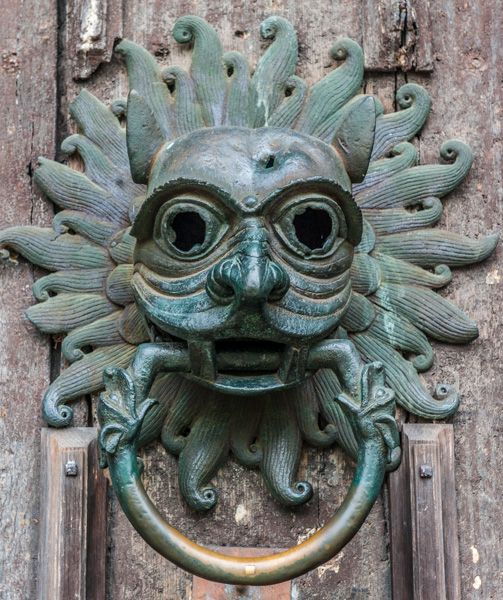
You enter by way of the north door, passing the most photographed knocker in England, the medieval sanctuary knocker in the shape of a strange face inside a sunburst. According to medieval law, any fugitive from justice who managed to reach the knocker could claim the right of sanctuary. That meant that the law could not touch him for a specified period of time -- often 37 days -- or as long as he remained inside the cathedral up to that limit.
In practise the right of sanctuary allowed time for criminals who had the means to arrange passage overseas to escape the law. The knocker we see today is an exact replica of the original medieval one, which is kept in safe storage in the cathedral treasury.
Interior Highlights
Two things really stand out in my memory from exploring the cathedral interior. The first are the extraordinary Romanesque pillars of the nave. These are one of the most striking examples of early Norman architecture I've ever seen in England, and it is astonishing the sense of height and spaciousness they give the cathedral interior.
My second highlight is the Galilee Chapel at the west end of the church. This is such an atmospheric place, with slender columns dividing up the space into linear aisles. In one of those aisles is the table tomb of The Venerable Bede. It was for me an awe-inspiring experience to sit quietly by the tomb and soak up the atmosphere. It is the sort of place you want to speak in hushed tones, if at all.
The Dun Cow Carving
One interesting feature that won't get into many guidebooks to the cathedral is a carving set on the exterior north wall, facing the cobbled, sloping alley known as Dun Cow Lane, thought to be one of the earliest streets in the city. The carving depicts the legend of the Dun Cow.
It seems that around AD 990, when the monks bearing St Cuthbert's coffin came to the area where Durham now stands, they rested on the hilltop of Warden Law, but when they attempted to resume their journey they mysteriously found themselves unable to move another step. For 3 days they were immobilised, until the image of Cuthbert appeared in a vision to one of the monks. The saintly vision instructed the monk to carry his coffin to 'Dun Holm'.
The monks had no idea where or what this instruction signified until a milkmaid appeared, searching for her 'dun cow', which an old woman informed her had last been seen at a place called Dun Holm. Dun in this case refers to a dull greyish-brown colour.
The monks followed the milkmaid towards the nearby hilltop of Dunholm, or Durham, where they established the saint's final resting place on the cliffs overlooking the River Wear. The carving shows two women, one balancing a large bucket on her head, with a cow between them.
Though the story of the Dun Cow is likely apocryphal, the carving is a lovely reminder of the sort of mythology that lingers in this wonderfully historic city, a place where the past is always present!
Cathedral Views
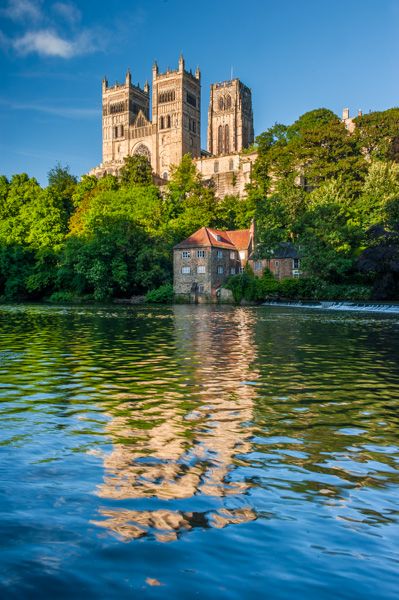
As a final note, one of the best views of the cathedral is not from the old city centre at all, but from the far side of the River Wear, on a lovely footpath that winds along the riverbank from Prebend's Bridge toward Milburngate Bridge. On a sunny summer evening the views of the cathedral and castle from the riverside are simply fabulous.


More Photos


About Durham Cathedral
Address: Durham, County Durham, England, DH1 3EH
Attraction Type: Cathedral
Website: Durham Cathedral
Email: enquiries@durhamcathedral.co.uk
Location map
OS: NZ272 423
Photo Credit: David Ross and Britain Express
HERITAGE
 We've 'tagged' this attraction information to help you find related historic attractions
and learn more about major time periods mentioned.
We've 'tagged' this attraction information to help you find related historic attractions
and learn more about major time periods mentioned.
Find other attractions tagged with:
Lindisfarne (Place)
NEARBY HISTORIC ATTRACTIONS
Heritage Rated from 1- 5 (low to exceptional) on historic interest
Durham Castle - 0 miles (Castle) 
Durham Museum - 0.1 miles (Museum) 
Durham Town Hall - 0.2 miles (Historic Building)
Crook Hall - 0.5 miles (Historic Building)
Finchale Priory - 3.3 miles (Abbey)
Brancepeth Castle - 4.2 miles (Castle)
Houghton-le-Spring, St Michael and All Angels - 6.3 miles (Historic Church)
Binchester Roman Fort - 7.9 miles (Roman Site)
Nearest Holiday Cottages to Durham Cathedral: