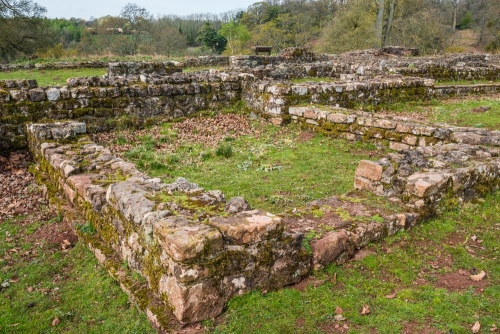
A Roman temple and bath complex stands within the earthworks of an earlier Iron Age hill fort in the Lydney Park estate, on the southern fringe of the Royal Forest of Dean.
History
The ruins occupy the summit of Camp Hill, an Iron Age hillfort defended by high earthwork banks. The hillfort is thought to have been created around 100 BC. You can still clearly see the earthworks, especially on the eastern slope of the hill.
There is some evidence of coin minting and metalworking on the site around the end of the 1st century AD. The first evidence of Roman occupation at Lydney comes from around AD 250. Excavations have revealed evidence of workers' huts, probably used by labourers in the iron mines to the north, in what is now the Old Park.
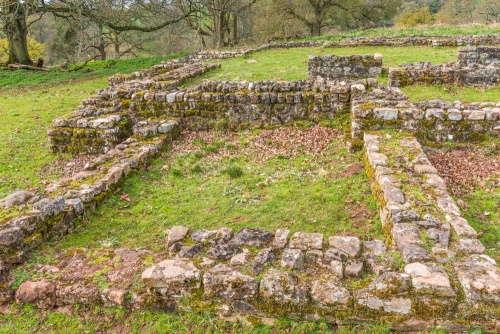
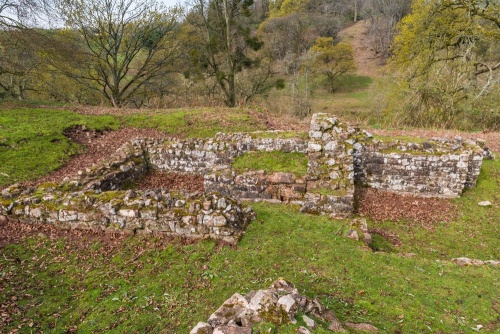
Sometime around the end of the 3rd century, a rectangular temple was erected on the site. The temple measures roughly 80 x 60 feet, with heavy buttresses to stabilise the building. The interior faces of the buttresses have small niches cut into them, probably to display statues.
There is a single entrance in the south-east of the temple, with a short flight of steps into the temple interior. The far end (in the north-west) is divided into three compartments. This suggests that a tripartite god was worshipped here, with each room representing a different aspect of the god's attributes.
Nodens
We do know that the temple was dedicated to an otherwise unknown god called Nodens. Anglo-Saxon scholar JRR Tolkien was called in by Lord Bledisloe, owner of Lydney Park Estate, to investigate the temple and its connection with Nodens. Tolkien, of course, is best known for his Lord of the Rings books, which were almost certainly influenced heavily by his research on Lord Bledisloe's behalf.
Tolkien found that the god Nodens developed from the Celtic god 'Nodens the Catcher', who had a magical hand. Nodens evolved in Irish legend as Nuada ('of the silver hand') and in Welsh folklore as Lludd Llaw Ereint, the inspiration for Shakespeare's King Lear.
Nodens may have been a god of fishing, but it is equally likely that he was a god of healing. Archaeologists discovered a huge number of votive offerings on the temple site, including quantities of bracelets, pins and models of dogs.
In Roman religion, dogs were thought to aid in healing and were often used in Greek and Roman temples to lick the afflicted part of the body to speed healing. Archaeologists also found numbers of tablets inscribed with healing requests.
The Temple
Romano-British temples were typically square and based on a basilica plan. The Lydney Park temple is quite different. It is rectangular and very unusually, it has two side chapels. The odd layout was likely influenced by the popularity of mystical cults in the 3rd and 4th centuries, which, in turn, influenced early Christian church layout. The Lydney Park temple has been interpreted as an expression of 'one of the early lost rivals to Christianity'.
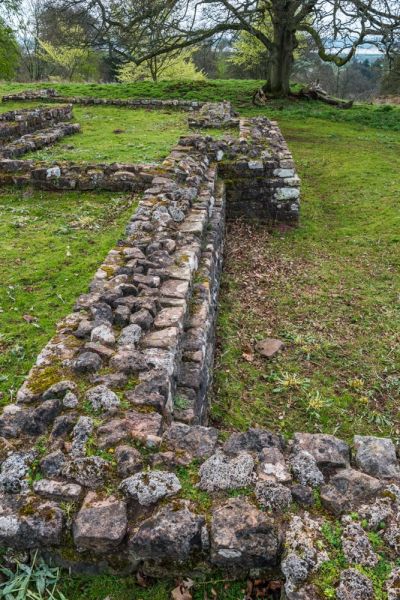
The temple formed part of a complex of buildings that included a bathhouse, a guest house, water tank and supply channels, and stalls. The complex was surrounded by a stone wall.
The site was investigated in the 18th century by amateur antiquarians. The first rigorous scientific investigation took place in 1805 by Charles Bathurst. In 1928 Viscount Bledisloe asked Sir Mortimer Wheeler, the father of modern archaeology, to investigate the site. Much of what we know today comes from Wheeler's work.
Investigation revealed over 8,000 coins on the temple site, which seems to have been used well into the 5th century, after the Romans had left Britain. One find was a bronze plaque depicting a woman.
The temple complex revealed wonderful mosaic floors. Mosaic fragments show fishermen, a sea god, and tritons. The temple mosaic was inscribed with the words, 'To the god Nodens, Titus Flavius Senilis, officer in charge of the supply depot of the fleet, laid this pavement out of money offerings; the work being in charge of Victorinus, interpreter on the Governor's staff'.
One of the artefacts found during excavations on the site was The Lydney Dog, a Romano-British cast bronze sculpture of a wolfhound. This dog likeness has become the symbol for Lydney Park Estate and is on display in the museum located in a wing of the mansion house.
Adam and Eve
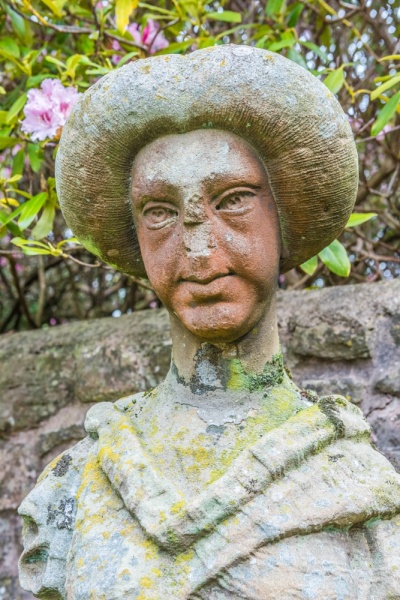
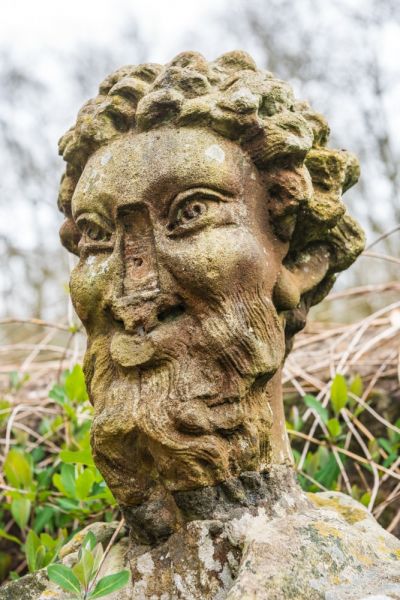
Around 1740 Thomas Bathurst, the owner of Lydney Park, erected a pair of statues at a viewpoint on Camp Hill. One figure is male (Adam) and resembles a faun, or a figure of Pan. The style is typical of 17th-century neo-classical style.
The other figure (Eve) is female and resembles a Roman bust, with a distinctive Roman headdress. The style is very similar to Roman statues found at Bath, dating from the Domitian or Flavian period. It isn't clear how old the 'Adam' and 'Eve' statues are but a date of around 1700 has been suggested. The statues now flank the entrance to the woodland garden at the bottom of Camp Hill.
The Bath Complex
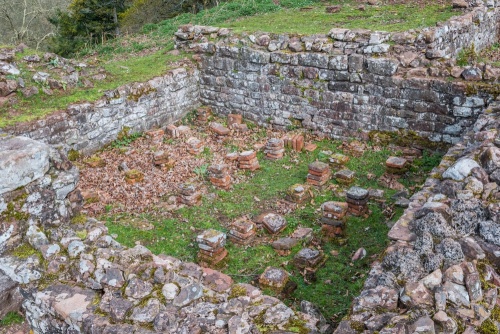
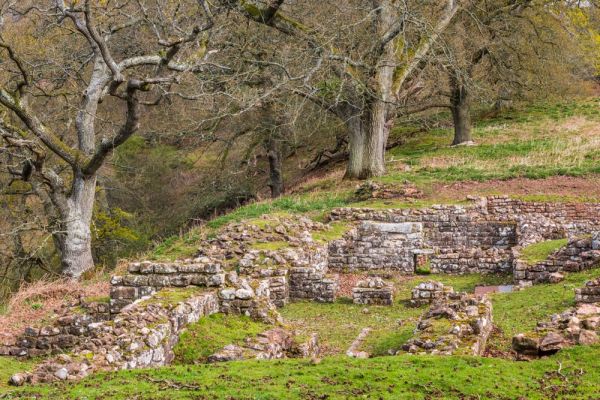
It seems clear that people must have travelled long distances to visit the temple. A large guest house was erected for visitors a stone's throw from the temple. This square building and its central courtyard now lie buried beneath the turf but a large part of its bathhouse is exposed to view.
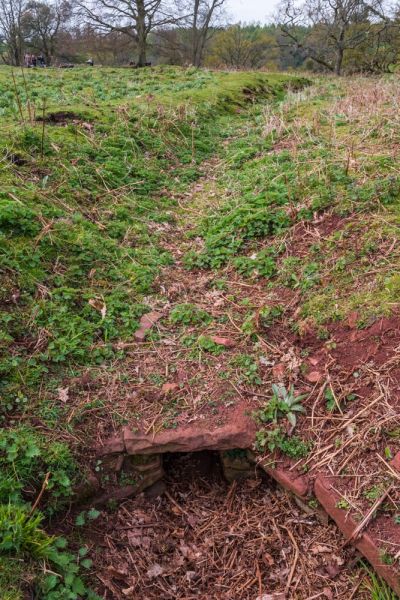
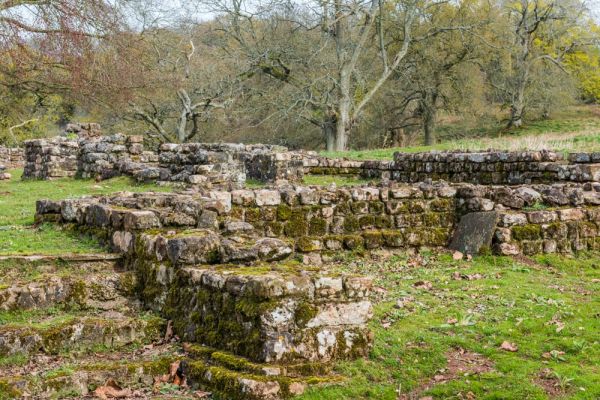
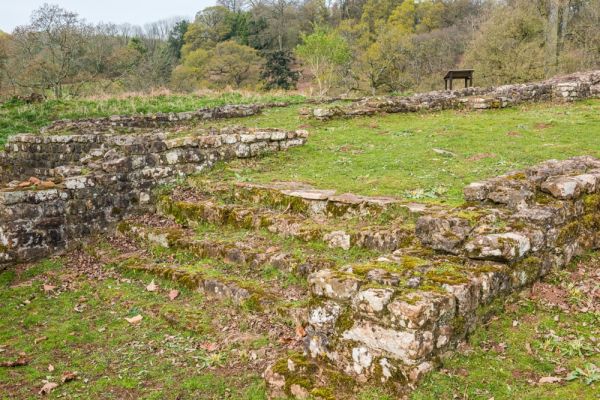
Only about half of the bathhouse is exposed. You can see the Caldarium (the hot baths), two furnaces, a Sudatorium (sweat room), and a Tepidarium (warm room). Still buried beneath the turf are the Frigidarium (cold water baths) and changing rooms, as well as a latrine block that emptied over the edge of the hill. The Tepidarium and Sudatorium both have remains of a hypocaust system for underfloor heating.
The bath complex is located in a dramatic position on the very northern edge of the hilltop. On one side of the baths ran the Long Building, which was divided into stalls, or booths, probably occupied by healers or used as shops for selling religious objects. Visitors in search of healing may also have slept in the Long Building, as it was considered beneficial to sleep within a temple precinct.
Visiting
The estate is open on specified days in spring and summer. Visits include an opportunity to explore the Roman camp and the ruins of a 12th-century Norman motte and bailey castle, enjoy the 8-acre woodland garden, and visit the museum highlighting archaeological finds on the Lydney Park Estate.
More Photos
About Lydney Park Roman Camp
Address: Lydney Park Estate, Old Park, Lydney, Gloucestershire, England, GL15 6BU
Attraction Type: Roman Site
Location: On the A48 immediately south-west of Lydney
Website: Lydney Park Roman Camp
Location map
OS: SO621021
Photo Credit: David Ross and Britain Express
HERITAGE
 We've 'tagged' this attraction information to help you find related historic attractions
and learn more about major time periods mentioned.
We've 'tagged' this attraction information to help you find related historic attractions
and learn more about major time periods mentioned.
Historic Time Periods:
Find other attractions tagged with:
12th century (Time Period) - 17th century (Time Period) - 18th century (Time Period) - 1st century (Time Period) - 3rd century (Time Period) - 5th century (Time Period) - castle (Architecture) - Celtic (Architecture) - hill fort (Historical Reference) - Iron Age (Architecture) - motte and bailey (Historical Reference) - neo-classical (Architecture) - Norman (Architecture) - Roman (Time Period) - Saxon (Time Period) - Shakespeare (Person)
NEARBY HISTORIC ATTRACTIONS
Heritage Rated from 1- 5 (low to exceptional) on historic interest
Lydney Park - 0 miles (Garden) 
St Briavels, St Mary's Church - 4.2 miles (Historic Church) 
St Briavel's Castle - 4.2 miles (Castle)
Dr Jenner's House - 4.3 miles (Historic Building)
Berkeley, St Mary's Church - 4.4 miles (Historic Church) 
Berkeley Castle - 4.4 miles (Castle)
Clearwell Caves and Ancient Iron Mines - 4.7 miles (Family Attraction)
Tintern Abbey - 5.6 miles (Abbey) 
Nearest Holiday Cottages to Lydney Park Roman Camp: