Bedfordshire Churches
- Map of Historic Churches in Bedfordshire
- Map of ALL Historic Churches in England
- Map of all attractions in Bedfordshire
Bedfordshire churches have been unfavourably compared to their neighbours in Northamptonshire, but this is probably a "bad rap"; Bedfordshire has a lot to offer aficionados of church architecture.
There really isn't such a thing as a "typical" Bedfordshire church; in the south many are built of flint, but the most common material is ironstone (carstone), which imparts a dark, sometimes grim look.
Anglo-Saxon work has survived in several churches, notably Turvey and St. Peter's, Bedford. Excellent early Norman monastic churches survive at Dunstable and Elstow. Several much later buildings are worth noting, such as the thatched Congregational church at Roxton, and Victorian Gothic structures at Woburn and Turvey.
Finally, it is impossible to speak of Bedfordshire churches without mentioning John Bunyan, who received his spiritual "wake-up call" at St. Paul's. Bedford, and regularly attended Elstow church where he delighted in ringing the bells.
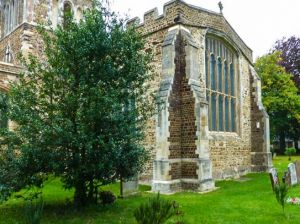
The 13th-century edifice of All Saints Church is the second church to stand on this site. The most striking part of the church as you approach it is the spire, which juts upward to a height of 190 feet. On the southwest pier is carved a depiction of a woman waving a spoon at a man. These figures may represent an elderly couple, Simon and Nellie, supposed originators of the Simnel cake.
Leighton Buzzard, Bedfordshire, England
Heritage Rating:  ?
?
Nearest Self Catering Cottages

Remnants of an older Saxon church can still be seen in the structure of medieval All Saints, a spacious church set beside Turvey House.
Turvey, Bedfordshire, England
Heritage Rating: ?
Nearest Self Catering Cottages

An Edwardian Gothic chapel built in 1907 and designed by GF Bodley in red brick. Bodley himself died before the chapel was finished, so the work was finished by his assistant Cecil Hare.
Bedford, Bedfordshire, England, MK40 2TU
Heritage Rating:  ?
?
Nearest Self Catering Cottages

St John the Baptist church in Bedford is known for its association with John Bunyan. It was in this church in 1653 that Bunyan converted to his own radical religious views. The 13th-century church was originally the chapel of the nearby Hospital of St John.
St. John's Street, Bedford, Bedfordshire, England, MK42 0DL
Heritage Rating: ?
Nearest Self Catering Cottages

An early Norman church with extensive rebuilding in the 14th century. St Mary's was for many years the parish church of Bedford, but it is no longer used for worship and is cared for by the Churches Conservation Trust.
St Mary's Street, Bedford, Bedfordshire, England, MK42 0AS
Heritage Rating: ?
Nearest Self Catering Cottages

St Paul's is a mix of old and new. The 'old' is 12th century, in the form of stonework brought here from Newnham Abbey. The founder of Newnham Abbey was Simon de Beauchamp (d. 1208) whose tomb is within the church. St Paul's is best described as a 'hall church' and the style is mostly Perpendicular Gothic, with considerable rebuilding in the Victorian period.
Saint Paul's Square, Bedford, Bedfordshire, England, MK40 1SQ
Heritage Rating: ?
Nearest Self Catering Cottages

Chalgrave church is notable primarily for its excellent medieval wall paintings. The oldest - at the west end of the aisles - date to the late 13th century, and are thought to represent the 12 apostles. Each apostle is portrayed life sized, under a covering canopy.
Chalgrave, Bedfordshire, England, LU5 6JN
Heritage Rating: ?
Heritage Highlight: Late 13th-century wall paintings
Nearest Self Catering Cottages
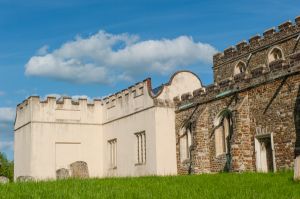
A superb family mausoleum attached to Flitton church, housing the memorials to generations of the De Grey family, holders of nearby Wrest Park. The mausoleum is possibly the largest and most magnificent sepulchral chapel attached to an English church.
Flitton, Bedfordshire, England
Heritage Rating: ?
Nearest Self Catering Cottages

St Peter's, Dunstable (more commonly known as Dunstable Priory) is one of the best examples of Norman church architecture in England. Henry I founded an Augustinian priory at Dunstable In 1131. In 1533 Henry VIII's marriage to Katherine of Aragon was officially annulled at the Priory. Shortly after, the priory was disbanded by Henry in his Dissolution of the Monasteries. However, St Peter's avoided destruction as parts of it were put to use as the local parish church.
Church Street, Dunstable, Bedfordshire, England, LU5 4HN
Heritage Rating: ?
Nearest Self Catering Cottages

St Mary's church was built about 1200 by the local lord, William de Cantelou (or Cantilupe). That Norman building has been altered considerably over the years, particularly in the late 15th century, when the manor of Eaton passed to Reginald de Bray, a follower of Henry VII. Bray is supposed to be the man who placed Richard III's crown on Henry's head after it was found on a bush at the Battle of Bosworth Field in 1485. Whether that piece of lore is historically accurate is open to debate, but what is certain is that Bray created a lovely Perpendicular church.
Eaton Bray, Bedfordshire, England, LU6 2DP
Heritage Rating: ?
Nearest Self Catering Cottages