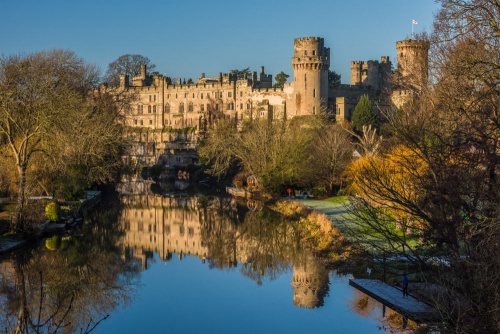
One of the most complete medieval fortresses in Britain, Warwick Castle is a place that everyone should visit at least once. Formerly the home of the powerful Earls of Warwick, the castle is now run by the company that also owns Madame Tussaud's Wax Museum in London.
The Castle
The castle as we know it was begun on the orders of William the Conqueror in the year 1086, but William's motte and bailey castle was not the first fortification on this spot. That honour goes to a rampart of earth constructed on the orders of Ethelfleda, daughter of Alfred the Great, in 914. William granted his castle to Henry de Newburgh, who was named the first Earl of Warwick.
That first Norman fortification was built atop the high motte or mound in the south-west corner of the castle grounds. In 1260 the wooden Norman fortress was rebuilt in stone. Just four years later, in 1264, Warwick was besieged by supporters of the rebel Simon de Montfort, who wreaked havoc on the defences and captured the current Earl, William Maudit, carrying he and his wife off to captivity at Kenilworth Castle.

In 1268 the fortunes of Warwick Castle took a turn for the better as the manor and the earldom were both granted to the powerful Beauchamp family. In 1312 Guy de Beauchamp abducted the unpopular Piers Gaveston, lover of Edward II, and tried him for treason at Warwick Castle.
The trial was only a formality and Gaveston was summarily executed. He was perhaps lucky that the Dungeon was not yet built; that followed in 1350, and visitors today can descend a narrow set of stairs to a sparse chamber set within the bowels of the castle, where prisoners were thrown. Set in the floor of an antechamber to the Dungeon is an oubliette, a hole where the most unlucky prisoners were cast.
In 1331 Thomas Beauchamp began a reconstruction of the ageing castle, and his work was carried on by his son, also named Thomas. Unfortunately, this second Thomas raised the ire of Richard II and was cast into the Tower of London for several years, and later exiled to the Isle of Man. Then in 1449 Warwick Castle passed to Richard Neville, known as 'The Kingmaker'.
Neville was the most powerful man of his age, but his endless machinations brought him only defeat on the battlefield at Barnet (1471), and Warwick Castle was granted to Richard, Duke of Gloucester, the future Richard III.
Whatever his subsequent reputation, Richard was a good administrator, and he saw the value in modernizing and strengthening the castle. Later improvements included remodelling the State Rooms and kitchens.

James I granted the castle (though not the earldom) to Sir Ffulke Greville (d. 1628). Greville poured enormous amounts of money into modernizing the castle and creating a comfortable residence from the crumbling ruins of the medieval fortress.
It is largely due to his efforts (and his considerable wealth) that the castle we see today has survived with so little deterioration of its medieval fabric. It was not until 1759 that the earldom and title to the castle were reunited, in the person of Francis Greville.
Kingmaker Exhibition
We've mention Richard Neville already. The most powerful nobleman in Britain during the latter half of the 15th century, Neville's influence alone was said to be able to put whomever he liked on the throne.
This exhibition, housed in the undercroft, describes Neville's life and subsequent death at the Battle of Barnet, and also shows what life was like during the late 15th century, with waxwork figures of nobles, tradesmen at work, women's role in castle life, as well as implements of daily life and work.

The Chapel and State Rooms
The State Room block of the castle is entered by way of the Chapel. This was built by Sir Ffulke Greville (see The Ghost Tower, below) just after 1600, possibility on the site of an early 12th-century chapel.
At the centre of the State Room block is the Great Hall. This huge chamber was built in the 14th century and served as the centre of social life in the castle. Here, people met to eat, drink, and socialize. The hall was rebuilt in the 17th century, and again in 1871.
There are three notable features of the hall; the first is located above your head. It is the beautifully crafted wooden roof, installed after a fire in Victorian times. In one corner of the Great Hall is a huge black cauldron known as 'Guy's Porridge Pot'.
The cauldron dates to around 1500 and was used as a stew pot for cooking - a testament to the size of the castle household! The feature of the Great Hall which will catch the eye of most visitors is the 'Kenilworth Buffet'. This magnificent oak sideboard was made for the Great Exhibition of 1851 by local craftsmen.
Visitors pass from the Great Hall through a succession of staterooms which date back to the 14th century, though most have been heavily remodelled over the subsequent centuries. Here you will find the State Dining Room, reception rooms, and bedchambers, furnished with superb period furniture. Of particular note are the gilded 17th and 18th-century ceilings.

A Royal Weekend Party
Adjacent to the State Rooms are the private family apartments. Here, waxwork figures recreate a house party given by Daisy, Countess of Warwick, in 1898. The principle guest for the party was Edward, Prince of Wales, who later became Edward VII.
Edward and other social elite of the day, including a young Winston Churchill and the Duke of York, are faithfully recreated, with period costumes. Photographs taken at that period have allowed designers of the exhibition to recreate exactly the furnishings and decor from the time of the original house party.
The Ghost Tower
In the northeast corner of the castle is a slender tower known as The Ghost Tower. This was originally constructed in the 14th century to prevent an attack from the river. The name was acquired because it is said to be haunted by the ghost of Sir Ffulke Greville (d. 1628), who lived there when in residence at Warwick.
Greville was murdered in London by his manservant, Ralph Haywood, who learned that his master was going to leave him a paltry 20 pounds in his will. As soon as the manservant realized what he had done, he turned his knife on himself. The tomb of the murdered lord can be seen in the chapter house of the church of St Mary's in Warwick, a short walk from the castle.
The Mound
Also known as Ethefleda's Mound, this is the oldest part of the castle. Though the fortifications erected by William the Conqueror have not survived, you can climb a winding path to the top of the mound, or motte, for superb views over the river and countryside, as well as the extensive grounds.

The Grounds
The Rose Garden
In a sheltered spot opposite the castle gatehouse is the Victorian rose garden. Here you walk beneath a long, trellised canopy, and wind among rose beds, past a rock garden where tumbling water falls down into a small pool. Just off the garden path are the icehouses; subterranean chambers where great blocks of ice were used to preserve food and drink in the days before refrigerators
The Mill and Engine House
At the base of the castle walls on the riverside is the old Engine House. This was the site of a water mill that ground grain for the castle as far back as the 15th century. In the late 19th century the Mill was converted into an Engine House, using the flowing water of the River Avon to generate electrical power for the castle.
The electrical equipment was installed in 1894, and the castle was wired for electrical power, though great care was taken to avoid damage to the fabric of the castle in the wiring process. The switch was thrown in December 1894, making Warwick Castle one of the first private homes in the country to be lit by electric lights (475 of them!).
The aged equipment has been so carefully restored that the Engine House once more provides enough electrical power to supply all the needs of the castle. Visitors can examine the waterwheel and turbines, and see the working electrical equipment in action.

Capability Brown landscape
Stretching out from the castle moat are grounds designed for the Earls of Warwick by Capability Brown, the foremost proponent of the English Landscape Garden style. Here, the emphasis is on a carefully controlled 'natural' look, with grassed lawns and winding paths beside the river.
On an island in the river is the largest working trebuchet in the world, which stands fully 18 metres, and tips the scales at 22 tonnes. This is not a museum piece, but an actual working model of a medieval siege machine.
Conservatory
The one formal note in the otherwise informal landscape of the castle grounds is the Conservatory. This lovely building was built in 1786 by a local mason named William Eborall. Stretching down from the Conservatory towards the river is an area of formal gardens called the Peacock Garden, after the four large topiary hedges shaped to look like peacocks that stand before a fountain pool.
In the centre of the Conservatory is a full-scale replica of the 'Warwick Vase', a Roman pottery vase unearthed near Tivoli in 1771. The original was presented to the Earl of Warwick, and the Conservatory was planned as a showcase for the ancient urn. The original Warwick Vase is now on display at the Burrell Collection in Glasgow.
Warwick Castle for Families
Well, if our children (ages 6 and 12) are anything to go by, your family will love visiting Warwick Castle. Children will enjoy climbing up to the battlements and exploring the nooks and crannies of the fortifications.
Older children will get a shivery thrill out of visiting the Dungeons and the Ghost Tower. There is lots of room for children to run around, and there is an ongoing program of medieval-themed events that will appeal to children of all ages.
About Warwick Castle
Address: Warwick,
Warwickshire,
England, CV34 4QU
Attraction Type: Castle
Location: off West Street, in the centre of Warwick
Website: Warwick Castle
Email: customer.information@warwick-castle.com
Location
map
OS: SP284 648
Photo Credit: David Ross and Britain Express
HERITAGE
 We've 'tagged' this attraction information to help you find related historic attractions and learn more about major time periods mentioned.
Historic Time Periods:
Find other attractions tagged with:
12th century (Time Period) - 14th century (Time Period) - 15th century (Time Period) - 17th century (Time Period) - 18th century (Time Period) - 19th century (Time Period) - Alfred the Great (Person) - Capability Brown (Person) - castle (Architecture) - chapter house (Architecture) - Edward II (Person) - Edward VII (Person) - Edwardian (Historical Reference) - James I (Person) - Medieval (Time Period) - moat (Historical Reference) - motte and bailey (Historical Reference) - Norman (Architecture) - Richard II (Person) - Richard III (Person) - Roman (Time Period) - Victorian (Time Period) - William the Conqueror (Person) - Winston Churchill (Person) -
NEARBY HISTORIC ATTRACTIONS
Heritage Rated from 1- 5 (low to exceptional) on historic interest
Warwick East Gate - 0.1 miles (Historic Building) 
Warwick, St Nicholas Church - 0.2 miles (Historic Church)
Collegiate Church of St Mary, Warwick - 0.2 miles (Historic Church) 
Lord Leycester's Hospital - 0.2 miles (Historic Building)
Warwick, East Gate and St James Chapel - 0.2 miles (Historic Building)
Stoneleigh Abbey - 4.6 miles (Historic House)
Kenilworth Castle - 4.7 miles (Castle) 
Hampton Lucy, St Peter ad Vincula Church - 5.1 miles (Historic Church)