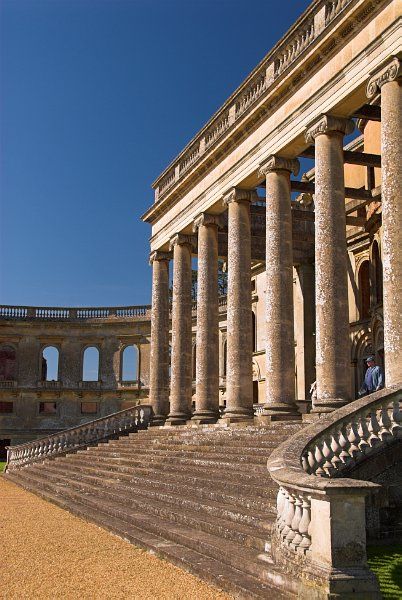
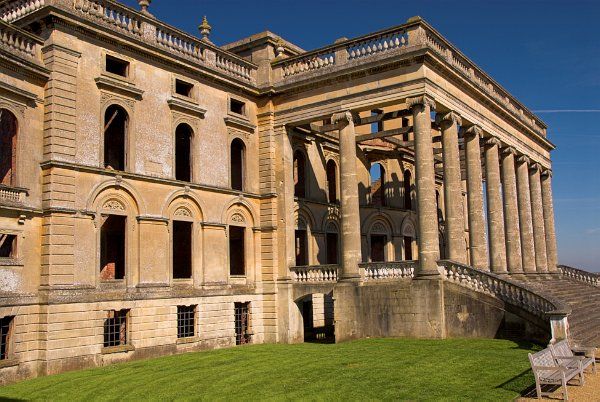
Until a disastrous fire gutted the house in 1936, Witley Court could claim to be one of the finest stately homes in the country. There was a manor at Witley as early as Saxon times, and after the Norman Conquest the land was granted to a relative of William the Conqueror, one Urso d'Abetot. The manor later passed through the hands of the Cooksey family and later the Russells of Strensham, before being purchased by Thomas Foley, son of an iron merchant from Stourbridge.
The house remained in the Foley's hands for 183 years, during which time the house and parkland were greatly extended, and the church built. In the early 19th century John Nash was brought in to add the imposing porticos.
Witley Church
St Michael and All Angels Church deserves special mention; the exterior is of modest brick, to a design by James Gibbs. The interior is notable for the monument to Lord and Lady Foley, the tallest funerary monument in the country.
The original interior was plain, but the 2nd Baron Foley acquired the windows, ceiling paintings, and organ from the estate of the Duke of Chandos, who had lost his fortune in the South Sea Bubble fiasco. The paintings, by Italian artist Antonio Bellucci, are simply superb. The organ was once used by Handel when he was music director for the Duke of Chandos.

The Foleys sold Witley Court in 1837 to Baron Ward (later Earl Dudley). For a time Ward was content to loan the house to Queen Adelaide, widow of King William IV, but in 1846 he embarked on an ambitious rebuilding program that transformed Witley Court into an opulent neo-Palladian mansion.
William Nesfield was brought in to create a remarkable park surrounding the house, littered with fountains, stonework, and gardens. The most impressive of the fountains is dedicated to Perseus and Andromeda and has recently been restored to full working order.
Finally, the house was bought by industrialist Sir Herbert Smith. It was still in Smith's possession when the deadly fire of 1937 turned the mansion into a ruin overnight.
Witley Court is under the care of English Heritage, who have recently opened The Jerwood Foundation Sculpture Park of modern British sculptures in the parkland. EH have also embarked on an ambitious program of restoration aimed at bringing the park, gardens, and sculpture back to their former glory. Personal audio tours are available.
Visiting Witley Court
I had read about Witley's history before visiting and had a vague notion that it would be a very grand house, but I was frankly unprepared for just how overwhelmingly opulent it was. It is hard not to let your jaw drop just a teensy bit while exploring the house and grounds. And when the Perseus and Andromeda fountain begins to spout forth, well, the effect is simply staggering. Witley deserves its reputation as one of the most imposing impressive of England's stately homes.
More Photos



About Witley Court
Address: Worcester Road, Great Witley, Worcestershire, England, WR6 6JT
Attraction Type: Historic House
Location: 10 miles north west of Worcester on A443
Website: Witley Court
English Heritage - see also: English Heritage memberships (official website)
Location map
OS: SO766652
Photo Credit: David Ross and Britain Express
HERITAGE
 We've 'tagged' this attraction information to help you find related historic attractions
and learn more about major time periods mentioned.
We've 'tagged' this attraction information to help you find related historic attractions
and learn more about major time periods mentioned.
Historic Time Periods:
Find other attractions tagged with:
19th century (Time Period) - John Nash (Person) - Norman (Architecture) - Palladian (Architecture) - Restoration (Historical Reference) - Saxon (Time Period) - William IV (Person) - William the Conqueror (Person)
NEARBY HISTORIC ATTRACTIONS
Heritage Rated from 1- 5 (low to exceptional) on historic interest
Great Witley, St Michael & All Angels Church - 0.3 miles (Historic Church) 
Wichenford Dovecote - 3.5 miles (Historic Building) 
Lower Sapey, St Bartholomew's Church - 5 miles (Historic Church)
Hawford Dovecote - 5.8 miles (Historic Building)
Bewdley Museum - 6.4 miles (Museum) 
Edward Elgar Birthplace Museum - 6.5 miles (Museum)
Leigh Court Barn - 7.4 miles (Historic Building)
Military Wireless Museum - 7.4 miles (Museum)
Nearest Holiday Cottages to Witley Court:


Great Witley, Worcestershire
Sleeps: 6
Stay from:£528 - £1,741