Winchester Castle
Winchester Castle holds a prominent position in English history. It was built in 1067, within a year of the Norman Conquest. At the time, it was one of the greatest strongholds in England, and for over a century it served as the seat of government before that position was taken by London.
The castle was extended and rebuilt under Henry III, who added the Great Hall, and Edward II. In 1302 Edward and his second wife, Margaret of France, narrowly escaped death when the royal apartments of the castle were destroyed by fire.
Little remains from that early period, however. The castle was held by royalist forces during the English Civil War, and when the fortress finally fell to Parliamentary troops in 1646, Oliver Cromwell ordered its destruction.

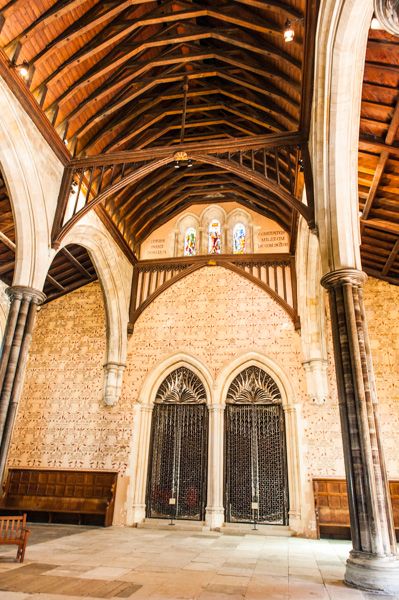
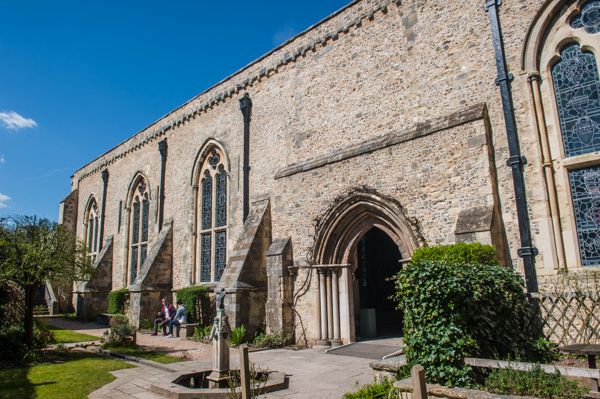
The site was later acquired by Charles II. It was Charles' intention to built upon this site a grand royal palace, called King's House, elaborate enough to rival the Palace of Versailles in France. Sir Christopher Wren was commissioned to begin building King's House, but plans were abandoned by James II. Today, only the Great Hall of Henry III (1222-35) survives, offering a glimpse of what the original castle must have looked like.
The Great Hall is an interesting building, built to a "double cube" design (that is, the height and width are exactly half that of the width. The interior measures 110' x 55' x 55'). Upon one end wall is hung a huge Round Table, reputed to be that of King Arthur, though recent investigation assigned a 13th-century date to the workmanship of the table. The table was repainted during the reign of Henry VIII.

Behind the hall is situated Queen Eleanor's Garden, a delightful recreation of a small medieval garden.
Attached to the Hall is an enjoyable small museum depicting the history of Winchester through historic documents and photographs.
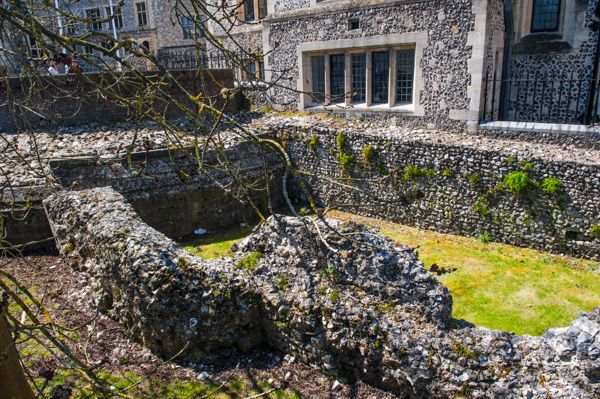
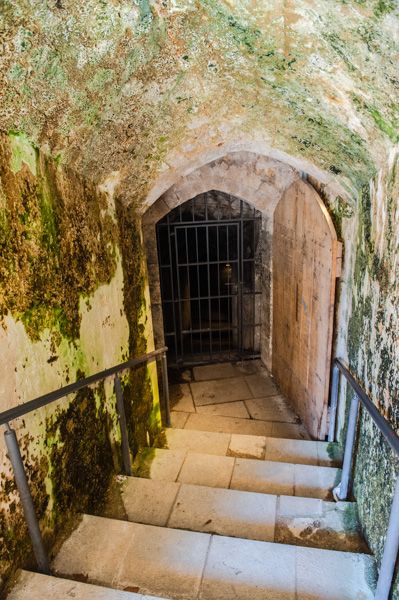
Across an open courtyard from the Great Hall are the scanty remains of the Castle foundations. Little can be seen above ground, though you can descend a steep, dimly lit stairwell that dives down into the castle cellar. A few feet from the exposed foundation in the photo above is Westgate, now a museum depicting medieval Winchester and daily life in the medieval period.
More Photos

About Winchester Castle
Address: The Great Hall, The Castle, Winchester, Hampshire, England, SO23 8PJ
Attraction Type: Castle
Location: In the centre of Winchester, just west of the market. Well signposted from the city centre.
Website: Winchester Castle
Email: the.great.hall@hants.gov.uk
Location map
OS: SU477294
Photo Credit: David Ross and Britain Express
HERITAGE
 We've 'tagged' this attraction information to help you find related historic attractions
and learn more about major time periods mentioned.
We've 'tagged' this attraction information to help you find related historic attractions
and learn more about major time periods mentioned.
Historic Time Periods:
Find other attractions tagged with:
13th century (Time Period) - castle (Architecture) - Charles II (Person) - Christopher Wren (Person) - Civil War (Architecture) - Cromwell (Person) - Edward II (Person) - Henry III (Person) - Henry VIII (Person) - James II (Person) - Medieval (Time Period) - Norman (Architecture) - Oliver Cromwell (Person) - Parliamentary (Historical Reference) - Royalist (Person) - William the Conqueror (Person)
NEARBY HISTORIC ATTRACTIONS
Heritage Rated from 1- 5 (low to exceptional) on historic interest
Queen Eleanor's Garden - 0 miles (Garden) 
Royal Green Jackets (Rifles) Museum - 0 miles (Museum) 
The Gurkha Museum - 0 miles (Museum)
Kings Royal Hussars Museum - 0 miles (Museum)
Royal Hampshire Regiment Museum - 0.1 miles (Museum)
Westgate Museum - 0.1 miles (Museum)
Winchester City Mill - 0.2 miles (Museum)
Winchester City Museum - 0.2 miles (Museum)
Nearest Holiday Cottages to Winchester Castle:


Meonstoke, Hampshire
Sleeps: 15
Stay from:£2,086 - £8,490