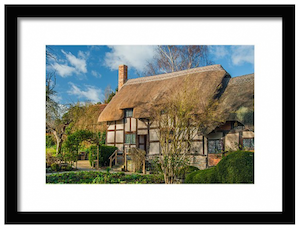
Tucked neatly in a narrow space behind the Great Hall of Winchester Castle is a quiet gem, Queen Eleanor's Gardens. This peaceful oasis is an accurate recreation of an early medieval garden, complete with many features that would have been present during the 13th century, and all the plants are known to have been grown in that period.

Queen Eleanor's Garden
The inspiration for the garden comes from surviving records of royal gardens. Within the walled enclosure is a grassy bower, a tunnel arbour, fountain and pool, and a herber, or secluded sitting area.
The "Eleanor" in the name of this garden refers to not one Eleanor, but two; Queen Eleanor of Castile, wife of Edward I, and Queen Eleanor of Provence, wife of Henry III. Both women spent considerable time living at Winchester Castle, which at the time was a principal royal seat.
One interesting aspect of the garden that may not be readily apparent to modern visitors is its symbolic nature. During the medieval period, certain plants were philosophically associated with particular religious or personal virtues.
Among the plants present in this garden are holly, ivy, and bay, which represented the medieval ideal of faithfulness. The roses, columbine, and strawberry plants all represented various aspects of Christian spiritual philosophy.

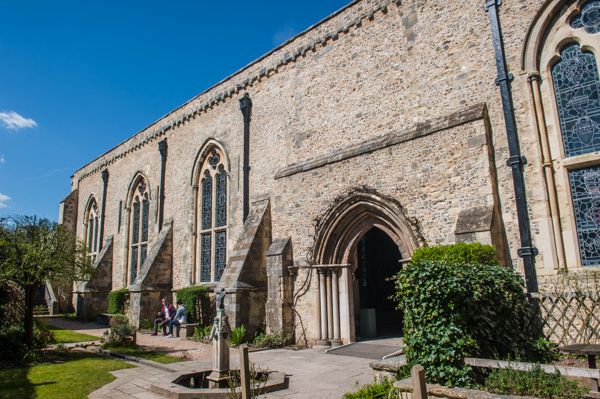
Forming one side of the garden is the last remaining wall of King's House, built by Sir Christopher Wren for Charles II in 1683, the house was used as a military barracks throughout the Victorian period until it was destroyed by fire in 1894.
Though small, the garden has a delightful ambience, with a quite remarkable variety of features packed into a small space.
A modern observer will quickly notice that medieval people had a quite different idea of what a garden should look like. There are no massed flower beds, indeed, there is very little in the way of colour, at least by modern standards.
Rather, there are small, informal garden areas, intertwined with pathways, and sprinkled with herbs and aromatic plants. For more on medieval gardens, click here.
More Photos
About Queen Eleanor's Garden
Address: The Great Hall, Castle Avenue, Winchester,
Hampshire,
England, SO23 8UJ
Attraction Type: Garden
Location: city centre, SE Westgate archway
Website: Queen Eleanor's Garden
Email: the.great.hall@hants.gov.uk
Location
map
OS: SU477294
Photo Credit: David Ross and Britain Express
HERITAGE
 We've 'tagged' this attraction information to help you find related historic attractions and learn more about major time periods mentioned.
Historic Time Periods:
Find other attractions tagged with:
13th century (Time Period) - castle (Architecture) - Charles II (Person) - Christopher Wren (Person) - Edward I (Person) - Henry III (Person) - Medieval (Time Period) - Victorian (Time Period) -
NEARBY HISTORIC ATTRACTIONS
Heritage Rated from 1- 5 (low to exceptional) on historic interest
Winchester Castle - 0 miles (Castle) 
Royal Green Jackets (Rifles) Museum - 0 miles (Museum) 
The Gurkha Museum - 0 miles (Museum)
Kings Royal Hussars Museum - 0 miles (Museum)
Royal Hampshire Regiment Museum - 0.1 miles (Museum)
Westgate Museum - 0.1 miles (Museum) 
Winchester City Mill - 0.2 miles (Museum)
Winchester City Museum - 0.2 miles (Museum)