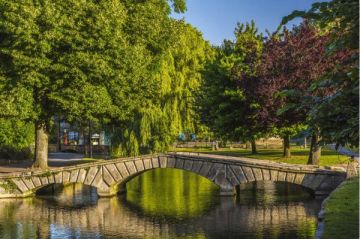
Historic Churches in Kent
- Map of Historic Churches in Kent
- Map of ALL Historic Churches in England
- Map of all attractions in Kent
By far the most popular historic church in the county is Canterbury Cathedral, a destination for pilgrims since the 12th century, but there are a wonderful variety of other fascinating churches to see. Look for the Heritage Rating to get an idea of how we ranked each church for its historic interest.
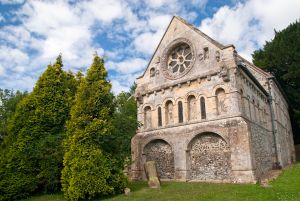
The small church of St Nicholas in Barfreston (or Barfrestone) is one of the hidden gems of Norman architecture in Kent, possibly in all of England. In the medieval period, the village of Barfreston was a stopover place for pilgrims on their way to the shrine of St Thomas a Becket at Canterbury. That may account for the likeness of Becket carved on the south door, the first known representation of Becket in the country.
Barfreston, Kent, England
Heritage Rating:  ?
?
Heritage Highlight: Superbly carved Norman south door, one of the finest in the country.
Nearest Self Catering Cottages
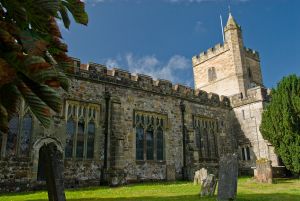
There was a church at Benenden at the time of the Domesday Book survey in 1086, making Benenden one of only four parishes in the Weald rich enough to have a church. That early building was enlarged in the 13th century when the current south porch was created.
Benenden, Kent, England
Heritage Rating: ?
Heritage Highlight: Kitty Fisher, of nursery rhyme fame, is buried in the Norris family vault
Nearest Self Catering Cottages
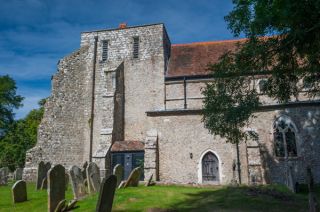
This striking country church has a wealth of historic features, including a 14th-century heart shrine and memorials to the Scotts, descendants of the Balliols of Scotland. In the chancel is perhaps the oldest stained glass anywhere in England still in its original setting.
The Street, Brabourne, Kent, England, TN25 5LR
Heritage Rating:  ?
?
Heritage Highlight: Unusual Balliol heart shrine and Norman stained glass window
Nearest Self Catering Cottages
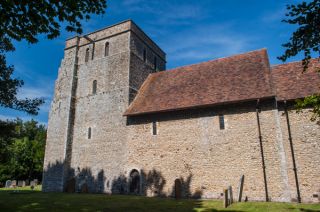
St Mary's Church in Brook is a tiny country church boasting a superb set of 13th-century wall paintings. St Mary's is one of the most complete Norman churches in Kent. There is a hagioscope, or squint in the chancel wall, which once connected to a medieval anchorite's cell, now vanished.
The Street, Brook, Kent, England, TN25 5PF
Heritage Rating:  ?
?
Heritage Highlight: 13th-century monochrome wall paintings
Nearest Self Catering Cottages
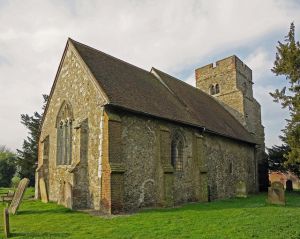
St Mary's, Burham is a historic church beside the River Medway, on the ancient pilgrim's route to Canterbury. The church is built of local ragstone and flint and consists of a nave, chancel, a west tower. An octagonal stair turret climbs the south-west angle of the tower. There used to be north and south aisles, but these were pulled down at some point in the past.
Church Road, Burham, Kent, England, ME1 3XY
Heritage Rating: ?
Nearest Self Catering Cottages
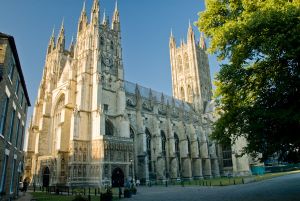
Even if Thomas Becket had chosen somewhere else to earn his martyr's crown, Canterbury would still deserve attention for its role in the spread of Christianity throughout England. It was here that St. Augustine began the conversion of the pagan islanders in 597.
Canterbury, Kent, England, CT1 2EH
Heritage Rating: ?
Heritage Highlight: The shrine of Thomas Becket was the most important pilgrimage destination in Britain in the medieval period
Nearest Self Catering Cottages
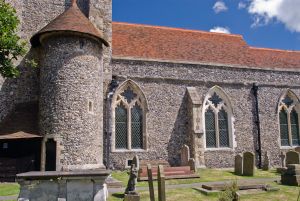
A small church with historical associations to kings, martyrs, archbishops, and chancellors, St Dunstan's Church stands at the western end of St Dunstan's Street, a few minutes stroll from the historic West Gate to Canterbury.
80 London Road, Canterbury, Kent, England, CT2 8LS
Heritage Rating: ?
Nearest Self Catering Cottages
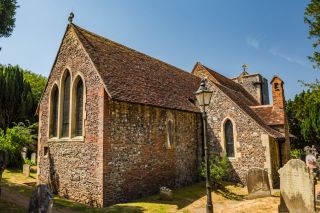
St Martin's can claim to be the oldest church in England; certainly, it is the oldest still in regular use. St Augustine set up a church here when he arrived in Kent in AD 597 to convert the inhabitants to Christianity.
North Holmes Road, Canterbury, Kent, England, CT1 1QJ
Heritage Rating: ?
Heritage Highlight: Roman chancel may be the oldest church in Britain.
Nearest Self Catering Cottages
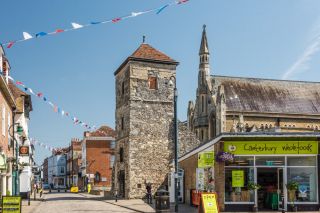
The tower is all that remains of the medieval church of St Mary Magdalene, which stands near the eastern end of Burgate, in the heart of historic Canterbury, a short stroll from the cathedral. The church was pulled down in 1871 after it had become ruinous. The tower is a 1503 rebuilding of an earlier medieval structure.
Burgate, Canterbury, Kent, England
Heritage Rating: ?
Nearest Self Catering Cottages
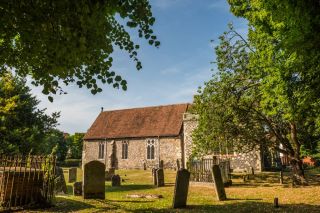
This ancient church is the oldest pre-Conquest church still standing within the city walls of Canterbury. It is a few short steps away from the remains of Canterbury Castle in the southwestern corner of the city.
Church Lane, Canterbury, Kent, England, CT1 2PP
Heritage Rating: ?
Heritage Highlight: 15th-century font, still with its original cover
Nearest Self Catering Cottages