Skye - Overview
'Speed bonnie boat, like a bird on the wing,
onward the sailors cry
carry the man who's born to be king
over the seas to Skye

The familiar words of this romantic ballad invite the modern traveller to emulate Bonnie Prince Charlie and come to the Isle of Skye - for an escape of a different kind. While Charles Edward Stuart (aka Bonnie Prince Charlie), was a man on the run, fleeing from the British forces that pursued him after his defeat at Cullloden in 1746, the modern visitor to Skye can escape to an island of dramatic mountins, unspoilt countryside, and breathtaking Highland scenery.
Prince Charlie and his rescuer, Flora MacDonald, landed near Kilmuir, on the Trotternish peninsula. Today, visitors can see the monument to MacDonald in Kilmuir cemetery, and stay at the hotel in Flodigarry that was her former home.
In Portree, the Royal Hotel stands on the site of the hostelry where Charles Stuart bid Flora MacDonald farewell. Near the lovely fishing village of Elgol, a short walk across the headland brings you to Prince Charlie's Cave, where the prince hid from the English before his eventual final escape to France.
Elgol is worth visiting in its own right. This quiet port is famous for its lovely sunsets (as, indeed, is the whole of the west coast of Skye), and for the views from the harbour across to the dramatic peaks of the Black Cuillins.

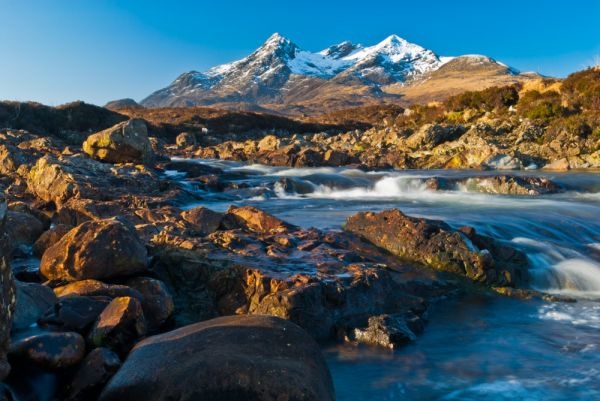
The Cuillins are arguably Scotland's most scenic mountains and are something of a Mecca for climbers. Even if you do not fancy the challenge of a scramble to the top of Sgur nan Gillean, you will enjoy the short boat trip from Elgol to Loch Coruisk, a sea loch that reaches into the very heart of the Cuillins, where dramatic volcanic peaks reach up to the sky above the blue waters.
There are really two Cuillin ranges; the Black Cuillins, formed of jagged dark igneous rock, and the softer, rounder peaks of the Red Cuillins, formed of red granite. The best places to access the Black Cuillins are from Elgol, Glen Brittle, to the west, and Sligachan, to the north.
The Red Cuillins are best approached through Sligachan, or from Broadford to the northeast. Either set of hills offers superb walking and climbing, but do equip yourself for the changeable weather, and use good Ordnance Survey maps.
If you don't fancy tackling the high peaks of the Cuillins, the Trotternish Peninsula in northern Skye offers some excellent opportunities for shorter rambles. The backbone of Trotternish is a high volcanic ridge, scoured by glacial action to create a wonderfully exotic landscape of pinnacles and mountain lochs.
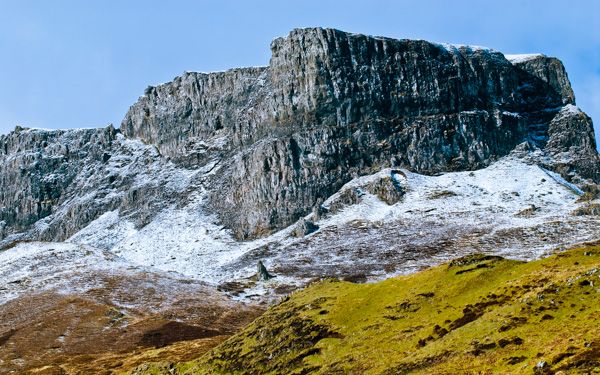
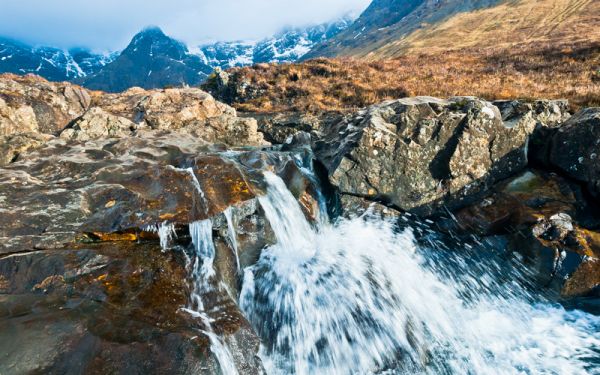
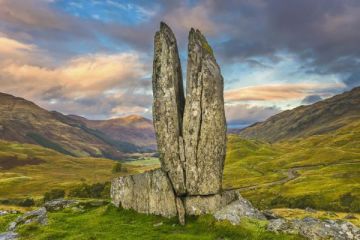
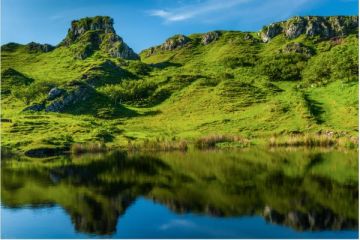
The most prominent geological features are the rock needle of The Old Man of Storr in the south, and The Quiraing, near Staffin, in the north. For an even easier outdoor experience, visit The Fairy Glen, near Uig, a magical pocket of peaks, valleys, and burns that has been described as a 'highlands in miniature'.

Many visitors come to Skye for recreation, but there is much more to do; Skye has been called the Jurassic Island, for the superb fossil hunting it offers. The beaches near Borreraig and Staffin, especially, offer wonderful opportunities for amateur palaeontologists to search for fossil remains. Many local finds are on display in the Staffin Museum.
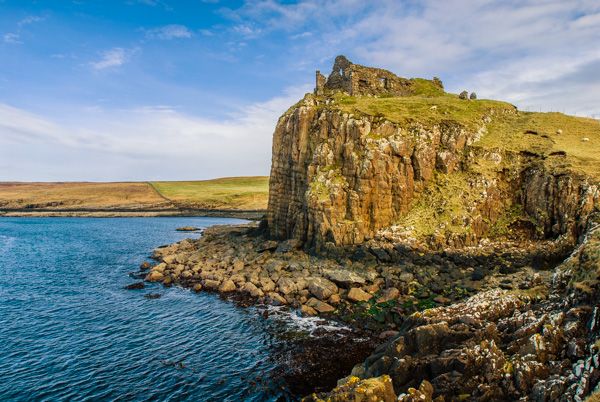
There are Iron Age brochs at Dun Beag, near Struan, and at several locations on the Waternish peninsula. Skye is home to a number of medieval castles, from Duntulm in the north, to Knock Castle and Dunscaith in the south.
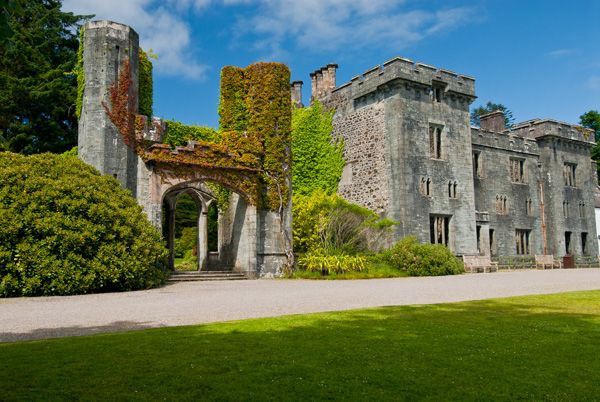
One castle that is definitely not a ruin is Dunvegan Castle, built on a rocky promontory above Loch Dunvegan. The castle has roots going back to the 9th century, making it probably the oldest continuously inhabited castle in Scotland. Dunvegan is the seat of Clan MacLeod, and visitors can see the famous MacLeod Fairy Flag, said to be gifted to a clan chieftain by his fairy wife.
Take a short boat ride from the castle into Loch Dunvegan, to see the common seals who make the waters their home. For a wildlife treat of another kind, visit the otter sanctuary at Kylerhea, where you can watch from hides to spot sea otters in the waters of Kyle Rhea. Just north, at Kyleakin, is another place for otter lovers; the Bright Water Visitor Centre, inspired by the writings of resident Gavin Maxwell, author of the Ring of Bright Water book series.

The Geology of Skye
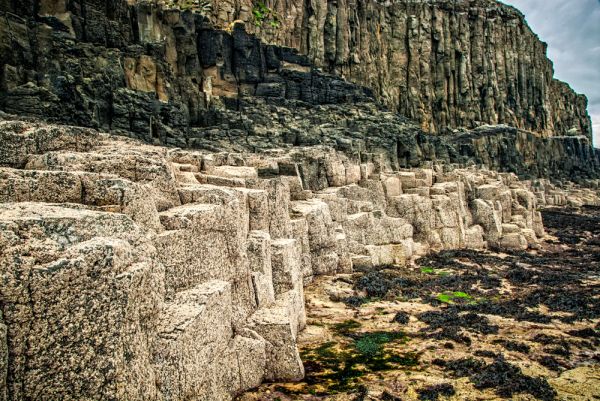
The northern Isle of Skye is primarily composed of Tertiary volcanic rock, with a thick layer of basalt lava forming the peninsulas of Trotternish, Waternish, and Duirinish. This lava plateau reaches over 2000 feet in places and falls away in steep cliffs to the sea below.
The most striking geological feature of the island is the igneous landscape of mountains and lochs formed by the Cuillin Hills to the south. The Cuillins are the remainders of Tertiary volcanoes, eroded over time to form irregular peaks, crags, and gullies that offer some of the most breathtaking scenic views in Scotland.
The island is 50 miles long and it is theoretically 25 miles wide at its broadest point, though that measurement is tempered with the realisation that you are never more than five miles from the sea, no matter where you are on Skye!
The Romans called Skye ‘The Winged Isle’, a reference to the peninsulas that reach like crooked fingers into the waters of the sea. A more common moniker is the ‘Misty Isle’, a name seemingly custom made to attract tourists, as if the romance of the landscape and its history were not enough.
More Photos