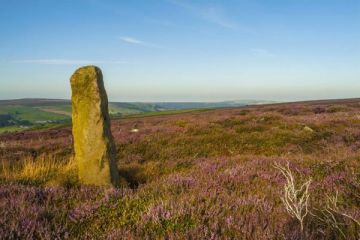
This pretty Hope Valley village, just off the A623, is one of the Peak District's most popular visitor attractions. Though the village itself is quite lovely, it is Eyam's tragic past that brings the visitors. For it was here in 1666 that one of the more memorable acts of heroism was performed in the face of personal tragedy and loss.
In 1666 the city of London was ravaged by plague. George Vicars, a tailor of Eyam, received a package of cloth from London. Little did he realise that the cloth bore a deadly burden - plague germs, that would bring death to the sleepy village. With a few days, Vicars was dead, and it was clear to the residents of Eyam that the plague was amongst them.
The rector of Eyam at that time was William Mompesson. Mompesson gathered together his parishioners and proposed a bold and selfless plan; that they would quarantine themselves, avoiding all contact with the outside world, and stay put in Eyam until the plague had run its course. They would bury their own dead, near their own houses, not bringing the corpses to hallowed church ground, where they might infect others who would gather there.

This way, Mompesson hoped, though Eyam might suffer, the plague would be contained to the village and would not spread further. The plan was agreed, and what is more remarkable, adhered to, in the tragic days and weeks that followed. Neighbouring villagers brought food and supplies to a sort of "no-mans-land" at the village boundaries, then retreated to let the inhabitants of Eyam collect the supplies.
Over the course of the next several weeks, an estimated 250 out of a total population of 350 people died in Eyam, and their graves can be seen around the village in little clusters of poignant headstones. Among those dead was Mompesson's own wife, who insisted on staying with him to administer to the people of Eyam throughout the tragedy.
Their efforts were not in vain; the plague was contained, and though the village of Eyam was decimated, the neighbouring villages were not, thanks to the heroism of the Eyam inhabitants.
A memorial to the vicar is in the parish church of St Lawrence. In the churchyard is a remarkable Celtic cross, believed to be of 8th-century origin. The carvings on the cross are in quite wonderful condition, though if you look closely you can see that the shaft of the cross was once taller, and the cross has had to be re-attached to a shortened shaft at some point in the past.
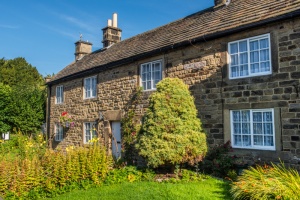
There are several reminders of Eyam's past throughout the village. Beside the church are the Plague Cottages, so named because it was there that some of the first plague victims lived and died.
An exhibit detailing Eyam's past, and the natural history of the area, can be seen in the restored medieval market hall, where the village stocks still stand upon the pleasant green. If you follow Dunlow Lane just west of the green you will find a footpath leading across fields to Cucklet Church, a natural rock arch where Rev. Mompesson would hold open-air services.
The rock arch acted as a natural amplifier, so he could preach to his flock arrayed on the hillside opposite. The open-air 'church' was thought to be a safer place to hold services than inside the parish church.

Across the way from the market hall is , a lovely Elizabethan manor. Eyam Hall has been the home of the Wright family since 1671. There are some excellent Jacobean furnishings within the house, and a popular craft centre in the farmyard.
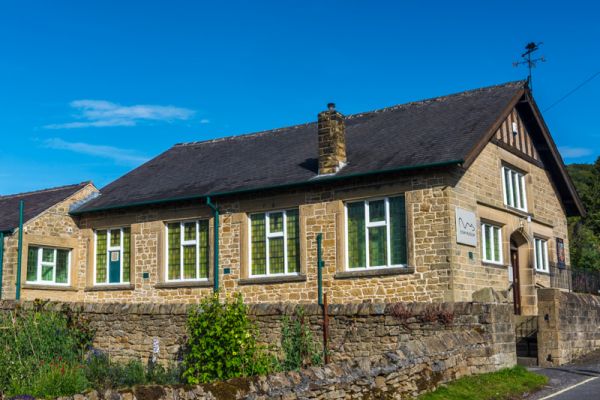
A few hundred yards from Eyam Hall is Eyam Museum, which tells the story of the village and the plague. The museum sign incorporates the shape of a rat, a reminder of how the plague spread to humans.
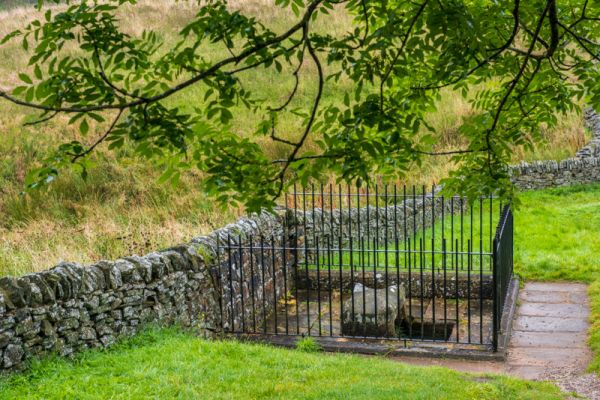
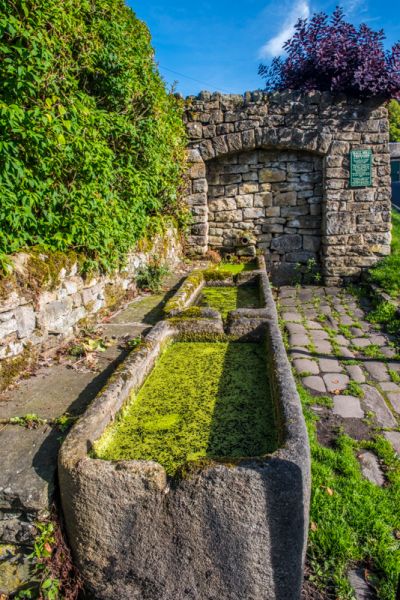
If you continue on up Hawk Hill Road past the museum to Edge Road, you will come to Mompesson Well, used by neighbouring villagers as a drop-off point for food and medical supplies. Eyam villagers would leave money in the well, believing that the water would purify the coins and prevent the spread of disease.
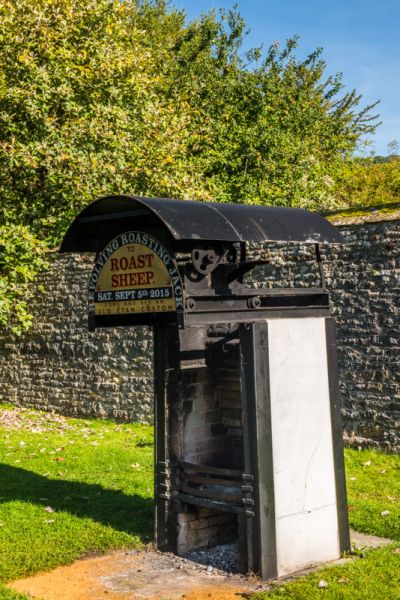
Eyam observes several interesting traditions, including well-dressing, which usually takes place in the last week in August, and Sheep Roasting, on the first Saturday in September. The sheep roasting spit can be seen just a few yards along the High Street from the plague cottages.
And, lest you provide unintentional amusement to the locals, let me warn you that the name of the village is pronounced 'E'em', not, 'Eye-am', as visitors might expect. We discovered the hard way!
More Photos


About Eyam
Address: Eyam,
Peak District,
Derbyshire,
England
Attraction Type: Town
Location map
OS: SK219 763
Photo Credit: David Ross and Britain Express
HERITAGE
 We've 'tagged' this attraction information to help you find related historic attractions and learn more about major time periods mentioned.
Find other attractions tagged with:
17th century (Time Period) -
NEARBY HISTORIC ATTRACTIONS
Heritage Rated from 1- 5 (low to exceptional) on historic interest
Eyam, St Lawrence Church - 0.1 miles (Historic Church) 
Eyam Hall - 1 miles (Historic Building) 
Eyam Museum - 1 miles (Museum)
Padley Chapel and Manor Gatehouse - 2.4 miles (Historic Building)
Thornbridge Hall Gardens - 3.6 miles (Garden)
Tideswell, St John the Baptist Church - 4.1 miles (Historic Church)
Edensor, St Peter's Church - 4.5 miles (Historic Church)
Peveril Castle - 4.5 miles (Castle)
Nearest Holiday Cottages to Eyam:
Stoney Middleton, Derbyshire
Sleeps: 8
Stay from: £1000.00 - 5748.00

Stoney Middleton, Derbyshire
Sleeps: 4
Stay from: £358.00 - 1704.00