Castles in Gwent
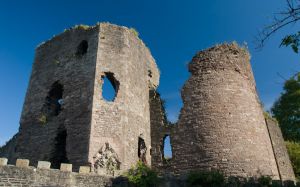
Abergavenny Castle is one of the earliest Norman castles in Wales, dating to 1081. Four substantial towers remain, with a 14th-century gatehouse and barbican. The motte is surmounted by a Victorian mock keep, built on the remains of the original 12th century version. During the late 12th century, the castle was owned by William de Braose, one of the most notoriously cruel of the Norman Marcher Lords.
Castle Street, Abergavenny, Gwent, Wales, NP7 5EE
Heritage Rating:  ?
?
Nearest Self Catering Cottages

The Romans settled at Caerwent almost 2000 years ago, but the remains we see today are primarily those of a Norman motte and bailey castle of 1085 vintage. The motte was originally surmounted by a wooden tower, with a twin-towered gatehouse at the base of the motte and a bailey with at least two more towers.
Castle Lane, Caerleon, Newport, Gwent, Wales
Heritage Rating: ?
Nearest Self Catering Cottages

Originally thought to be a Norman motte built on site of a Roman fort, it seems more likely that Caerwent Castle is an early Roman site with little medieval connection. The site is a rectilinear arrangement of courts and ranges measuring about 74 metres long by 38 metres wide.
Caerwent, Gwent, Wales
Heritage Rating:  ?
?
Nearest Self Catering Cottages
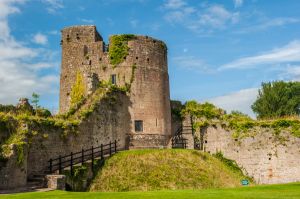
More than one castle calls Caldicot home. The earliest, now lost, was erected in Saxon times. On the site of that earlier fortress the Normans erected a motte and bailey castle in 1086. Henry de Bohun, Earl of Hereford, built a stone keep atop the motte in 1221, and added a curtain wall and two corner towers. Later, a two-story gatehouse with portcullis entry was erected. The Bohun family held the castle until 1373.
Church Road, Caldicot, Newport, Gwent, Wales, NP6 4HU
Heritage Rating:  ?
?
Nearest Self Catering Cottages
Castell Machen (also called Castell Meredydd) is the only native Welsh castle in Gwent. Only fragments of a keep and curtain footings remain of this late 12th or early 13th-century fortress on a clifftop site near Machen.
Machen, Gwent, Wales
Heritage Rating: ?
Nearest Self Catering Cottages
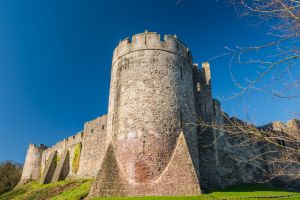
Chepstow is one of the earliest stone castles in Britain, and its design heavily influenced later castles. The fortress served as the administrative heart of the Marcher lordship of Chepstow, one of the most important of the English-dominated territories along the Welsh border.
Chepstow, Gwent, Wales, NP16 5EY
Heritage Rating: ?
Heritage Highlight: A superb example of an early medieval castle and town walls
Nearest Self Catering Cottages
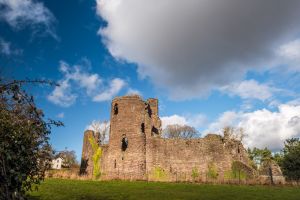
Grosmont is one of three castles built to guard to main route between Hereford and south Wales - the others being Skenfrith and White Castle. The castle is protected by a wide moat, 20 metres across, and a system of ditches and banks.
Grosmont, Gwent, Wales, NP7 8EP
Heritage Rating: ?
Nearest Self Catering Cottages

Monmouth Castle was built between 1067-71 by William fitz Osbern, but its most famous moment in history came in 1387 (the exact date is uncertain), when the future Henry V was born here. A 12th-century tower and 13th-century great hall are the best surviving features, in addition to short sections of the castle walls.
Monmouth, Gwent, Wales, NP25 3BS
Heritage Rating: ?
Nearest Self Catering Cottages
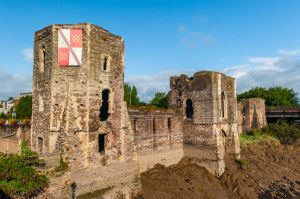
The 14th-century east front and towers are all that survives of this castle on the banks of the River Usk, mainly used for administrative purposes. The 14th-century castle replaced an earlier castle built by Gilbert de Clare just over half a mile to the south-west, near the current cathedral. That earlier fortification was swept away to make way for Isambard Kingdom Brunel's Great Western Railway in the 1840s.
Newport, Gwent, Wales
Heritage Rating: ?
Nearest Self Catering Cottages
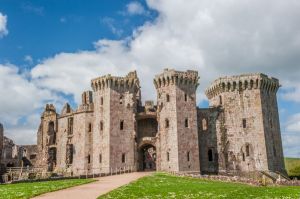
The traditional home of the Somerset family, Earls of Worcester, Raglan Castle was one of the very last castles built in Britain, begun in 1435 by William ap Thomas. It is part castle, part palace, with far more attention to comfort than earlier castles. However, it was certainly built for defence as well, for it took one of the longest sieges of the Civil War to subdue it.
Raglan, Gwent, Wales, NP15 2BT
Heritage Rating: ?
Nearest Self Catering Cottages