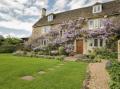
It is hard, if not impossible, to select any one place as the birthplace of photography, but Lacock Abbey, nestled in water meadows beside the meandering River Avon, comes as close as any. It was here in the early 1830s that William Henry Fox-Talbot performed his experiments into the properties of light, and it was here that Fox-Talbot took his first 'photograph', a rather unremarkable composition of an oriel window. The window can be seen, looking much the same as it did when posing for its history-making photo.
History
Lacock began life as an Augustinian nunnery, and many of the underpinnings of the house show its monastic origins. The nunnery was founded in 1232 by Ela, Countess of Salisbury, in memory of her husband William Longespee, the illegitimate son of Henry II and half-brother of Richard the Lionheart.
When William Longespee went on Crusade to the Holy Land, Countess Ela acted as Sheriff of Wiltshire in his place. Together the couple helped found Salisbury Cathedral.
The new nunnery at Lacock was dedicated to the Virgin Mary and St Bernard.

On the same day that she founded Lacock Abbey, Countess Ela also founded a Carthusian monastery at Hinton Charterhouse, 15 miles away.
When the abbey was established she became its first abbess, a post she held for 17 years. She owned a copy of the Magna Carta, created in 1225. The document was kept at Lacock Abbey until 1946 when it was transferred to the British Museum in London.
It is thought to be the very last religious house disbanded during Henry VIII's Dissolution of the Monasteries, closing its doors in 1539.
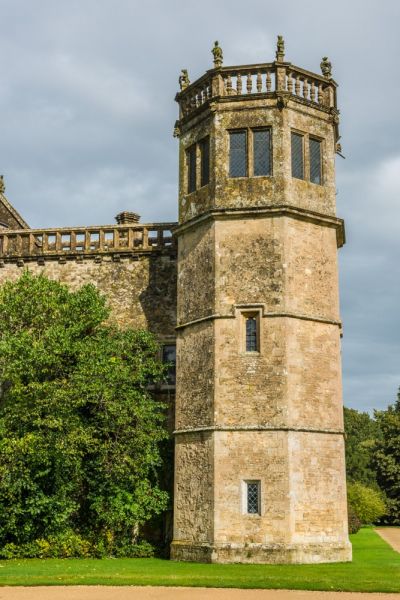
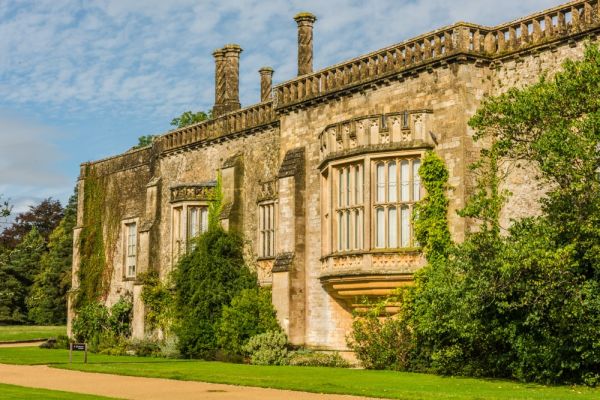
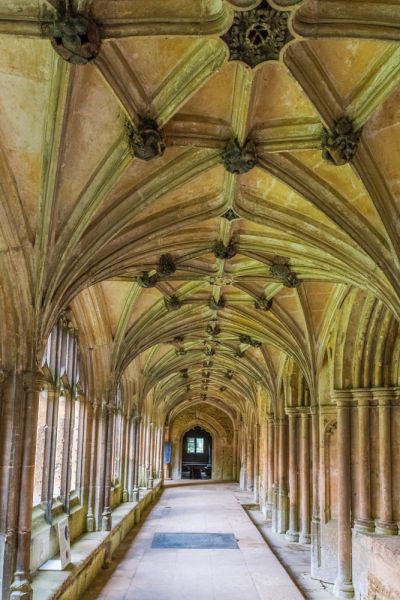
Sir William Sharington bought the abbey in 1540. He tore down the abbey church and chapel and many of the other monastic buildings and used the stone to build a comfortable Tudor mansion on the same site, with a striking octagonal tower in one corner. Thankfully, Sharington dod not destroy the medieval cloisters, which have survived in a remarkably intact state.
When he tore down the abbey church Sir William had the tomb of Countess Ela moved to the cloisters. The tomb is inscribed with these words,'Below lie the bones of the venerable Ela, Who gave this house as a home for nuns. She also lived here as holy Abbess and Countess of Salisbury, full of good works'.

Queen Elizabeth stayed at Lacock Abbey in 1574, and in thanks for the hospitality shown her by her host Henry Sharington (the brother and heir of Sir William Sharington), she knighted him.
When Sir Henry died the house passed to his daughter Olive and her husband John Talbot. In a curious twist, Talbot was a descendant of Countess Ela, who had founded the nunnery over 300 years earlier. This inheritance began a long association of Lacock Abbey and the Talbot family.
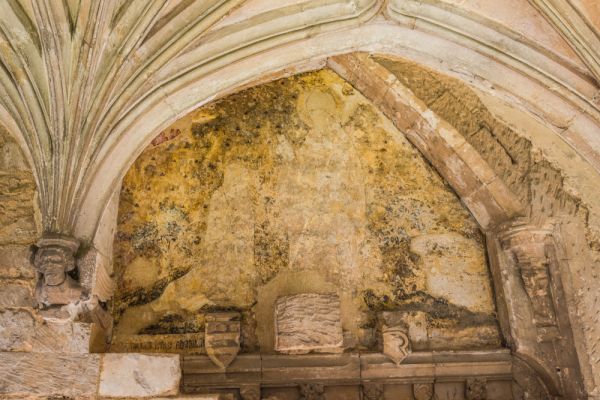
One of the Talbots of Lacock was John Ivory Talbot, who inherited the Abbey in 1714. He dramatically altered the Tudor mansion in the fashionable 'Gothick' style. He was responsible for the elegant dining room and grand hall, and added the Gothick Arch that acts as a visitor entrance to the house frontage.
The First Photograph
William Henry Fox Talbot inherited Lacock Abbey in 1800 when he was just five months old. His father had left the estate deeply in debt, so it was let to tenants until Fox Talbot was 27. William Henry Fox Talbot was a scientist and mathematician, but he is best remembered as a pioneer of photography. Many of his experiments took place at Lacock Abbey.
Perhaps the first true photographic negative was a photo he took in 1835 of an oriel window in the Abbey's South Gallery. You can see the exact view of the famous photo, and the original negative is on display in the Fox Talbot Museum at the Abbey entrance. Fox Talbot died in 1877 and is buried in the village cemetery on West Street.

What to See
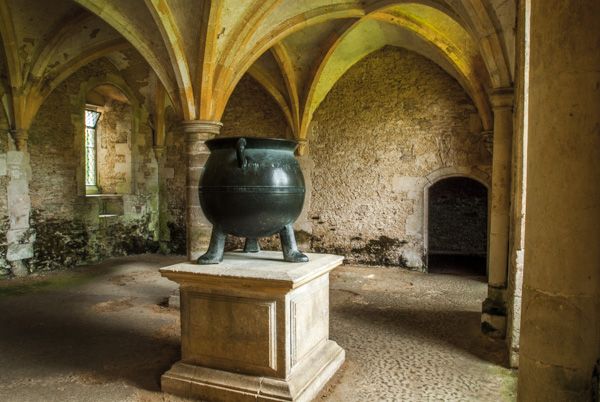
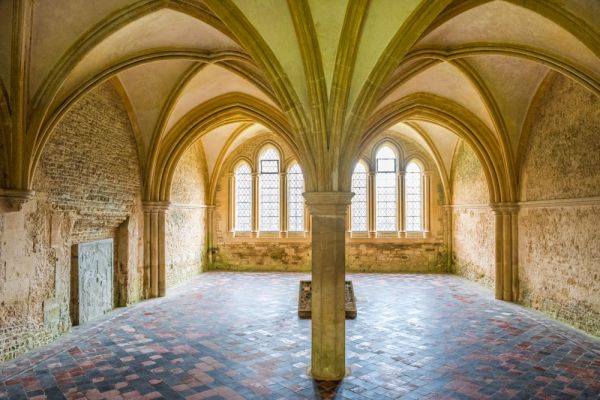
You can walk the (rather chilly) medieval cloister surrounding a green square, and delve into the old monastic chapter house and warming room. This part of the house offers a fascinating glimpse into the lives of the nuns who made Lacock their home for three centuries.

Rather more comfortable are the 'modern' Tudor rooms, begun by Sir William Sharington in 1539. Sharington was a bit of a scoundrel, and nearly lost his life when it came to light that he had been involved in debasing coins. When Sherington took over Lacock he pulled down the church and built his new house out of the nun's dormitory, refectory, and ranges.
The most remarkable of the interior furnishings is a massive stone table in the tower strong room. The table is supported by leering satyrs while scorpions, the Sharington family symbol, gambol about the base.
The grand hall is notable for the whimsical terracotta statues decorating niches around its perimeter. These were commissioned by John Ivory Talbot in 1754 as part of his attempt to transform the hall into a mock-Gothic fantasy. Judge for yourself the aesthetic success of his efforts.
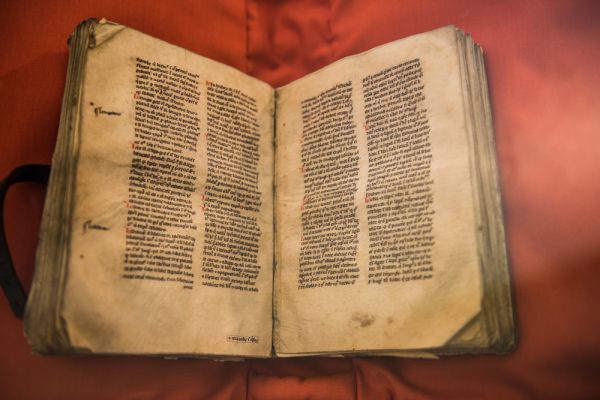
One historical treasure deserves special mention; the 'Brito' book, a dictionary of theological terms used by the nuns of Lacock Abbey. The book is named for Guillaume le Breton (William Brito) who compiled it in the middle of the 13th century. The Brito Book is the only monastic manuscript in an English abbey that is still in the building it was made for. This copy of the manuscript was hand-written on vellum (animal skin) by a group of scribes and bound between wooden boards linked by leather thongs.

The Gardens and Grounds
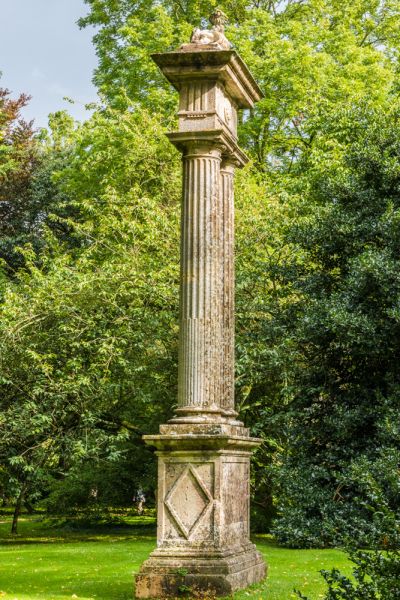
Do take the time to explore the grounds of Lacock Abbey. Near the house is a Gothick Arch designed by Sanderson Miller for John Ivory Talbot, and on the main path from the visitor centre to the house is a neo-classical double column topped by a figure of a Sphinx.
Close to the Abbey entrance is a walled Botanic Garden, planted with unusual species of plants. A short stroll from the Botanic Garden leads you to an orchard where old varieties of apples grow.
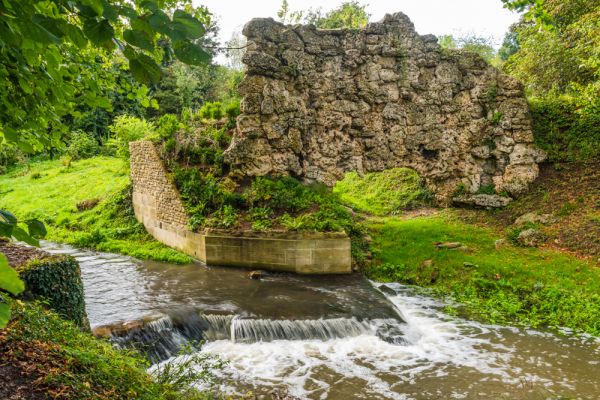
Past the orchard is the Rockworks, an 18th-century folly in the form of a ruined wall beside the Byde Brook, with a manmade cascade. The Rockworks was carefully placed to act as an eye-catcher, a focal point to draw the viewer's gaze.
In the abbey courtyard is a very well-preserved Tudor brewhouse.

Lacock is worth visiting as much for the village that surrounds it as for the house. The entire village has been purchased by the National Trust and preserved intact from the ravages of modern civilization. Here you will find no television aerials or other blatant signs of the modern world.
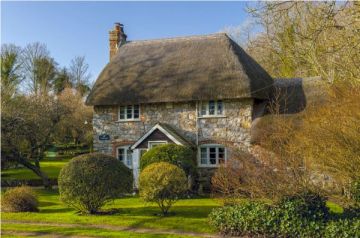
It is easy to imagine yourself transported back several centuries in time as you walk through this relaxed village. The cottages are built of wonderful honey-toned Cotswold stone, and the whole village exudes an aura of charm and relaxed timelessness. Movie-makers have recognized its charms, and Lacock was featured in film adaptation of Jane Austen's Pride and Prejudice and, more recently, several of the Harry Potter films.
Don't miss the excellent Fox Talbot Museum at the Abbey entrance, where you can discover more about William Henry Fox Talbot and the history of photography. A stone's throw away is a restored 14th-century tithe barn built to hold the rents of the Abbey tenants. Lacock boasts several good bed and breakfasts and pubs.
Lacock Abbey and village repays a visit many times over. Highly recommended.
More Photos

About Lacock Abbey
Address: Lacock, Chippenham, Wiltshire, England, SN15 2LG
Attraction Type: Historic House
Location: off A350
Website: Lacock Abbey
Email: lacockabbey@nationaltrust.org.uk
National Trust
Location map
OS: ST919 684
Photo Credit: David Ross and Britain Express
POPULAR POSTS
HERITAGE
 We've 'tagged' this attraction information to help you find related historic attractions
and learn more about major time periods mentioned.
We've 'tagged' this attraction information to help you find related historic attractions
and learn more about major time periods mentioned.
Historic Time Periods:
Find other attractions tagged with:
Augustinian (Historical Reference) - Augustinian (Historical Reference) - chapter house (Architecture) - Henry VIII (Person) - Tudor (Time Period)
NEARBY HISTORIC ATTRACTIONS
Heritage Rated from 1- 5 (low to exceptional) on historic interest
Fox Talbot Museum - 0.1 miles (Museum) 
Lacock Tithe Barn - 0.2 miles (Historic Building)
Lacock, St Cyriac's Church - 0.2 miles (Historic Church)
Corsham Almshouses - 3 miles (Historic Building)
Corsham, St Bartholomew's Church - 3.1 miles (Historic Church)
Bowood House and Gardens - 3.9 miles (Historic House) 
Sheldon Manor - 4.1 miles (Historic House)
Corsham Court - 4.7 miles (Historic House)
Nearest Holiday Cottages to Lacock Abbey: