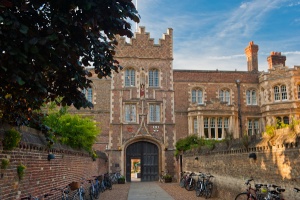
Jesus College is off the beaten tourist track, yet only 5 minutes walk from the city centre. It was founded in 1496 by John Alcock, Bishop of Ely. Unlike several other Cambridge colleges, Jesus College possesses spacious grounds and does not seem hemmed in by the city at its gates.
Alcock's memory is preserved in the rebus, or architectural pun, set above the entry. In Alcock's case, the rebus is fairly straightforward; several cockerels strut above the gateway.
The college was founded in 1496 upon the remains of a nunnery dedicated to St. Mary and St Radegund. Bishop Alcock had the nunnery closed and the nuns disbanded for bad behaviour. The nunnery design is clearly preserved in the cloisters to the right of First Court. The refectory became the college hall, and the house of the prioress became the Master's Lodge.
Alcock's original charter for the college called for it to be given the unwieldy name of "The College of the Blessed Virgin Mary, Saint John the Evangelist and the glorious Virgin Saint Radegund, near Cambridge". Not surprisingly the name was later shortened, and instead, the college was called after the priory chapel, which had been dedicated to Jesus.

One famous early Fellow of Jesus College was Thomas Cranmer, later Archbishop of Canterbury, who lost his fellowship when he married the niece of the landlady of a nearby tavern. When his wife died in childbirth a year later Cranmer was able to regain his place at Jesus. Samuel Taylor Coleridge was another member of the college, and a lock of the poet's hair is preserved in the Old Library.
The chapel is the highlight of a visit to Jesus College. It is joined by a Norman gallery from the nunnery building, and the chancel is mostly 13th century. It was sympathetically restored in the 19th century, much of the work attributable to Augustus Pugin (most widely known for his work on the Houses of Parliament).
The painted ceiling of the nave was designed by William Morris, and the windows in the nave and transepts were completed by Morris to a design by his friend and collaborator Edward Burne-Jones.
Famous Jesuans
Thomas Cranmer, Archbishop of Canterbury
John Flamsteed, astronomer
Laurence Sterne, author
Samuel Taylor Coleridge, poet
Alistair Cooke, broadcaster and writer
HRH the Prince Edward
About Jesus College
Address: Jesus Lane,
Cambridge,
Cambridgeshire,
England, CB5 8BL
Attraction Type: Historic Building
Website: Jesus College
Location
map
OS: TL453 589
Photo Credit: David Ross and Britain Express
NEARBY HISTORIC ATTRACTIONS
Heritage Rated from 1- 5 (low to exceptional) on historic interest
Cambridge, All Saints - 0.1 miles (Historic Church) 
Sidney Sussex College - 0.2 miles (Historic Building) 
Christ's College, University of Cambridge - 0.3 miles (Historic Building)
St Johns College - 0.3 miles (Historic Building)
Round Church, Cambridge - 0.3 miles (Historic Church)
Trinity College - 0.4 miles (Historic Building)
Gonville and Caius College - 0.4 miles (Historic Building)
Magdalene College - 0.4 miles (Historic Building)
Nearest Holiday Cottages to Jesus College:
Cambridge, Cambridgeshire
Sleeps: 10
Stay from: £1432.00 - 5784.00
Fulbourn, Cambridgeshire
Sleeps: 2
Stay from: £282.00 - 1174.00
More self catering near Jesus College