HISTORY
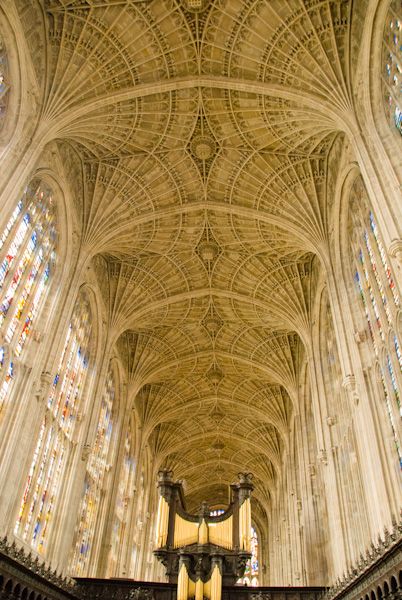
King's College Chapel is arguably the most magnificent example of late medieval English architecture in the entire country. Guidebooks run out of superlatives to describe the richness of its interior decoration and the sumptuous flowing lines of the structural elements.
The Chapel was founded by Henry VI in 1441 as part of his grand scheme for creating at King's a college to take graduates of Eton, founded the previous year. The chapel was intended to form one side of a grand court but the residential ranges planned for the other three sides of the court were never completed.

Henry compelled landowners in the town to sell him plots along the river, and he proceeded to pull down residences, shops, and even a parish church to make room for his creation. Henry intended his chapel to be without equal.
He employed his royal architect, Reginald of Ely, to draw up plans for a church along the lines of a cathedral choir, and Henry himself laid the foundation stone of the new chapel on 25 July 1446.
Building continued until 1461, through the opening hostilities of the Wars of the Roses. But when Henry VI was taken prisoner by the future Edward IV, workmen packed up their tools and went home. It is said that a half-cut stone left by the workmen was eventually used as the foundation stone for Gibb's building in 1724.
The extent of this early building phase is clearly noticeable. The builders used white Tadcaster limestone, and the upper limit of this stone can be traced, particularly in the buttresses. Very little building was done under Edward IV, but Richard II's short reign saw the first 5 bays of the chapel completed and put into daily use.

Henry VII provided the necessary funds to turn the half-finished chapel into a complete building. The chest which carried Henry's initial gift of money is preserved in the Chapel Exhibition in the northern side chapel. The main structure was finished in 1515, and Henry VIII funded the interior woodwork and screen.
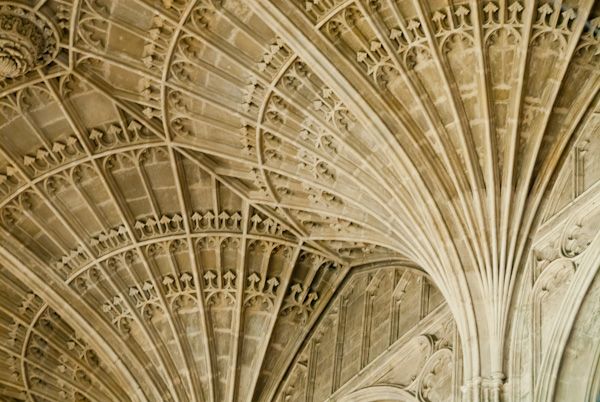
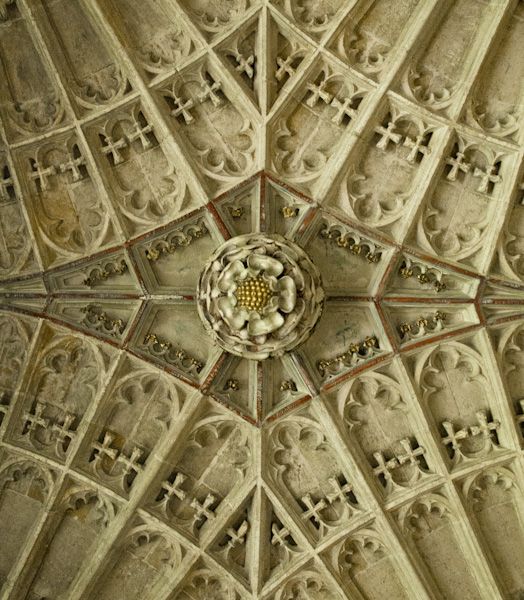
The magnificent - there is no other word to describe it - fan vaulting was completed in just 3 years, between 1512-1515 by master mason John Wastell.
The chapel surprisingly escaped major damage during the Civil War, despite the fact that Cromwell's troops used it for a training ground in inclement weather. It is possible that Cromwell himself, being a Cambridge student, gave orders to spare the chapel. Most of the stained glass was removed during WWII, and the Chapel again escaped damage.
CHAPEL HIGHLIGHTS
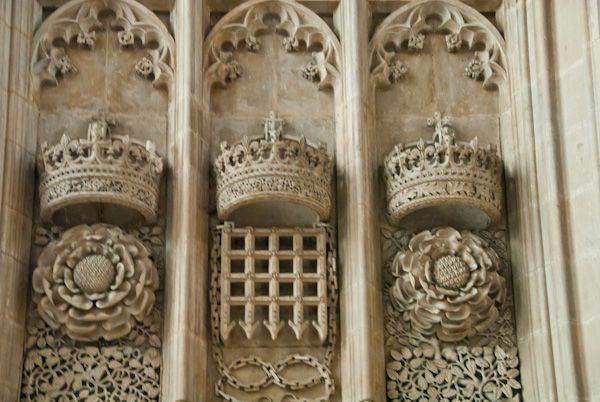
The interior is composed of 12 bays, making it the largest in the world covered with fan vaulting. The vaulting is decorated with intricately carved bosses of wood and stone, featuring heraldic beasts, coats of arms, and Tudor motifs.
The superbly carved screen between the antechapel and choir was a gift of Henry VIII. The screen bears Henry's initials twined around those of Anne Boleyn.
The organ is a true work of art, constructed 1666-68, and rebuilt several times since then. The pipes rise above the screen, upon which they rest.
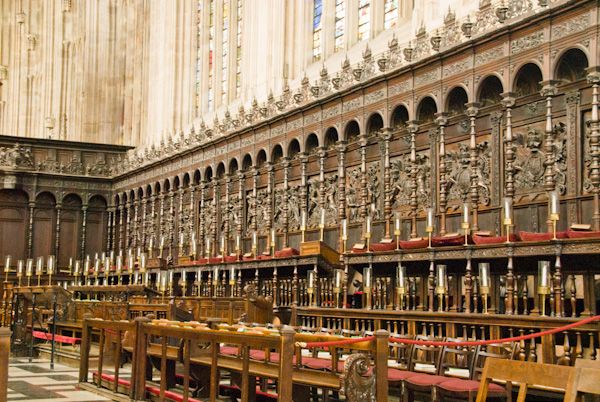
The Tudor choir stalls were made by Peter the Carver, who was also responsible for the screen. The canopies were added in the 17th century. Rubens' striking painting Adoration of the Magi (1634) looks down on the high altar.
To the left of the altar is the Chapel Exhibition, which illustrates the different phases of the chapel's building, with scale models, plans, workman's tools and period costumes.
SERVICES
Evensong
If you can make the effort to attend Evensong, you will be rewarded by a truly remarkable experience. The setting and the world-famous King's College Choir unite to produce a memorable event. Services are sung by King's College Choir from Tuesdays to Sundays, and on Mondays by the College's mixed-voice choir, King's Voices. Evensong is held at 5:30 pm except for Sundays, when it is 3:30.
Christmas Eve Carol Service
Otherwise known as the Festival of the Nine Lessons and Carol Services, this annual event was first held in 1918. It is broadcast live around the world, but if you want to be there in person, be prepared to queue from 11:00 am for the 3:00 pm service.
More Photos
Related:
Kings College
About King's College Chapel
Address: King's College, King's Parade, Cambridge, East Anglia, Cambridgeshire, England, CB2 1ST
Attraction Type: Historic Church
Website: King's College Chapel
Email: tourism@kings.cam.ac.uk
Location map
OS: TL448 584
Photo Credit: David Ross and Britain Express
HERITAGE
 We've 'tagged' this attraction information to help you find related historic attractions
and learn more about major time periods mentioned.
We've 'tagged' this attraction information to help you find related historic attractions
and learn more about major time periods mentioned.
Historic Time Periods:
Find other attractions tagged with:
Medieval (Time Period)
NEARBY HISTORIC ATTRACTIONS
Heritage Rated from 1- 5 (low to exceptional) on historic interest
King's College - 0 miles (Historic Building) 
Byard Art - 0 miles (Art Gallery) 
Primavera Gallery - 0 miles (Museum)
Cambridge, Great St Mary's Church - 0 miles (Historic Church)
Cambridge Arts Theatre - 0 miles (Theatre)
Whipple Museum of the History of Science - 0.1 miles (Museum) 
Clare College - 0.1 miles (Historic Building)
Cambridge, St Bene't's (St Benedicts) Church - 0.1 miles (Historic Church) 
Nearest Holiday Cottages to King's College Chapel:
Fulbourn, Cambridgeshire
Sleeps: 2
Stay from:£344 - £1,388