<< Back - VIRTUAL TOUR - Next >>
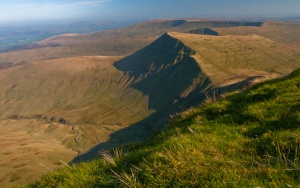
This area of Wales is divided into three regions: Brecon Beacons, the Heart of Wales and the old county of Montgomeryshire.
The Uplands of South and Central Wales, a high country consisting of gently rolling moors, forests, plateaus, farmland, rivers and streams is known as the Brecon Beacons. The National Park, lying within the southern uplands, is 519 square miles (1344 sq. km) in size and stretches 40 miles (65km) from east to west.
There are four mountain ranges within the park. Near the border with England are the Black Mountains, Next lie the Brecon Beacons, then the Fforest Fawr and, in the far west, the wilderness of Black Mountain. The two highest peaks in southern Britain are located in the Park.
Because of the different patterns of limestone and grit erosion which dominate the area, waterfalls, gorges and caves have formed over the centuries.
Peregrine falcon and raven can be seen in flight. Look for red kites in oak and ash woodlands. Arctic alpine plants blossom, while in the valleys, foxgloves and bluebells hold sway.

The Usk is the major river in the park. It is famous for both salmon and trout fishing. The Wye flows along the eastern Park boundary and the Tywi in the west. Other rivers disappear into caves. At Devil's Bridge, the Mynach River plunges 300 ft (91.4m) on its way to meet the River Rheidol. Man-made reservoirs have added to the natural lakes in the area.
Remnants of chambered long cairns dotting the valleys attest to man's long habitation in the area. Mysterious standing stones hide in the mountains. Iron Age man and the Romans built fortifications in the area, and the Normans, when they conquered Britain, constructed castles. Sheep and cattle are scattered throughout the landscape.
A good place to start a journey is at the Brecon Beacons Mountain Centre, six miles (10km) southwest of Brecon. There are waterfalls, old viaducts, reservoirs, castles, caves and walks to be enjoyed amid nature's scenic wonders. One of the most popular areas of the Park has been dubbed Waterfall Country, where circular trails lead past an array of spectacular waterfalls.

Tretower is the site of two separate buildings. One is a 13th-century three-storey round keep. The keep was added to a castle built in 1150 and served as a residence. The other is an excellent example of a late medieval fortified house, Tretower Court. The house was built in more peaceful times in the 15th century and is much as it was then.
The town of Brecon, beside the River Usk on the north-central edge of the Park has medieval origins. Narrow alleyways, a riverside promenade, a 1700's inn and the Brecon Cathedral are part of the attractions. The Brecknock Museum, on Captains Walk Street, is full of fascinating objects on all aspects of the area. Canal boats can be rented for travelling on the Monmouthshire and Brecon Canal.
Rolling hills, mountains, valleys, meadows and the Wye River characterize the Heart of Wales. The perfectly preserved Victorian and Edwardian spa town of Llandrindod Wells boasts tall houses with towers, turrets, balconies and ironwork.
Hay-on-Wye is known as the 'Town of Books'. It is a book lover's mecca with bookstores housing thousands of volumes of new and used books. It sits on the border between Wales and England near the banks of the River Wye and the foothills of the Black Mountains.

The 70 square mile (181 sq. km) Elan River Valley runs through gently rolling green hillsides punctuated with crags, hay meadows, oak woodland, grasslands, bogs, rivers and streams. It's an important wildlife site. The lakes supply water to Birmingham and provide recreation for visitors-sightseeing, walking and horseback riding. There are twelve sites of special scientific interest and a National Nature Reserve.
The atmospheric Judge's Lodgings in Presteigne is lit by gaslight as it was during Victorian times. Original furnishings grace the elegant apartments. The fully equipped servants' quarters and huge courtroom are part of this 1870 Shire Hall.
Knighton, a small market town, sits on the Welsh-English border at the approximate mid-point of the Offa's Dyke Path. It is the home of the Offa's Dyke Centre with an interesting exhibition and AV presentation. The town, with many 17th century houses, is on the hillside above the Centre. Traces of late stone & Bronze Age settlements and Iron Age fortifications can be found in the surrounding area. It was the scene, 700 years ago, of one of Owain Glyndwr's victories against the English.
The county town of Montgomery is an unspoilt architectural gem and a delight to explore with its short cobbled street hugging the hillside. The tiny Bell Museum is full of interesting treasures. High on a hilltop above the town are the remnants of Montgomery Castle, built in 1223 to guard the border. It commands a view over the countryside, the town and the 13th century St Nicholas' Church. The castle saw action in the Civil War and was demolished by Parliament's army.
Lake Vyrnwy, created by a dam built in 1888, is in the beautiful, wild and mostly unpopulated countryside of Montgomeryshire. A village, Llanwddyn, was submerged for the dam's creation. The land is a nature reserve and a bird watcher's paradise. There is a drive around the entire lake and over the dam. The noise of the water pouring over the dam is both thundering and mesmerizing.
More information about Mid Wales/Brecon Beacons:
Hotels | Self Catering
Attractions
Tourist Information Centres