Northumberland Castles Gazetteer
- Map of Castles in Northumberland
- Map of ALL Castles in England
- Map of all attractions in Northumberland
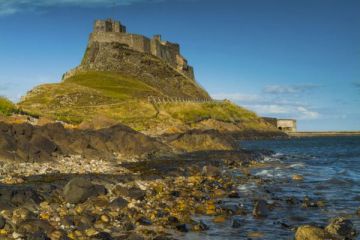
Northumberland is home to some of the finest medieval castles in England, particularly along the coast, where fortresses such as Bamburgh and Dunstanburgh are situated in striking locations overlooking the sea.
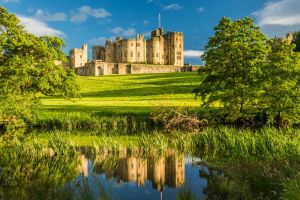
Alnwick Castle is the stronghold of the immensely powerful Percy family, built in the 14th century on Norman foundations. The severity of the medieval exterior turns to 18th and 19th century opulence inside, for generations of Percys put their fortune into creating one of the great show houses of England. Highlights include a solid marble staircase and a truly magnificent art collection, with a focus on 16th-century Italian works. The state rooms are incomparably sumptuous. Do not miss Alnwick Castle!
Alnwick, Northumberland, England, NE66 1NQ
Heritage Rating:  ?
?
Nearest Self Catering Cottages

Aydon Castle is a superb example of a fortified 13th-century manor house. The castle was constructed as a simple manor, but almost immediately fortified in the light of the escalating conflict between Scots and English in modern Northumberland. The fortifications did not stop the Scots from sacking Aydon in 1315 and the castle changed hands several times over subsequent years.
Off Aydon Road, Corbridge, Northumberland, England, NE45 5PJ
Heritage Rating:  ?
?
Nearest Self Catering Cottages

A wonderfully situated castle, built atop an outcrop of basalt high above a sandy beach, looking out across the North Sea to the Farne Islands. There has been a castle on this spot since the 6th century, but the current building dates from the 12th century, though it was subsequently heavily restored by the first Lord Crewe in the 1750s and later by the first Lord Armstrong in the late Victorian period. The castle was attacked during the Wars of the Roses, and became the first English castle to surrender to an artillery siege.
Bamburgh, Northumberland, England, NE69 7DF
Heritage Rating:  ?
?
Nearest Self Catering Cottages
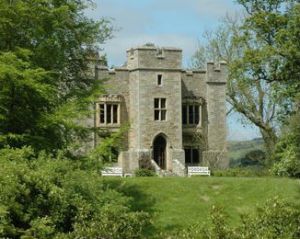
Bellister Castle is not one, but several fortifications located on the south bank of the River Tyne, across from the town of Haltwhistle. The first castle was built on the motte and bailey plan in the late 11th century. Of this, little remains beyond the earthworks and the tall mound of the motte.
Featherstone, Haltwhistle, Northumberland, England, NE49 0HZ
Heritage Rating: ?
Nearest Self Catering Cottages

Belsay Castle is a ruined medieval fortification in the grounds of Belsay Hall. The castle was built sometime in the 14th century and stands beside the ruin of a Jacobean mansion and an early 19th-century neo-classical hall.
Belsay, Northumberland, England, NE20 0DX
Heritage Rating: ?
Nearest Self Catering Cottages

Berwick Castle is a ruined 12th-century castle built by King David I of Scotland, and later strengthened and extended by Edward I of England. Edward also added the extensive town walls of Berwick, much of which still survive. The castle passed from Scottish to English hands and back again many times over the following centuries.
Berwick-upon-Tweed, Northumberland, England, TD15 1DF
Heritage Rating: ?
Nearest Self Catering Cottages

Blenkinsopp Castle is a 13th-century pele, or tower house, built by the Blenkinsopp family. The castle was later incorporated into a 19th-century mansion (now demolished). A license to crenellate the castle was granted in 1340, and the Blenkinsopps lived here for several centuries before moving to their other properties at Bellister Castle and Dryburnhaugh.
Greenhead, Northumberland, England, TD12 4TJ
Heritage Rating: ?
Nearest Self Catering Cottages
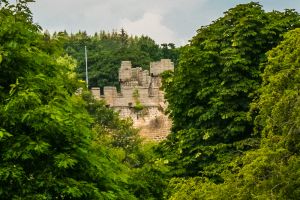
Bywell Castle is an 11th-century Norman castle probably built by Guy de Balliol around 1090. The castle stands on the north bank of the River Tyne. The original Norman fortification was later restored and strengthened in the 14th and 15th centuries by the Neville family, with the addition of a curtain wall and gatehouse.
Bywell, Northumberland, England
Heritage Rating: ?
Nearest Self Catering Cottages

Cartington Castle is a partially restored castle high above the River Coquet two miles outside the market town of Rothbury. It is not known exactly when the castle was constructed, but the first record of an owner of Cartington Castle comes from 1154. To this early castle, a pele tower was added in the 14th century.
Cartington, Northumberland, England
Heritage Rating: ?
Nearest Self Catering Cottages
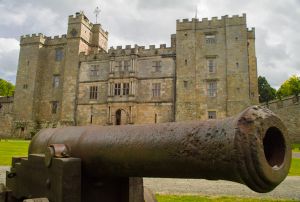
A superb medieval fortress, rich in historical interest, Chillingham Castle was built in the 13th century as a monastery. Chillingham has been in the hands of the Grey family and their descendants since the year 1246. At the centre of the castle is the Great Hall, an Elizabethan chamber overlooked by a medieval minstrel's gallery.
Chillingham, Northumberland, England, NE66 5NJ
Heritage Rating: ?
Nearest Self Catering Cottages