Brecon
Abbey
A Dominican Friary founded circa 1250. The domestic buildings are gone.
After the dissolution of the monasteries in 1541, the church was used
as a chapel by Christ College, which occupied the site and other buildings
of the friary. (In 1855 it became a public secondary school). The chapel
was partially restored in the 19th century, but the choir is 13th century
with shafted lancets, and a 14th century arcade still stands. Two halls
have 15th century timber roofs. See
map
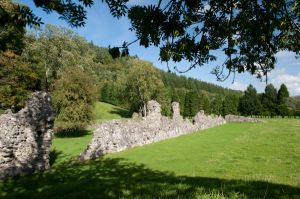
Cwmhir
Abbey 5
1/2m north of Llandrindod Wells, Powys
At one time
in its proud past this Cistercian abbey was the largest in Wales and
boasted one of the largest naves in all Britain at 242 feet (bested
only by York, Durham, and Winchester cathedrals). The abbey is the reputed
last resting place of Llewelyn ap Gruffydd, who was killed at nearby
Climery in 1282.
Some
legends state that Edward I intentionally built the abbey on top of
Llewelyn's tomb. The Welsh monks at Cwmhir were once fined by Henry
II for aiding a Welsh attack on English troops. At the time of the Dissolution
only 3 monks lived on at Cwmhir, and there are few decent remains left
of the monastic buildings. See
map
Valle
Crucis near
Llangollen, Cadw
The original site chosen for Valle Crucis had one small problem; there
was a village in the way. The entire population of the village of Llanegwerth
was moved, though only some villagers received compensation for the
loss of their homes. The 13th century carved doorway on the west front
is superb, as is the chapter house, with its ribbed vaulting. Part of
the site was converted to farm use in the 19th century, though later
restoration work gives a good sense of the abbey's former splendour.
See
map