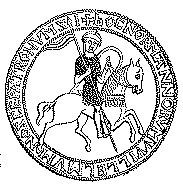
William the Conqueror was an innovator in government. He built a strong centralized administration staffed with his Norman supporters. He was also not about to put up with any backtalk from the newly conquered English.
He subdued the south and east easily, but the north rose in rebellion. William's response was the ferocious "Harrying of the North" (1069-70), which devastated the land in a broad swath from York to Durham. The results of this burning and destruction left much of the area depopulated for centuries.
Hereward
Following on the heels of northern resistance the most famous English rebel of them all, Hereward the Wake, stirred up resistance to the Norman conquerors in East Anglia from a base at Ely, deep in the fenland. Eventually Hereward, too, was subdued, perhaps bought off, and the land was William's to hold.
Early Castles
One of the ways he ensured that he held it was to build castles everywhere. These were often hurried affairs in a continental "motte and bailey" design, usually in wood, only later replaced with stone. Most were built with forced local labour on land confiscated from English rebels. The castles were given to Norman barons to hold for the king.
In theory, every inch of English land belonged to the Crown and William's vassals had to swear fealty directly to the Crown. Contrast this with the earlier Saxon practice where each man swore allegiance to the person of his lord (click here to review). Now William was making loyalty to the nation, in the form of the Crown, supersede loyalty to the individual person of a lord.
William's Church
Anglo-Saxon churchmen were replaced gradually by Normans appointed by William. Under the administration of Lanfranc, Norman Archbishop of Canterbury, new monasteries were founded, while rules and discipline were enforced more stringently.
Church and lay justice were separated; the bishops were given their own courts, allowing common law to evolve independently. William retained the right to appoint bishops and impeach abbots. He used these churchmen as his major administrators, which made perfect sense, for they were by far the best-educated members of society. Indeed, they were often the only educated members of society.
The Domesday Book
The thing for which William I is best remembered, aside from winning the battle of Hastings and making England a European kingdom, is the Domesday Book. The Domesday Book was, in effect, the first national census. It was a royal survey of all England for administration and tax purposes.
William needed proper records so that his new, efficient Norman bureaucracy could do its job, especially when it came to collecting all the revenues due to the crown. Inspectors were sent into every part of England to note the size, ownership, and resources of each hide of land.
Contrary to popular belief, some small areas did seem to have escaped the assessors notice, but for the times the Domesday Book represented an amazing accomplishment. It also left exact records behind which give historians a lot of data about Norman English life.
See here for a map of the major towns in England at the time of the Domesday Book.
William the Conqueror's Castles
Related:
The Battle of Hastings - Glossary of terms used in the Domesday Book
Also see Medieval London in our London History guide.