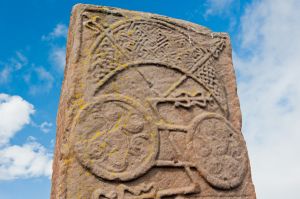
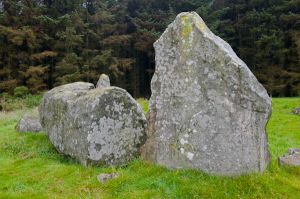
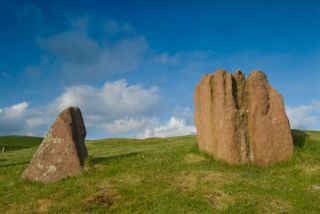
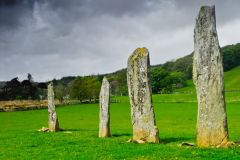
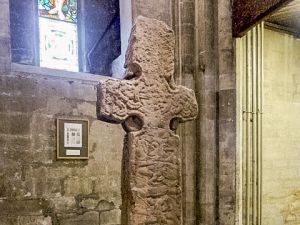
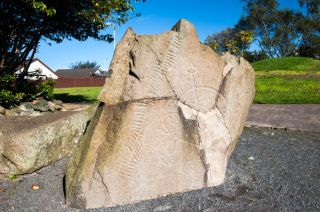
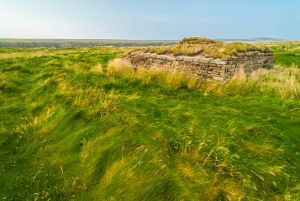
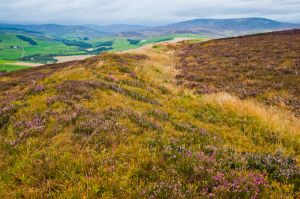
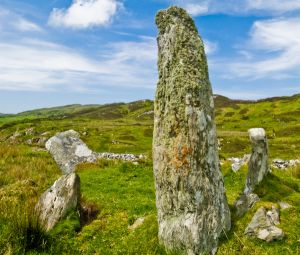
There are four stones. The largest is a cross-slab standing in the churchyard. This features beautiful carving of interlaced decoration and Pictish symbols. It stands about 6 feet high and the carving is some of the finest in Scotland. One side of the cross depicts animal figures, while the other shows a battle scene. Three other stones, dating from 7-9th century AD, stand by the road.
Forfar,
Tayside,
Scotland
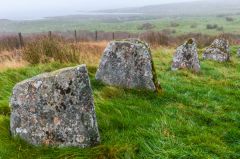
A stone circle in a lovely location overlooking the village of Old Deer. The circle is composed of 9 stones and one recumbent stone, making a circle of just over 14 metres in diameter. There was apparently one more upright stone but this has now disappeared.
Old Deer,
Grampian,
Scotland
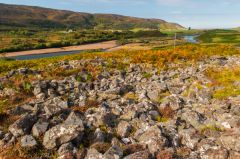
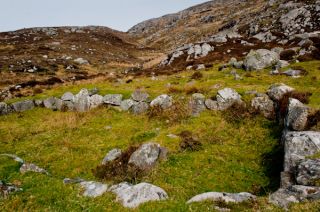
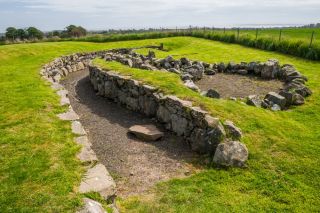
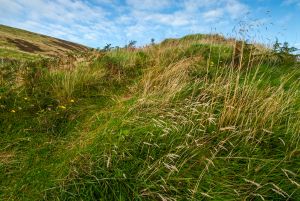
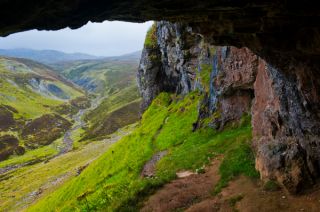
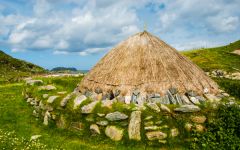
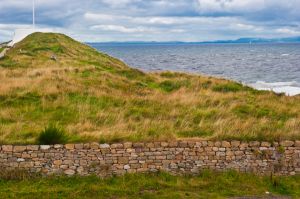
Marked as Gortein, Allt Chrysal or Allt Chrisal on OS maps, but known locally as Allt Easdail, this fascinating complex of historic buildings stands on the southern slope of Ben Tangaval, looking across to Vatersay island. Here you can find evidence of occupation spanning 5,600 years, from the Neolithic period to the 18th century. The site was undiscovered until 1998 when archeological surveys in preparation for the building of the Vatersay causeway revealed a rich complex of buildings on the slope of the hill.
Castlebay,
Barra,
Highlands and Islands,
Scotland
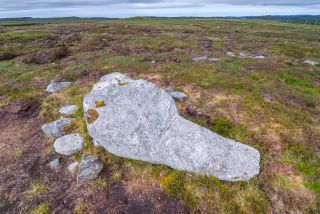
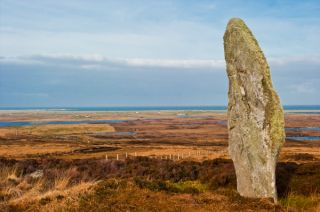
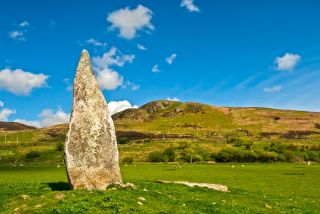
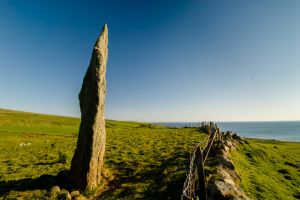
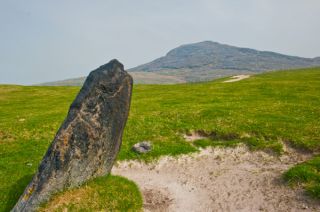
Also known as Loch an Aithan standing stone, this striking prehistoric monument is the tallest standing stone in the southern isles, measuring over 17 feet high. It is set on the western slope of Beinn a' Charra, just off the A865 north of Kildonan, South Uist. Unlike some prehistoric monuments in the Western Isles it is actually quite easy to get to the stone; it is located immediately downhill of a modern water reservoir and the access road to the reservoir leads almost directly to the stone.
A865,
Ormacleit,
South Uist,
Highlands and Islands,
Scotland
Attraction Type:
Prehistoric Heritage Rating:? Location: Off the A865 up an access road to the water reservoir above Loch an Aithan. The reservoir is signposted, but the stone is not. You can drive to a parking area if the access road is open.
A Bronze Age burial cairn surrounded by circle of 15 standing stones. Auchagallon is an odd sort of monument, a cross between a stone circle and a burial cairn. The site has not been excavated so we know little about how or when it was built or whether the standing stones were added at a later date to an existing cairn. The location is fabulous, however, with wonderful views across to Kintyre. A few miles to the south are the standing stones and burial mounds at Machrie Moor.
Machrie,
Arran,
Ayrshire and Arran,
Strathclyde,
Scotland
Attraction Type:
Prehistoric Heritage Rating:? Location: Just off the A841. Easy access on foot, just north of the golf course at the junction of the A841 and the minor road towards Brodick.
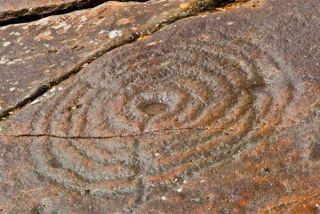
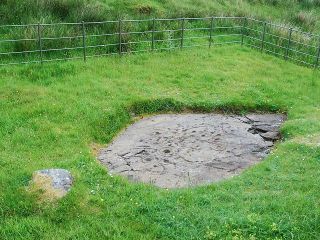
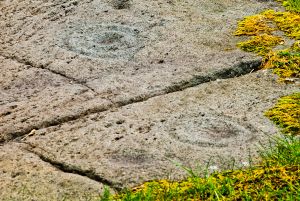
Another of the fantastic group of prehistoric monuments that line Kilmartin Glen, Baluachraig is a series of cup and ring marks carved into a natural outcrop of level rock. Baluachraig is located just slightly north of the Dunchraigraig cairns and standing stones.
Kilmartin Glen,
Kilmartin,
Strathclyde,
Scotland
Attraction Type:
Prehistoric Heritage Rating:? Location: 1 mile south of Kilmartin off the A816
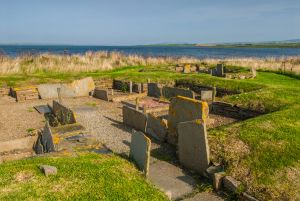
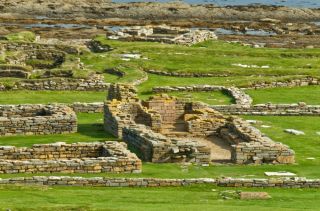
A Neolithic village located on the shores of Loch Harray beside the Stones of Stennes circle and just a short distance from the Ring of Brogar. The village was inhabited from about 3200 BCE, suggesting that this may posssibly have been where the builders of Maes Howe, Brogar, and Stenness lived. There are several different sizes of hut, but nothing beyond the foundations remain.
Stenness,
Orkney,
Highlands and Islands,
Scotland
A beautifully carved Celtic cross, probably dating to before the 10th century. The cros originally stood in open country near Houston in Renfrewshire, but is now within Paisley Abbey for protection from the elements.
Abbey Close,
Paisley,
Strathclyde,
Scotland,
PA1 1JG
Attraction Type:
Prehistoric Heritage Rating:? Location: In Paisley Abbey, in the centre of Paisley off Abbey Close
A good example of a Neolithic chambered cairn, though not so well preserved as the similar cairn just north at Reineval. The mound rises about 2.5 metres, above a base some 25 metres across. Several shieling huts were later built into the base of the cairn, making it rather difficult to make out the exact shape of the Neolithic mound.
Frobost,
South Uist,
Highlands and Islands,
Scotland
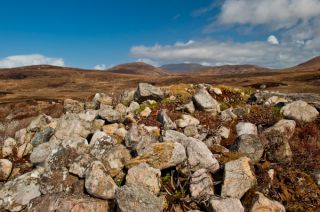
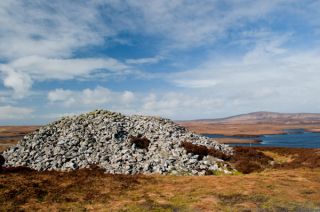
Signposted off the main road a mile north of Clachan, this beautifully preserved Neolithic passage grave cairn is set on the slope of a high hill with wonderful views to the west. There is a small parking area and informational signs explaining about the site, and a gravel path up a fairly steep slope to the prominent cairn a few hundred yards above the road.
A867,
Langais Clachan,
North Uist,
Highlands and Islands,
Scotland
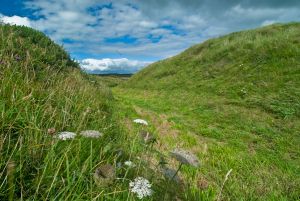
An Iron Age promontory fort looking south to the Isle of Man. The fort is defended on the landward side by a deep ditch between a pair of banks, and by the natural slope of the land on the seaward side.
Monreith,
Dumfries and Galloway,
Scotland
Attraction Type:
Prehistoric Heritage Rating:? Location: On the promontory overlooking Barsalloch Point, one mile or so west of Monreith on the A747.
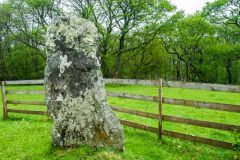
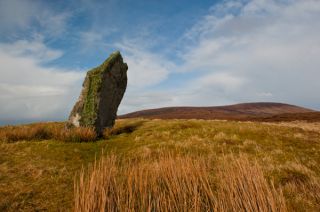
This chunky standing stone sits on the slope of Beinn a' Charra, just east of Committe Road, North Uist. The stone is canted at a considerable degree, about 2 metres off centre, leaning to the south. From tip to toe the stone measures 9' 3" high and is 6' 6" wide.
Committee Road,
Malacleit,
North Uist,
Highlands and Islands,
Scotland
Attraction Type:
Prehistoric Heritage Rating:? Location: Just east of Committee Road, about 3 miles south of the Malacleit turnoff. There is a pullover at the base of the hill, but the site is unsigned and a good OS map is essential!
OSNF786691 Nearest
attractions and accommodation Nearest:hotels - cottages - Bed
and Breakfasts
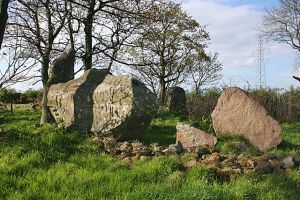
Berrybrae is a complex site consisting of several distinct phases. There was originally a circle here (actually an oval) consisting of a recumbent stone surrounded by 9 standing stones arranged around an earthen bank ranging from 12.8 metres to 1.8 metres diameter. Within the circle was a ring cairn containing 3 burials.
Crimond,
Grampian,
Scotland
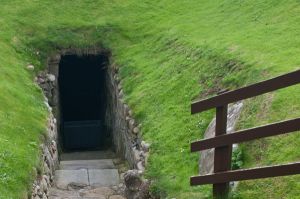
A Neolithic chambered cairn dating to approximately 2500 BCE. Entry to the interior reveals an elongated corbeled chamber with upright partitions. The interior is unusuallly well lit due to plexiglass skylights inserted in the roof.
Tratland,
Rousay,
Orkney,
Highlands and Islands,
Scotland
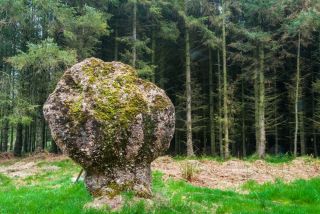
A solitary standing stone looking rather lost in the midst of coastal machair about 50 yards from the coastal road opposite the signposted road to Borve village. Haphazard excavations here have turned up evidence of human remains, possibly a Viking burial.
A888,
Borve,
Barra,
Highlands and Islands,
Scotland
An early Pictish symbol stone with an ogham (ancient British and Irish alphabet of 20 symbols formed either side of or across a continuous line) inscription. The stone was broken up for use in repairing a nearby dyke, but has now been restored.
Inverurie,
Grampian,
Scotland
Attraction Type:
Prehistoric Heritage Rating:? Location: Off the A96 (off Burghmuir Drive) at the corner of Gordon Terrace
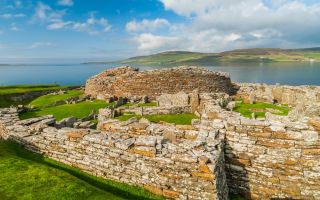
One of the finest brochs in Scotland, Gurness stands on the shore looking across to Rousay. The very extensive remains include striking earth ramparts and the remains of several Iron Age buildings.
Aikerness,
Mainland,
Orkney,
Highlands and Islands,
Scotland
Remains of Pictish and Norse settlements in a spectacular coastal setting. Pict remains are houses and metalworking debris. Norse remains are of farmsteads, domestic buildings and the Norse cathedral dating from the early 12th century. Graves have been unearthed on the island. Museum at the site.
Brough Head,
Mainland,
Orkney,
Highlands and Islands,
Scotland
There are two Caterthun hill forts near the village of Edzell, in Angus. The larger, and more impressive, is White Caterthun Fort. About a mile to the north east is Brown Caterthun. The fort was built sometime in the last few centuries BCE, and covers a total area about 1000 feet by 900 feet.
Edzell,
Tayside,
Scotland
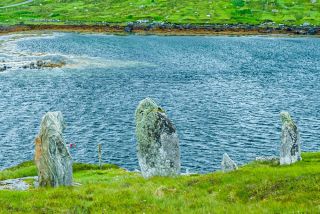
A small stone circle on a hill above Scalasaig, with a 7 foot high standing stone forming a circle with seven smaller stones ranging from 18 inches to 2.5 feet high. The taller stone was said locally to represent Christ, and the smaller stones to represent the Apostles.
Scalasaig,
Argyll and Bute,
Strathclyde,
Scotland
Attraction Type:
Prehistoric Heritage Rating:? Location: From Scalasaig Farm take the old road that leads to Kiloran (just past the Colonsay Hotel). After a few hundred metres you will see the stone circle clearly on your right.
OSNR388942 Nearest
attractions and accommodation Nearest:hotels - cottages - Bed
and Breakfasts
A huge early Bronze Age or late Neolithic cairn on a terraced hillside site above the River Feugh. The cairn stretches 27 metres across, and up to 4.5 metres high.
Banchory,
Grampian,
Scotland
The town of Burghead occupies a promontory joined to the mainland by a narrow neck of land. Though the town itself dates from the 19th century, the site has been in use since at least the Pictish era, as evidenced by not one, but two fort enclosures, called, appropriately, the upper and lower forts.
Burghead,
Grampian,
Scotland
The Aberdeenshire town of Burghead packs a lot of historic interest into a small area. Among the numerous historic remains is a peculiar underground chamber, cut out of the solid rock. Steps lead down below the surface of King Steet to a large, vaulted chamber. At the centre of the chamber is a rectangular cistern, or well, with a raised ledge, or seat at one side.
King Street,
Burghead,
Grampian,
Scotland
This famous landscape garden designer gained his odd nickname from his habit of telling clients that their estates had 'great capability of improvement'