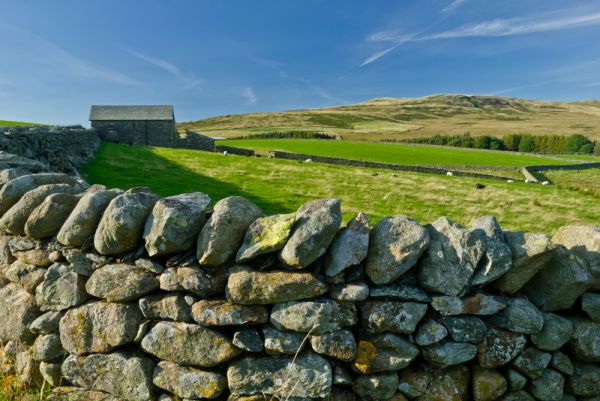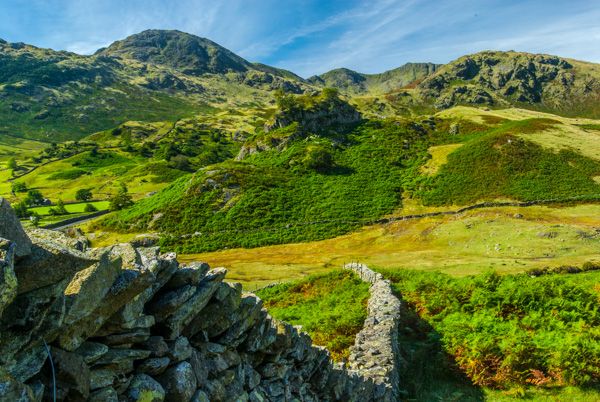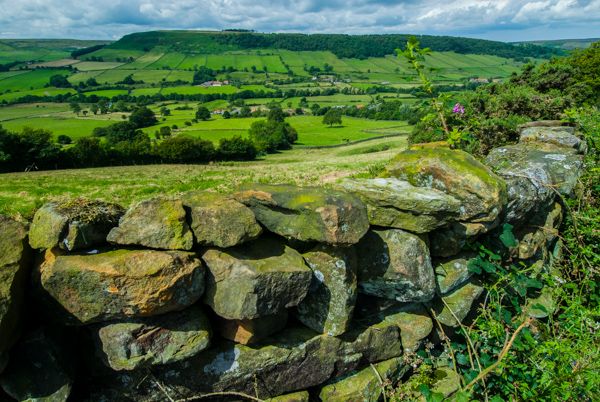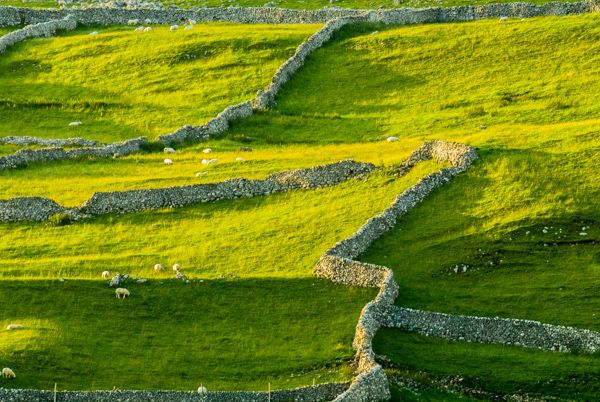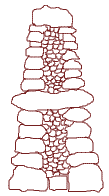
of a drystone wall
Drystone walls are, with hedgerows, one of the most commonly used field boundaries in England, and help create what we now regard as the traditional pattern of field and lanes so evocative of rural England.
While hedgerows are most common in the Lowland Zone, drystone walling is most often found in the Highland, or Upland, Zone (roughly the south-west, the Pennines, the Lake District, the Northeast). In addition, most of Wales and Scotland can be included in the Highland Zone.
Dry stone walls are commonly used as field boundaries in the highlands, such as the Yorkshire Dales. In the lowland regions of England hedges are the most common traditional boundary.
The roots of drystone walling as a method of enclosing fields lie at least as far back as the Iron Age. In Cornwall fields dating from that time are often enclosed by earthen banks surmounting large boulders. These banks are then topped with smaller stones and more earth.
Drystone walling fell out of favour in the Dark Ages, not least because the Anglo-Saxons tended to settle in the lowlands, where their agricultural techniques were more successful.
Throughout the medieval period, as settlement in the Highland areas increased, so too did drystone walling. Many monastic houses, particularly those in remote locations favoured by the Cistercians, favoured walls of dry stone, and many of these medieval walls can still be seen (notably at Fountains Abbey in Yorkshire).
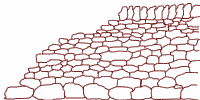
Drystone walls are not merely features of agricultural interest; they are in a sense, living history; a legacy of the movement towards enclosure of common farming and grazing land as English society moved away from feudalism.
As individual landowners abandoned farming in favour of raising sheep and cattle, they enclosed land which had been owned or used "in common", by all the inhabitants of a village. The right to use the common land was lost as landowners enclosed fields and, in some cases, evicted villagers to make room for sheep!
Most of the drystone walls we see today are products of the post-medieval move toward enclosure. In the lower slopes of the Highland Zone the walls are rough and irregular in shape, enclosing small farms dating to the late medieval period and the 16th century.
Higher up the slopes the walls enclose larger fields dating from the 16th and 17th centuries. At the highest elevations are the great sheep grazing areas bounded under Acts of Parliament during the great Enclosure Movement of the 18th and 19th centuries. These walls are the most regular and may run for many miles across otherwise forbidding landscape.
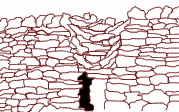
a drystone wall
So how are these traditional walls built? Although techniques may have varied in different locations, the common practice was to cut a narrow trench, and lay a base of small stones within it. Then the wall is built up in progressive layers, each narrowing slightly towards the centre of the wall.
That centre is filled with small stones or rubble. At about a height of 2 feet a layer of throughstones is laid across the entire width of the wall to tie it together, and then the wall continues above the throughstones. The wall is generally topped with a row of slanting or vertical stones. When the wall is forced to climb a steep slope, the stones are commonly laid horizontally, not parallel to the slope.
Drystone walls must naturally be pierced by openings for livestock. Though more modern openings might incorporate posts and gates, a more traditional opening is the "sheep-creep", a square opening made in the lower part of the wall, and filled in on top. Some are made so that the upper layers of stone can be removed to create an opening large enough for cattle to pass through. These larger openings are, quite predictably, called "cow-creeps".
Related:
English Hedges