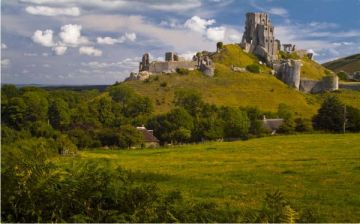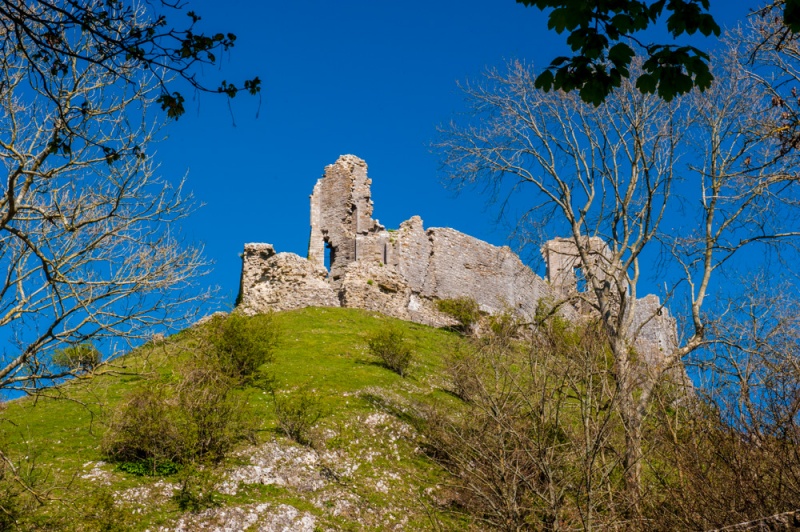
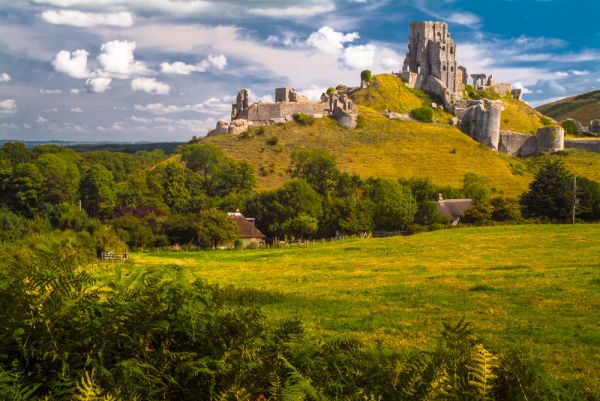
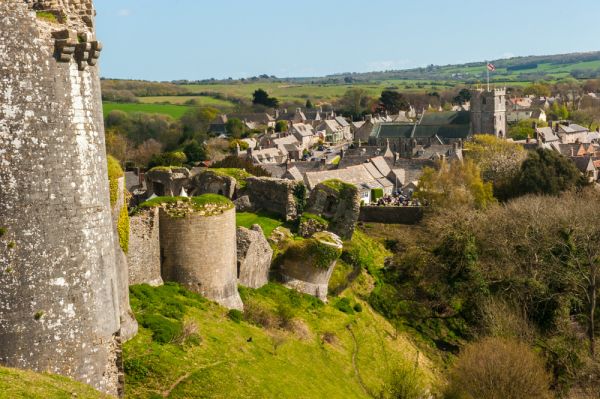
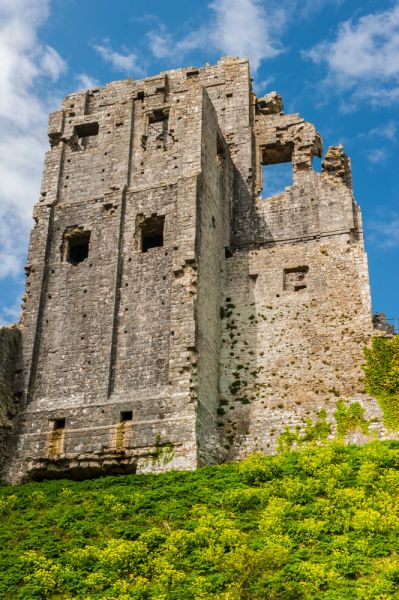
Corfe Castle is a ruin, but what a ruin! Soaring above Corfe village, the early Norman castle is an unforgettable sight. Corfe Castle was built in the reign of William the Conqueror to control passage through the Purbeck Hills via a road between Swanage and Wareham. There was a fortress at this spot long before the Normans, however; there may have been a Roman military presence here, and certainly there was a wooden palisade here as early as the 9th century.
Corfe saw its fair share of historical drama; it was here in AD 975 that Edward the Martyr, boy-king of Wessex, was murdered at the orders of his stepmother AElfrida to allow the still younger Aethelraed ("the Unready") to take the throne.
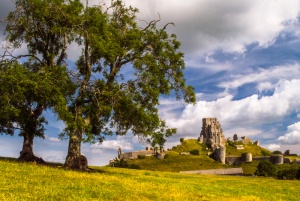
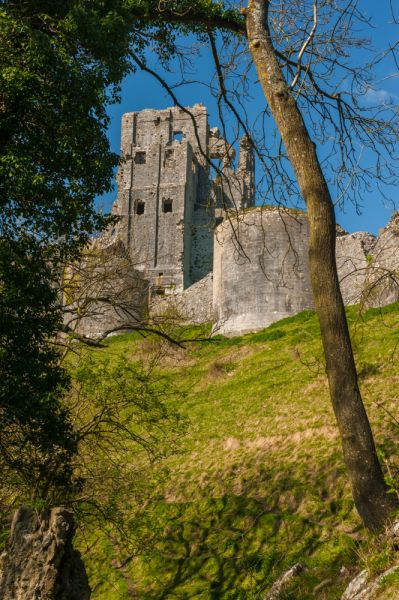
In the late 11th century the Saxon castle was replaced by a small hall of stone surrounded by a perimeter wall. This wall would later become the inner bailey. During the reign of Henry I, a rectangular keep was erected within the wall.
King John expanded Corfe Castle, building an outer curtain wall, domestic ranges, a great hall, and chapel. He later used Corfe to store part of his royal treasury as well as political prisoners. Here he kept his daughter Eleanor a prisoner, and here he allowed 22 of her French knights to starve to death in the dungeon. Another royal prisoner stayed at Corfe Castle; the unfortunate Edward II was held here until being sent on to Berkeley Castle and murder.
In 1635 the castle was sold to Sir John Bankes, Lord Chief Justice of England (see Kingston Lacy). Bankes used it as a second home rather than a fortress. He spent much of his time in London, leaving Corfe in the care of his wife, Lady Mary Bankes.
However, the Bankes family did not have long to enjoy their new possession. The castle was besieged twice in the Civil War. The defenders, led by Lady Bankes, held out against Parliamentary troops for almost three full years until they were betrayed by one of their own numbers.
The indomitable Lady Bankes fought on until the bitter end, locking herself in her personal chambers and throwing hot coals out the window on the attacking forces. Though she was finally induced to surrender, Lady Bankes had so impressed the Parliamentary commander with her courage that she was allowed to leave the castle with her garrison and the keys to the castle! Those keys are preserved at the Bankes family home of Kingston Lacy.
The castle was heavily slighted (made unsuitable for use) by Parliamentary troops afterwards to produce the evocative site we see now. The Corfe Castle Model Museum has created a replica of the castle before it was destroyed, using the same local grey limestone as that used to construct the original fortress and most of the slate-roofed cottages in the village.
In the town hall is the Corfe Museum, tracing the history of the village and castle. A steam railway offers regular trips to nearby Swanage.
More Photos



About Corfe Castle
Address: The Square,
Corfe Castle,
Dorset,
England, BH20 5EZ
Attraction Type: Castle
Location: 5 m NW Swanage, on A351
Website: Corfe Castle
Email: corfecastle@nationaltrust.org.uk
National Trust - see also:
National Trust memberships (official website link)
Location
map
OS: SY960 821
Photo Credit: David Ross and Britain Express
HERITAGE
 We've 'tagged' this attraction information to help you find related historic attractions and learn more about major time periods mentioned.
Find other attractions tagged with:
castle (Architecture) - Civil War (Architecture) - Norman (Architecture) - Parliamentary (Historical Reference) - William the Conqueror (Person) -
NEARBY HISTORIC ATTRACTIONS
Heritage Rated from 1- 5 (low to exceptional) on historic interest
Corfe Castle, St Edward the Martyr Church - 0 miles (Historic Church) 
Worth Matravers, St Nicholas Church - 2.9 miles (Historic Church)
Arne RSPB Nature Reserve - 3.6 miles (Countryside) 
Arne, St Nicholas Church - 3.8 miles (Historic Church)
St Aldhelm's Chapel - 4.1 miles (Historic Church)
Studland, St Nicholas Church - 4.7 miles (Historic Church)
Brownsea Island - 5.6 miles (Countryside)
Lulworth Castle - 6.5 miles (Historic House)