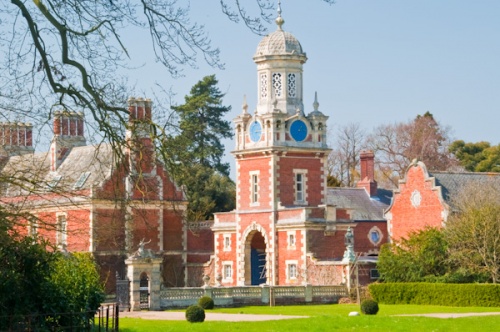
One of the premier stately homes in East Anglia, Somerleyton is an early Victorian mansion built upon the foundations of a 13th-century house. That first manor was built by Sir Peter Fitzosbert in about 1240, though it later passed through marriage to the Jernegan family, who owned the estate until the early 17th century.
In 1610 the Hall was rebuilt by John Wentworth in the Tudor red-brick style so often seen in East Anglian houses of this period. The house was sacked by Parliamentary troops during the English Civil War, and the estate eventually passed to the Anguish family, who owned it until the mid-Victorian period.
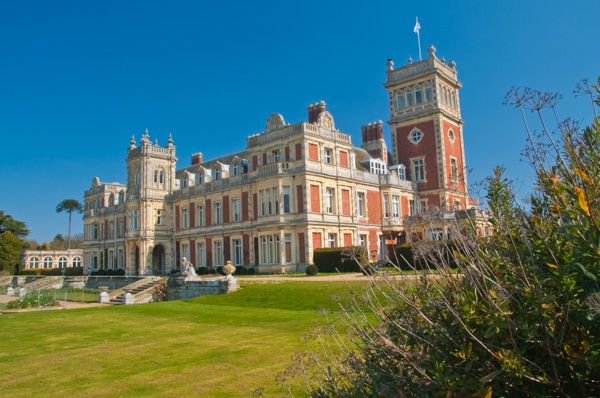
In 1842 Somerleyton was purchased by a successful businessman Sir Morton Peto. It is to Peto that we owe the house we can see today at Somerleyton.

Sir Morton Peto
The man responsible for rebuilding Somerleyton was a fascinating character, who rose from the position of apprentice builder to become head of an international construction empire responsible for building railways in Denmark, Canada, the Argentine, Russia, and his native Britain. At one time Peto's company was the largest employer of labour in the entire world.
Among the projects which he helped build are the Palace of Westminster and Nelson's Column in London, and, closer to home, Lowestoft harbour and esplanade. A tireless worker for bettering condition of his workers, Peto was also a great public benefactor, putting large sums of his own money into public projects.
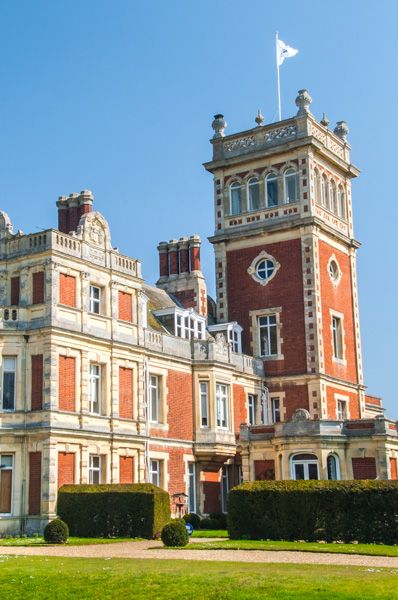
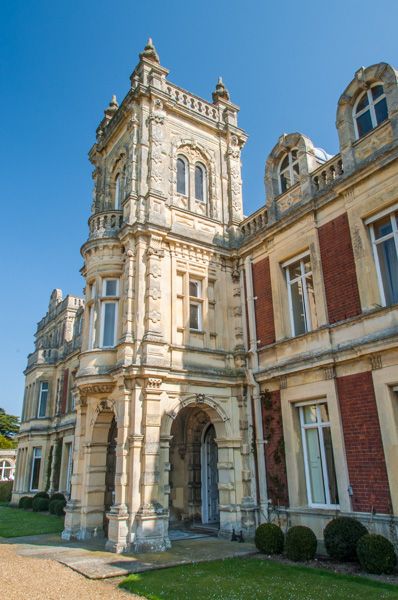
Peto spared no expense in his lavish rebuilding of Somerleyton Hall. From 1844-1851 he had the house and grounds completely rebuilt in sumptuous style. The architect of Peto's vision was John Thomas, who had previously worked for Sir Charles Barry on the Houses of Parliament. Thomas kept little from the older Jacobean mansion, replacing it with an ornate structure with touches of French, Italian, and Dutch styles.
In 1863 Somerleyton was sold to Sir Francis Crossley to pay off Peto's rising debts, and the Crossley family holds the estate to this day. Crossley, who, like Peto, was a prominent philanthropist, made his fortune in the cloth industry by automating the process of making carpets.

Highlights of the Hall
The house is built around three sides of a courtyard, approached through the gardens built for Peto. The entrance is an imposing three-storied structure in Elizabethan style which overlooks the gardens. Within, the oaken staircase is lined with coats of arms from the 14 families who have owned Somerleyton from the 13th century.
The marvellous domed Entrance Hall is supported on a dozen oak pillars and features some very attractive stained glass with patterns of birds. Less expected, and all the more striking for it, are two large stuffed polar bears, souvenirs of Lord Somerleyton's 1897 excursion to the Arctic.
The Oak Room is worth noting; it is lined with panelling from the Jacobean house, and the wood for the panelling was milled from trees grown on the Somerleyton estate. A magnificent gilt mirror hangs between the windows of the Oak Room; this was originally built in the early 18th century for the Doge's Palace in Venice.

The Gardens
There are 12 acres of gardens and parkland at Somerleyton. We've mentioned the gardens in passing, but it's worth noting a few of their features.
The gardens are notable for the number and variety of evergreens. Though evergreens are not uncommon today, Somerleyton was one of the first houses to feature the conifers when they were first introduced to Britain in the 17th century.
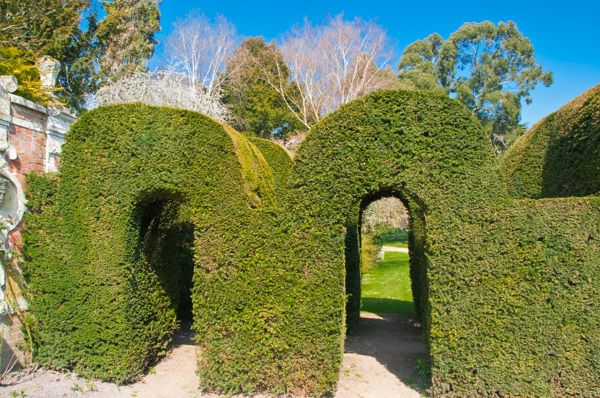
In addition to the evergreens, there are fine specimen trees, such as Giant Redwood and Eucalyptus, as well as the more traditionally British herbaceous borders, roses and topiary yews. A unique Tunnel Garden houses a collection of old and unusual gardening utensils.
The most popular feature of all, however, is the yew maze, first planted in 1846 by William Nesfield. A journey of some 365 feet (assuming no wrong turns!) leads visitors to a Chinese pagoda topping a small mound in the centre of the maze.
A short walk across fields from the Hall brings you to the 15th-century church of St Mary, which boasts a superb 15th-century screen and an exceptional black marble tomb to John and Anna Wentworth, c. 1651.
More Photos
About Somerleyton Hall
Address: Lovingland,
Somerleyton,
Lowestoft,
East Anglia,
Suffolk,
England, NR32 5QQ
Attraction Type: Historic House
Location: NE Lowestoft off B1074
Website: Somerleyton Hall
Email: info@somerleyton.co.uk
Historic Houses Association
Location
map
OS: TM492977
Photo Credit: David Ross and Britain Express
HERITAGE
 We've 'tagged' this attraction information to help you find related historic attractions and learn more about major time periods mentioned.
Historic Time Periods:
Find other attractions tagged with:
13th century (Time Period) - 17th century (Time Period) - 18th century (Time Period) - Civil War (Architecture) - Elizabethan (Architecture) - Parliamentary (Historical Reference) - Sir Charles Barry (Person) - Tudor (Time Period) - Victorian (Time Period) -
NEARBY HISTORIC ATTRACTIONS
Heritage Rated from 1- 5 (low to exceptional) on historic interest
Somerleyton, St Mary's Church - 0.3 miles (Historic Church) 
Herringfleet, St Margaret's Church - 1.3 miles (Historic Church) 
St Olave's Priory - 2.3 miles (Abbey) 
Burgh Castle Roman Fort - 4.6 miles (Roman Site)
Polkey's Mill & Reedham Marshes Steam Engine House - 4.6 miles (Historic Building)
Berney Arms Windmill - 4.8 miles (Historic Building)
Raveningham Hall - 5.9 miles (Garden)
Gisleham, Holy Trinity Church - 5.9 miles (Historic Church)