A
B C
D E
F G H
I J K L M N
O P
Q R S
T U V W X Y
Z
See also: Wales |
Scotland
Wells
Cathedral
Wells, Somerset, England, BA5 2UE, Website: www.wellscathedral.org.uk,
Email: office@wellscathedral.uk.net,
Tel: 01749 674483, Fax: 01749 832210.
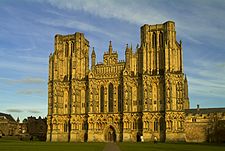
Wells
became a see in 909, and for the next 300 years squabbled with nearby
Bath for the position. In the 13th century
the quarrel was ended by creating the joint bishopric of Bath and
Wells. In the meantime Wells had gained what has been called the earliest
completely Gothic
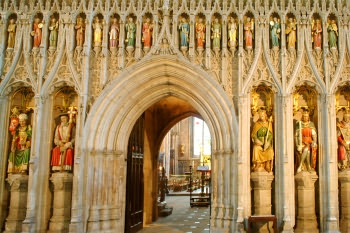
cathedral in Europe. The west screen, with places for 300 carved figures,
is a striking sight, as is the scissors vault (more properly called
strainer arches) that was a 14th century attempt to shore up the shifting
foundations of the central tower. Look at the carvings decorating
the transepts. One shows a man grimacing with a fearsome toothache.
The Wells chapter house is amazing, with its central pier sprouting
32 vaulting ribs, but the staircase to reach it is equally notable;
it curves and undulates like flowing water. There is also a 14th century
mechanical clock that strikes the hours by having two wooden knights
bash each other with battleaxes. Nearby is the Bishop's Palace and
the 14th century purpose-built street of houses for the vicars of
the cathedral. The ambience is wonderful. Don't miss Wells. South
West England attractions map
Westminster
Abbey
Westminster, London, Greater London, England, Website: www.westminster-abbey.org,
Email: info@westminster-abbey.org,
Tel: 020 7654 4900, Fax: 020 7654 4894.
Ok, ok, it isn't actually called a cathedral, but it has to go somewhere,
and this is the place. Begun by Edward the Confessor, who lived just
long enough to see it consecrated on December 28, 1065. Edward's tomb
is behind the high altar. Just a week after Edward's death, Harold
Goodwineson was crowned in the Abbey, and every monarch since then
has followed suit (except Edward V and Edward VIII, neither
of whom was ever crowned). Little of the Confessor's church remains,
beyond the undercroft and the Chamber of the Pyx, because in 1245
Henry III decided to rebuild the whole thing. In the process he created
the highest nave in the country at 102 feet. Rebuilding continued
over the next few centuries, though thankfully the original style
was sympathetically adhered to. The crowning architectural addition
to the Abbey is Henry VII's amazing chapel, with its intricate fan
vaulting.
The interior of the Abbey can be disappointing. For one thing it is
swarming with people gawking just like you are. For another, it is
crammed with memorials, over 1,000 of them. The monarchs are here,
of course, but so are politicians, scientists, artists, and so many
literary giants that Poet's Corner was created. More moving is "Innocent's
Corner", with the tombs of the infant daughters of James I and
the Princes
in the Tower. Note: Westminster Abbey should not be confused with
the nearby Westminster Cathedral, a Victorian Catholic church. Inner
London attractions map
See
our History
of Westminster Abbey and Touring
Westminster Abbey
Whipsnade
Tree Cathedral
Dunstable, Bedfordshire, England, Website: www.nationaltrust.org.uk,
Email: henryblyth@yahoo.co.uk,
Tel: 01844 212759. Location: 2 m S Dunstable, off B4540. National
Trust.
A cathedral of a different sort: a peaceful green space created with
different varieties of trees planted in the shape of a cathedral,
with nave and transepts. Heart
of England attractions map
Winchester
Cathedral 
Winchester, Hampshire, England, SO23 9LS, Email: cathedral.office@winchester-cathedral.org.uk,
Tel: 01962 857200, Fax: 01962 857201.
A see as early as 662, Winchester was home to St. Swithin, an early
bishop. His wish to be buried outside was politely ignored when
he died. The early church was rebuilt beginning in the late 11th
century under Walchelin, the first Norman bishop. He chose a very
unpromising site; the ground was so marshy that thousands of wooden
piles had to be driven into the ground to make it solid enough to
build what was then the longest church in Europe. When William Rufus
died in the New Forest in 1100 he was buried beneath the tower crossing.
The tower promptly fell down, causing widespread concern that heaven
disapproved of the unpopular king's resting place. Such was Winchester's
importance in the Middle Ages that the cathedral was used as many
as three times a year for royal court functions.
Winchester's greatest bishop was William of Wykeham, founder of
Winchester College and New College, Oxford, who began the rebuilding
of the Norman nave. Look up above the piers; there you can see metal
brackets that were used to hang tapestries. Winchester is also rich
in chantry chapels, the tombs of the bishops. In the presbytery
there are mortuary chests containing the bones of Saxon kings and
bishops. When Parliamentary troops despoiled the cathedral during
the Civil War, they used these bones as missiles to break up the
stained glass windows. South
Central attractions map
Worcester
Worcester, Worcestershire, England, WR1 2LH, Website: www.cofe-worcester.org.uk/cathedral
Email: info@worcestercathedral.org.uk,
Tel: 01905 28854, Fax: 01905 611139.
Home to St. Oswald, a Saxon bishop in the late 10th century, whose
shrine is incorporated in the 11th century crypt. St. Wulstan was
bishop at the time of the Norman Conquest, and he was the only Anglo-Saxon
bishop to retain his see, due to his sermons preaching that the
English defeat was a judgement on the native inhabitants for their
sins. Wulstan began the building of a new church in 1082, and when
he was canonised in 1203 the resulting pilgrims created a welcome
new source of revenue. King
John is buried here in a wonderful tomb of Purbeck marble. Much
of the exterior, including both east and west fronts, is Victorian
restoration work. West Midlands
attractions map
More
Cathedrals in England
Browse
alphabetically or page by page
A B
C D
E F G
H I J K L
M N O
P Q R
S T U V W
X Y Z 
Page
1 | 2
| 3 | 4
| 5 | 6
Text © David Ross and Britain Express 2001