Alfred the Great effectively saved Anglo-Saxon England from being completely overwhelmed by the Danes. Yet Alfred was wise enough to realise that his military successes were only temporary. A more permanent measure of protection was needed against the growing threat of the Danes.
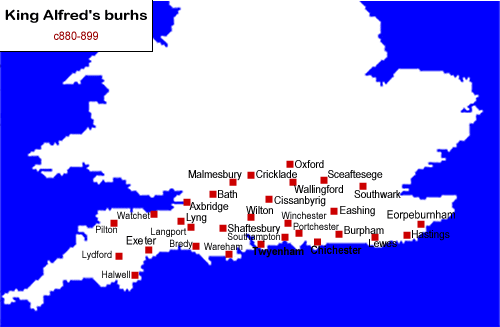
Alfred began a policy encouraging the formation of fortified towns, or burhs, throughout his lands, such that no place in Wessex was more than 20 miles from a town. In exchange for free plots of land within the towns, settlers provided a defence force. The burhs were also encouraged to become centres of commerce and local government. These burhs were located primarily along the coast and the borders of Alfred's lands.
Alfred's son Edward the Elder continued his father's policy of establishing fortified towns, and he and his sister Aethelflaed of Mercia built a new double row of burhs along the old Roman road of Watling Street, which marked the border of the Danelaw as it ran from the Mersey to Essex.
The burhs were remarkable for their time in that they used a regular grid pattern of streets - not unlike the old Roman towns. Indeed, in many cases, pre-existing Roman town sites were re-used to create Saxon towns. Why re-use Roman sites? Three main reasons can be found.
First, the Roman towns were sited at key points along the old Roman network of roads. In other words, communication was a key factor in siting Saxon towns. Chester and Gloucester are two examples of towns sited at major road intersections, though they were established by Alfred's successors.
Second, the Roman towns had basic fortifications in place. Walled towns such as Portchester were already defensible. Other Roman towns had earthwork defences that could easily be repaired and strengthened.
Third, the growth of Christianity influenced the choice of town sites. In areas where the Roman church was strongest (i.e. the south and east), a conscious choice was made to establish sees in metropolitan centres. Contrast this with the Celtic church, which concentrated its efforts on evangelizing in the countryside.
Other Saxon burhs were established on entirely new sites. In this class of burh, we find Wallingford, Wareham, and Wilton, among others. Some, such as Lewes, Lyng, and Lydford, were built on promontories of land, with a simple ditch and bank combination adding to the natural defences.
In cases where Roman towns were reused to create burhs the Saxons did not necessarily follow the Roman street pattern. Although frequently the main street was reused, as at Chichester and Winchester, the Saxons often built their houses upon the firm foundations of the Roman street, with the new streets running alongside.
Of the burhs that have survived as modern towns, little remains to be seen of the Saxon settlements. In some cases, the modern streets follow the Saxon street plan, as at Winchester, Cricklade, Chichester, and Wallingford. Remnants of the defensive ditch and bank can be seen at Wallingford, Wareham, Maldon, Witham, and Cricklade.
Map of Saxon burhs
Related:
Alfred the Great
Saxon architecture
More about Anglo-Saxon England