English Architecture - Gargoyles
Carved beasts and other figures used as church decoration and for practical purposes as well.
Home > Architecture > Gargoyles

Home
spacer
Accommodation
 Hotels
 B&B
 Self catering
Blog
 Heritage Traveller
Attractions

 Scotland
 Wales
 England

England Travel Guide

Regions
Cotswolds
Lake District
London
East Anglia
East Midlands
Heart of England
South Coast
South East
South West
West Midlands
Yorkshire & Northeast

English Counties

Virtual Tour of England

English Castles Photo Gallery

Attractions
Abbeys
Ancient Sites
Castles
Cathedrals
Countryside
Gardens
Historic Houses
Museums
Roman sites

Travel Resources
Tourist Info Centres
Local Travel links

Accommodation
Hotels
 Castle Hotels
Self catering
Bed & Breakfast


Tourist Info Centres
 England
 Scotland
 Wales
Heritage
 History
 Culture
Travel Directory
 England
 Wales
 Scotland
 B&B
 Hotels
 Tour Operators
 Car Rental
 Walking Holidays
 Waterways  Holidays
 more....
Fun

 Photo of the Day
 RSS Feeds
 Historic Attraction Quiz
 British History Quiz
 Monarch Mayhem
 This Day in British History

About
 Contact
 About us
spacer

  
Architecture


Gargoyles in English Architecture

What is a gargoyle?
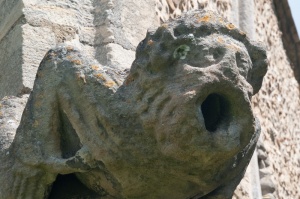
By definition a gargoyle is a carving which projects out from a wall, the purpose of which is to drain rainwater away from the wall. Given their utilitarian purpose of water drainage, gargoyles generally have a pipe projecting through the carving itself. Rainwater funneled towards the pipe by a system of channels or pipes would flow through the pipe, exiting from the gargoyle's mouth a foot or two away from the line of the wall, rather than running straight down the wall and eating away at the building foundations. Gargoyles are primarily, though not exclusively, seen in ecclesiastical architecture.

When were gargoyles used?
Gargoyles as a decorative element were in use as far back as classical Greece. The influence of the Greeks extended well into medieval Britain, where Greek themed images such as griffins or centaurs are often seen. Gargoyles became extremely common in English church architecture in the post-Norman period, and can be found all the way through to the Victorian Gothic Revival

What kinds of figures are used as gargoyles?
The short answer is, 'practically anything'. You'll see dragons, chimeras, human and mostly-human figures, and some strange and wonderful creatures that defy description. The most common motifs used for gargoyles are fantastic beasts or distorted, grotesque human forms. In some cases the gargoyle was probably intended as a form of charm to ward off evil, or more simply, as a visual way to represent religious themes to the illiterate masses of church-goers during the medieval period.

Adderbury, Oxfordshire
St Mary the Virgin church, Oxford
Bloxham, Oxfordshire

What isn't a gargoyle
The term 'gargoyle' is, in common usage' applied rather loosely to any type of carving, usually a grotesque animal or human form, found under or above the eaves of a church, or terminating the drip-cap of a window surround. The distinction is that these latter uses were purely ornamental, that is, they served no utilitarian purpose, whereas a true gargoyle was used for the very practical purpose of water drainage. This may seem a pedantic distinction, but we may as well be accurate when we use the term!

drip stop at Kilpeck, Hertfordshire
Frieze at Temple Guiting, Gloucestershire
drip stop at Kilpeck, Hertfordshire

These latter types of figures are sometimes called 'grotesques'.
See also
English parish churches
Gothic architecture


Related
History | Prehistory | Roman Britain | Dark Ages | Medieval Britain | The Tudor Era | The Stuarts | Georgian Britain | The Victorian Age

Contents © 2003 David Ross and Britain Express


HISTORY CORNER

Name the Historic attraction

Name the mystery historic attraction
See larger image


British Heritage Awards

Celebrate the best of British Heritage in our annual
British Heritage awards.

View this year's winners.

British History Quiz

The second wife of Henry VIII


 Clue

This Day in British History

12 February, 1554

Lady Jane Grey executed

Grey became famous as the 'Nine Days Queen', a pawn in the ambitions of the Earl of Northumberland

Monarch Mayhem

This king abdicated the throne on 11 December, 1936, before he had officially been crowned


 Clue


British Heritage

History of England
History of Wales
London HistoryHeritage

Castles
England
Scotland
Wales

Stately Homes
England
Scotland
Wales

Monasteries
England
Scotland
Wales

Prehistoric Sites
England
Scotland
Wales

More
Medieval Life
British Battles
British Biography
English Architecture
Royal Family