Prehistoric Sites in Gwynedd
- Map of Prehistoric Sites in Gwynedd
- Map of ALL Prehistoric Sites in Wales
- Map of all attractions in Gwynedd
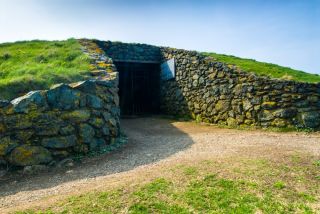
Barclodiad y Gawres is one of the most impressive of the many prehistoric remains on the Isle of Anglesey. This Neolithic chambered tomb has been partially reconstructed, which helps a great deal to give an idea of the site and how it was used.
Rhosneigr, Anglesey, Gwynedd, Wales
Heritage Rating:  ?
?
Heritage Highlight: One of the largest Neolithic tombs in Wales, with unique spiral carvings
Nearest Self Catering Cottages
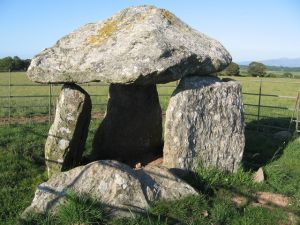
Bodowyr is a Neolithic burial chamber, or passage grave. The chamber consists of three large upright stones with a capstone on top, and the interior is reached by a short passageway at the east end. Easy, signed access in a farm field makes this one of the most visited prehistoric sites on Anglesey.
B4419, Llangaffo, Gwynedd, Wales
Heritage Rating:  ?
?
Nearest Self Catering Cottages
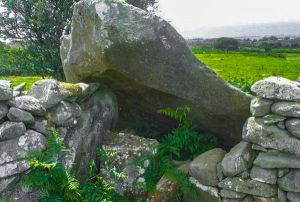
Bron y Foel Isaf is a badly damaged portal dolmen in a superbly scenic location just a few miles from Dyffryn Ardudwy. The large capstone has slipped from its perch.
Barmouth, Gwynedd, Wales
Heritage Rating: ?
Nearest Self Catering Cottages

Fifteen stones survive in this cairn circle. The stones, up to 6 feet tall, spread out from the centre of the cairn like a porcupine's bristles. Access is via a 4 mile walk through marshy ground, so be sure to bring good footwear!
Talsarnau, Gwynedd, Wales
Heritage Rating: ?
Nearest Self Catering Cottages

Bryn Celli Ddu is a very well-preserved megalithic mound tomb, one of the finest in Britain. The earthwork mound was once surrounded by a stone circle, which seems to have been destroyed in the construction of the tomb.
Llanfair PG, Anglesey, Gwynedd, Wales
Heritage Rating: ?
Heritage Highlight: The most famous archaeological site on Anglesey
Nearest Self Catering Cottages
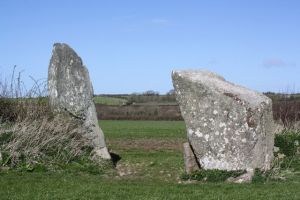
Two large stones are all that remain of this large circle that must originally have sported 8 stones in a ring of 40 feet in diameter. These are among the tallest standing stones in Wales, with one at 13 feet in height and the other measuring about 10 feet.
Pont Mynach, Dwyran, Anglesey, Gwynedd, Wales
Heritage Rating: ?
Nearest Self Catering Cottages

The name Caer Leb translates loosely as Leaven Castle. That might conjure up images of battlements and drawbridges, but nothing could be further from the truth. This 'castle' is a prehistoric enclosure near the River Braint. The site is bounded by an arrangement of double banks and ditches, some sections of which have since been levelled.
Brynsiencyn, Anglesey, Gwynedd, Wales
Heritage Rating: ?
Nearest Self Catering Cottages
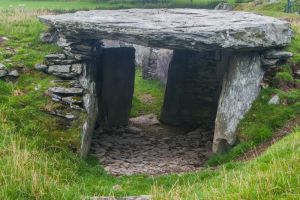
A Neolithic burial chamber, built sometime around 2000 BCE. There are two false entrances, but the real tomb is entered from the south, where an inner passage leads to a cross passage leading to two circular burial chambers located on an east/west axis.
Capel Garmon, Gwynedd, Wales
Heritage Rating: ?
Nearest Self Catering Cottages
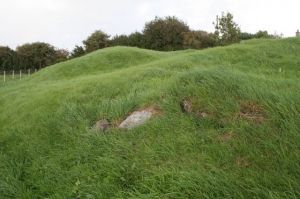
Castell Bryn Gwyn is one of a number of prehistoric sites in the fields near Brynsiencyn village. The 'castle' is a fortified enclosure, probably erected in the Neolithic period, though it appears to have been used throughout the Iron Age and the Roman period.
Brynsiencyn, Isle of Anglesey, Gwynedd, Wales
Heritage Rating: ?
Nearest Self Catering Cottages
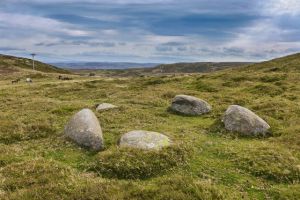
Five low stones form Circle 275, a prehistoric stone circle that has been called the smallest in Britain. Quartz deposits have been unearthed in a pit in the centre of the circle. Circle 275 is quite close to the more striking Druid's Circle.
Penmaenmawr, Gwynedd, Wales
Heritage Rating: ?
Heritage Highlight: Is this the smallest stone circle in Britain?
Nearest Self Catering Cottages