Stratford-upon-Avon
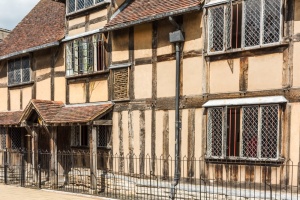
William Shakespeare was born in 1564 in a timber-framed house in Henley Street, Stratford-upon-Avon. His father was John Shakespeare, a glove maker and wool dealer, and his mother was Mary Arden, daughter of a farmer from Wilmcote.
Young William attended King Edward VI School in Stratford from the age of seven until he was 14. The grammar school was held on the upper floor of the old Guildhall, where the classes were held in Latin, concentrating on grammar and the ancient classics of Greece and Rome.
Shakespeare was withdrawn from school due to his family's financial difficulties, and never completed his education, which makes his subsequent accomplishments all the more remarkable.
At the age of 18, Shakespeare married Anne Hathaway, the daughter of a yeoman farmer from Shottery, close to Stratford. The marriage may have been forced, as Anne was already 3 months pregnant with a daughter, Susanna. This first child was followed by twins Hamnet and Judith in 1585.
The next seven years of Shakespeare's life are a mystery, though he is rumoured to have worked as a school teacher. Sometime before 1592 Shakespeare fled his home and family to follow the life of an actor in London.
London's theatres were closed in January 1593 due to an outbreak of the plague, and many players left the capital to tour the provinces. Shakespeare preferred to stay in London, and it was during this time of plague that he began to gain recognition as a writer, notably of long poems, such as Venus and Adonis, and Rape of Lucrece.
He was fortunate to find a patron, Henry Wriothsley, Earl of Southampton, to support him in his writing. Venus and Adonis was wildly successful, and it was this work that first brought the young writer widespread recognition.
Apart from his longer poetry, Shakespeare also began writing his sonnets during this period, perhaps at the behest of Southampton's mother, who hoped to induce her son to marry.
When the theatres reopened in late 1594, Shakespeare was no longer a simple actor, but a playwright as well, writing and performing for the theatre company called "Lord Chamberlain's Men", which later became "The King's Men".
Shakespeare became an investor in the company, perhaps with money granted him by his patron, Southampton. It was this financial stake in his theatre company that made Shakespeare's fortune. For the next 17 years, he produced an average of two plays a year for The King's Men.
The early plays were held at The Theatre, to the north of the city. In 1597 the company's lease on The Theatre expired, and negotiations with the landlord proved fruitless. Taking advantage of a clause in the lease that allowed them to dismantle the building, the company took apart the place board by board and transported the material across the Thames to Bankside.
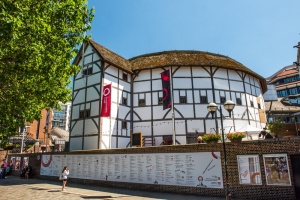
There they constructed a new circular theatre, the grandest yet seen, called The Globe. The Globe remained London's premier theatre until it burned down in 1613 during a performance of Shakespeare's Henry VIII.
Shakespeare held a share in the profits from the Globe, which netted him a princely yearly income of GBP200-250. His financial success enabled Shakespeare to purchase New Place, the second-largest house in Stratford. It was here that he retired around 1611.
When he died in 1616, William Shakespeare divided up his considerable property amongst his daughters (his son Hamnet had died in childhood) but left only his second-best bed to his wife, Anne. Shakespeare was buried in the chancel of Holy Trinity church.
| Name | Date |
|---|---|
| 1588-93 | The Comedy of Errors |
| 1588-92 | Henry VI (three parts) |
| 1592-93 | Richard III |
| 1592-94 | Titus Andronicus |
| 1593-94 | The Taming of the Shrew |
| 1593-94 | The Two Gentlemen of Verona |
| 1593-94 | "The Rape of Lucrece" |
| 1593-1600 | "Sonnets" |
| 1588-95 | Love's Labor's Lost |
| 1594-96 | Romeo and Juliet |
| 1595 | Richard II |
| 1594-96 | A Midsummer Night's Dream |
| 1590-97 | King John |
| 1592 | "Venus and Adonis" |
| 1596-97 | The Merchant of Venice |
| 1597 | Henry IV (Part I) |
| 1597-98 | Henry IV (Part II) |
| 1598-1600 | Much Ado About Nothing |
| 1598-99 | Henry V |
| 1599 | Julius Caesar |
| 1599-1600 | As You Like It |
| 1600-02 | Twelfth Night |
| 1600-01 | Hamlet |
| 1597-1601 | The Merry Wives of Windsor |
| 1600-01 | "The Phoenix and the Turtle" |
| 160I-02 | Troilus and Cressida |
| 1602-04 | All's Well That Ends Well |
| 1603-04 | Othello |
| 1604 | Measure for Measure |
| 1604-09 | Timon of Athens |
| 1605-06 | King Lear |
| 1605-06 | Macbeth |
| 1606-07 | Antony and Cleopatra |
| 1607-09 | Coriolanus |
| 1608-09 | Pericles |
| 1609-10 | Cymbeline |
| 1610-11 | The Winter's Tale |
| 1611 | The Tempest |
| 1612-13 | Henry VIII |
| 1613 | The Two Noble Kinsmen |
| Name | Date |
Note: Some dates are estimates - many works were not officially published until long after Shakespeare's death.
What to see:
London:- The New Globe Theatre on Bankside is a replica of the original theatre.
- Shakespeare's Birthplace - exactly what it sounds like
- Shakespeare's Schoolroom - where Shakespeare was educated
- Anne Hathaway's Cottage - the childhood home of Shakespeare's wife, a lovely thatched cottage
- New Place - the Bard's final home
- Hall's Croft - Susanna Shakespeare's home after she married
- Mary Arden's House - the home of Shakespeare's mother
- Holy Trinity Church, Stratford - Shakespeare's grave
- Royal Shakespeare Theatre - holds regular performances of Shakespeare's works.