Churches and Religious Places in Pembrokeshire
A guide to Pembrokeshire, South west Wales, highlighting attractions, history, and
visitor information.
Home > Wales > Pembrokeshire > Churches
SITE MAP

Home
spacer
Accommodation
 Hotels
 Hostels
 B&B
 Self catering
Attractions

 England
 Scotland
 Wales

Wales Travel Guide

Regions
Anglesey
Cardiff
Carmarthenshire
Ceredigion
Mid Wales
North Wales (Snowdonia)
Pembrokeshire
Swansea and Gower
Wye

Virtual Tour of Wales

Attractions
Abbeys
Ancient Sites
Castles
Churches
Gardens
Historic Houses
Museums
Roman sites

Travel Resources
Tourist Info Centres
Travel links

Accommodation
Wales Hotels
Self Catering
Bed & Breakfast


Travel Services
 Tours
 Rail Tickets
 Car Rental
Tourist Info Centres
 England
 Scotland
 Wales
Heritage
 History
 Culture
Travel Directory
 England
 Wales
 Scotland
 B&B
 Hotels
 Tour Operators
 Car Rental
 Walking Holidays
 Waterways  Holidays
 more....
About
 Contact
 About us
spacer
  
Wales

Pembrokeshire

Pembrokeshiremap
spacerspacer

Churches and Religious Places

Click on a thumbnal image to see a larger photo

Amroth - St Elidyr
At Amroth on minor road off the A477. The church was granted to the Knights of St John of Jerusalem in 1150.

Bosherston - St Michael and All Angels Bosherton church
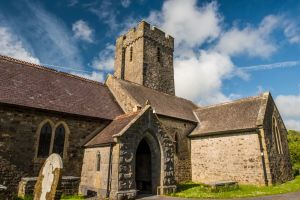
At Bosherston, on minor road off the B4319, south of Pembroke, Pembrokeshire. Late 13th century Norman church, built in form of a cross, on site of a former church. Restored in 1855 by first Earl of Cawdor, on whose estate the church was sited. His arms are in the tiling of the chancel and sanctuary floor.

Caldey Island - St David Caldey Island - St David's
On Caldey Island, reached by boat from Tenby, A478. A church built on pre-Norman foundations.

Caldey Island - St Illtud
On Caldey Island, reached by boat from Tenby, A478. This small 13th century church has a pebble floor and Ogham stone. It is part of the monastic buildings on the island.

Carew - St John the Baptist
At Carew, on the A4075. Built in the Early English style. The Carew Celtic cross is at the head of the village near the castle.

Haverfordwest - St Mary
On the High St, at Haverfordwest, on the A40/4076. Large 13th century church with carvings and a 15th century tie beam roof.

Jeffreyston - St Jeffrey and St Oswald
At Jeffreyston off B4586, north of Tenby. Originally a church belonging to the priory of Pembroke, granted to the canons of St David's.

Nevern - St Brynach Nevern church
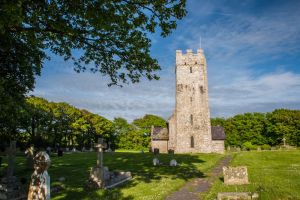
On the B4582, at Nevern. Named after St Brynach of Pembrokeshire who founded a place of worship here in the 5th century. The church was on the pilgrimage route to St. David's. It has a post-Norman tower.

Nevern Celtic cross
Celtic cross at Nevern

The 13ft high, 10th-11th century patterned Celtic cross (in the churchyard) is notable among the collection of 6th century engraved Celtic memorial stones (one is carved with Latin and Ogham writing) and a pilgrim's cross. The churchyard contains cypress trees and ancient yews (147 species).

Pembroke - St Petrox
On the B4319, south of Pembroke, Pembrokeshire. 13th century church, dedicated to the 6th century saint, who visited Wales, Ireland and Cornwall. The church has a tall, narrow tower and was mostly restored in the mid 1800's. There are several monuments in the church.

Rudbaston - St Michael
At Rudbaston, off A40 on minor roads, 4 miles north of Haverfordwest. Early 13th century church with a 17th century Howard monument that covers the entire east wall of the south aisle.

St David's - St David's Cathedral St David's Cathedral
In St David's. St. David, patron saint of Wales, founded a 6th century monastery here and trained missionaries to spread Christianity to Ireland. The present cathedral was built under the Norman bishop Peter de Leia in 1180. The shrine to St. David was a popular pilgrimage site in the Middle Ages; two trips here were worth one trip to Rome!

A holy site it may have been, but a stable one it was not. The ground was swampy and if you look at the piers in the nave you will see that they lean out and to the side. St. David's draws much from Romanesque traditions; the arches are rounded and heavy. The nave is finished with a rich, coffered ceiling of painted oak. Before the high altar is the tomb of Henry VIII's grandfather, Edmund Tudor, and to the left is St. David's shrine.

In the presbytery is a coffin said to contain the bones of St. David and St. Justinian. Of note throughout is the delicate purple sandstone, quarried locally, which gives St. David's a unique character.

St David's - St Non's Chapel
Minor road off A487, south of St David's. Cadw. A rectangular building, the traditional birthplace of St David. Nearby is a holy well.

St Govan's Head - St Govan's Chapel St Govan's Chapel
On St Govan's Head, near Bosherton. St. Govan's Chapel is a small medieval church clinging to the ragged rock halfway down the cliffs of a secluded headland. It is difficult to imagine a more strikingly situated church in all of Britain.
St. Govan was a sixth century hermit who established a cell for himself on this lonely spot, in the fashion of early Celtic Christian monks, who tended to live in isolated places. Legends sprang up about the saint, and about the curative properties of the natural spring which used to rise just inside the door of the chapel.

During the medieval period the holy well and cell became a place of pilgrimage for cripples seeking a cure, and the original cell was rebuilt as a small chapel in the 13th century. The chapel is a very simple rectangular building with a steeply pitched roof and bellcote. Access is by way of 52 stone steps from the top of the cliffs.

Legend has it that the chapel was founded when St. Govan hid in a rocky fissure of the cliff to escape from pirates. A further legend states that King Arthur's knight Sir Gawain lies buried beneath the stone altar of the chapel.

St. Govan's Chapel is contained within the Pembrokeshire National Park, and the Pembrokeshire Coast National Trail runs along the nearby cliffs. The area is far enough off the beaten track that even today it retains an air of secluded beauty.

St Twynnell - St Twynnell
At St Twynnell, on minor road off the B4319, south of Pembroke. St Twynnell is also named Gwynnoc or Gwynnog, among many other variations. The church was established in 1259 and once belonged to
St Nicholas Abbey, Pembroke. It is mostly 13th century and consists of a nave, chancel and sanctuary. There is a square tower at the west end containing 3 bells. The church owns a 1662 solid silver Communion Chalice and a rare, pre-Reformation pewter paten and bread plate. Near the west porch is a stone preaching cross.

Stackpole - St James and St Elidyr
At Stackpole, on minor road off the B4319, near Pembroke. Traditional cruciform church with tall, slender tower containing three bells. Dates back to 12th century, restored in mid 1800's. The church has Minton tiles on the chancel floor, 14th century vaulting in the transepts, and rib vaulting in the Lort chapel. The church contains a number of monuments. The lychgate is in the art nouveau style.

Tenby - St Mary Tenby church interior
At Tenby on the A478. St Mary's is one of the largest parish churches in Wales. It has a 152-ft spire. The original church was 13th century. It was enlarged 200 years later. The chancel has a wagon roof with carved bosses. The church is full of memorials from the 15th-19th centuries.


CHURCHES & RELIGIOUS SITES OF WALES
Anglesey & Snowdonia | North Wales & Borders | Mid Wales & Brecon Beacons | Ceredigion | Pembrokeshire | Carmarthenshire | Swansea & Gower | Cardiff and South Wales Coast | Wye Valley & Vale of Usk

WALES TRAVEL GUIDE
ATTRACTIONS IN WALES BY REGION
Map of Regions
Anglesey and Snowdonia | North Wales Coast and Borderlands | Mid Wales and Brecon Beacons | Ceredigion | Pembrokeshire | Carmarthenshire | Swansea, Gower and the Vale of Neath | Cardiff, Coast, & Valleys of South Wales | Wye Valley and Vale of Usk

ATTRACTIONS IN WALES BY TYPE OF ATTRACTION
Abbeys & Monasteries | Ancient Sites | Castles | Gardens | Historic Churches & Religious Sites | Historic Houses | Museums | Roman Remains


Photo credits - St Mary, Tenby courtesy of Lynn, St Govan's Chapel courtesy of Wales Tourist Board, all other photos © Barbara Ballard


Accommodation in Wales

Snowdonia
- hotels
- cottages
Pembrokeshire
- hotels
- cottages

Cardiff
Swansea