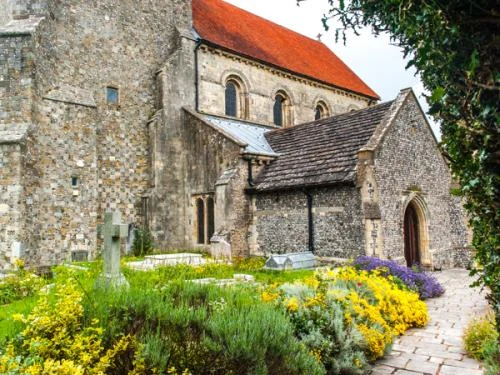
The parish church of Steyning, dedicated to St Andrew and St Cuthman, dates to the late 11th century and is closely connected with Cuthman, a 7th-century Saxon saint, who is said to have built the first church on this site.
Who was St Cuthman?
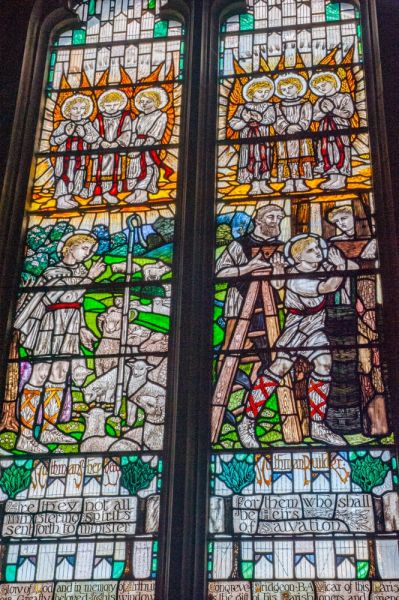
Cuthman, or Cuthmann, was a poor shepherd boy, born in AD 681, probably in Chidham, near Bosham, West Sussex. If the date and place of his birth are correct, it seems likely that Cuthman would have heard St Wilfrid preach, and it may well have been St Wilfrid who converted and baptised Cuthman and his parents into Christianity.
After Cuthman's father died, he looked after his mother, who was paralysed and had to be carried in a cart, or wheelbarrow. Cuthman pushed the barrow towards the rising sun, using a rope over his shoulders to spread the weight, and vowed that when the rope broke, it would be a sign from God that he should stop and build a church.
The rope broke at what is now Steyning, so he stopped and built a church on the site [This is traditionally thought to have been around the year AD 700]. A stranger appeared to help him lift a roof beam into place and when Cuthman asked the stranger his name, he replied, 'I am he in whose name you are building this church.'
When he died, Cuthman buried in his church and his grave became a destination for pilgrims. As a result, Steyning became a place of importance and, later, a royal manor.
That's the traditional story, but there's a flaw in the tradition; it wasn't recorded for at least four centuries after Cuthman's death. A much more plausible story is that Cuthman was sent by St Wilfrid to help convert this area of Sussex to Christianity.
History
We know that there was a church at Steyning at least as early as AD 858, for in that year Æthelwulf, King of Wessex, the father of Alfred the Great, was buried here before being later reinterred at Winchester.
As for Cuthman, he was venerated in the Steyning area long before the Norman invasion, and in charters from the court of William the Conqueror, Steyning is called St Cuthman's Parish and St Cuthman's Port.
Throughout the medieval period, the parish church of Steyning was dedicated to St Andrew, but in 2007, after pressure from the parishioners, the church was rededicated to St Andrew and St Cuthman.
In 1047, Edward the Confessor granted Steyning to the abbey at Fécamp in Normandy. Since Fécamp was under direct control of the papacy, so was Steyning, which meant that the church was not under the jurisdiction of any English bishop. A college of secular canons was established here in the late 11th century, around the time the current church was built. Steyning was later transferred to the Abbey of Syon.
It seems clear from marks scratched into some of the nave pillars that there was a processional route for pilgrims which guided them eastwardly along the south aisle, then across the east end to the north aisle, where St Cuthman's shrine stood.
When Henry VIII suppressed the monasteries, the college of secular canons was dissolved. Income from pilgrims to the St Cuthman's shrine disappeared, and the church was allowed to fall into decay.
As a result, the crossing tower, chancel, and transepts had to be pulled down. Sometime in the early years of the 17th century a new tower was erected at the western end of the nave. The chancel was rebuilt in the mid-Georgian period.
Historical Highlights
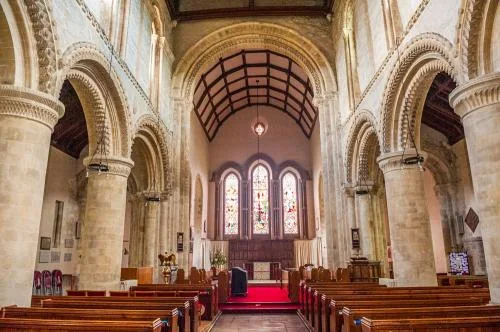
The first thing you notice about Steyning's parish church is the impressive height of the nave and the square, stolid appearance of the tower. Once inside, the oldest part of the church is the western end of the nave.
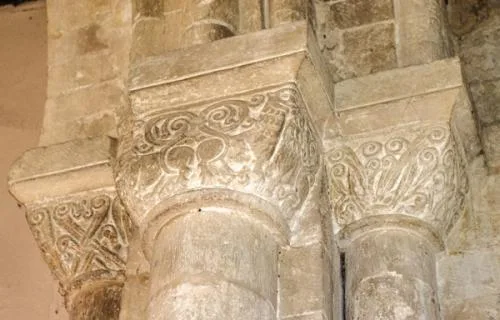
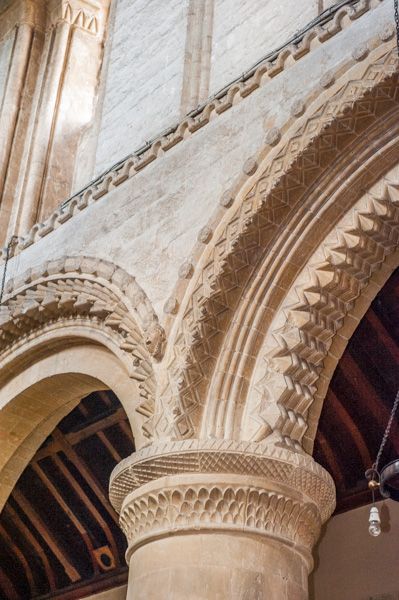
Here you will see beautifully-carved column capitals, one showing a pair of lions sharing one head. On the column shaft below is a carving of people harvesting crops. This depiction of daily life is extremely rare for the period.
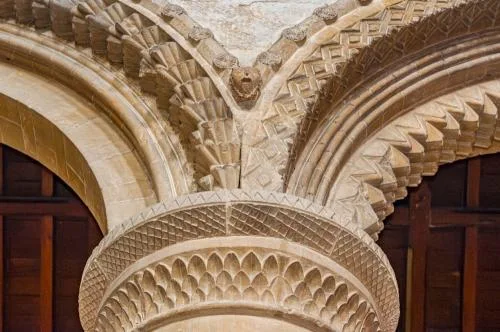
The nave arcade is richly carved with grotesque heads of beasts, florets, chevrons, and human heads.
The Tudor Screen
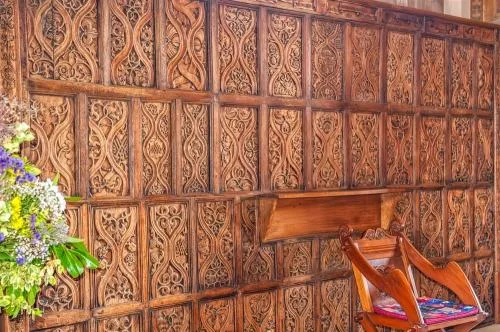
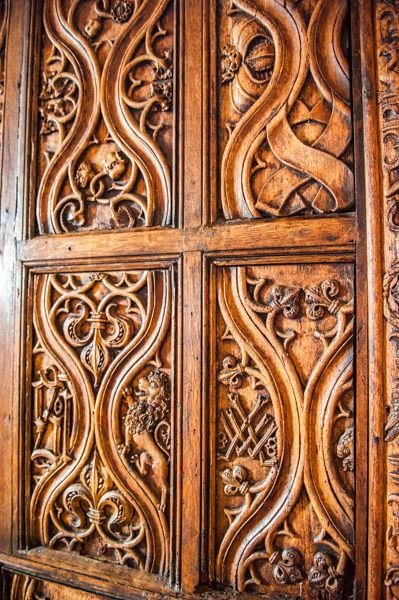
Perhaps the most interesting feature inside the church is a stunning Tudor screen in the north aisle. This screen is actually a section of ornate panelling, created in 1522. It was made by the order of Richard FitzJames, Bishop of London, to celebrate the marriage of Henry VIII to Catherine of Aragon.
It was intended for a chamber in Fulham Palace, London, where Bishop FitzJames entertained the king and queen. However, after Henry procured a divorce from Catherine, the panelling would have been a major embarrassment, so it was taken down. It somehow made its way to the Steyning vicarage and from there to the church itself.
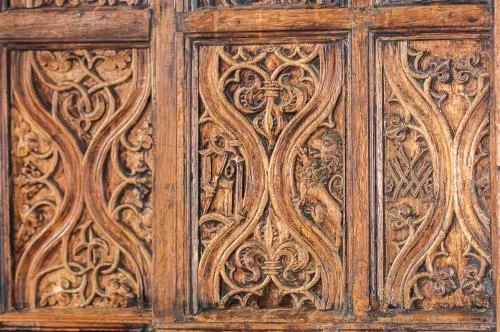
The screen is magnificent, with carved panels showing heraldic symbols, foliage, coats of arms, strange beasts, and geometric designs. Look for the pomegranate symbol of Aragon, the Tudor rose, royal symbols, and the arms of Bishop FitzJames.
The most puzzling symbol is a monogram which looks rather like a capital W interlaced with two Ls, one of which is reversed. The whole is between two Es, one of which is reversed. This monogram occurs 11 times across the screen, so it is obviously of great importance, but no one is sure what it means. One theory suggests that it refers to St Richard of Chichester.
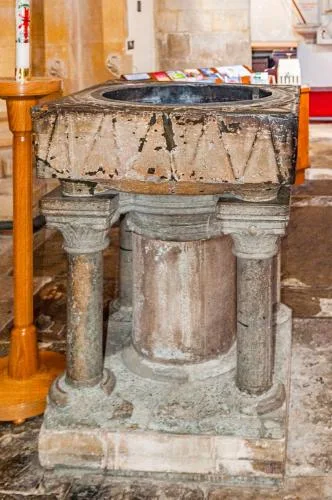
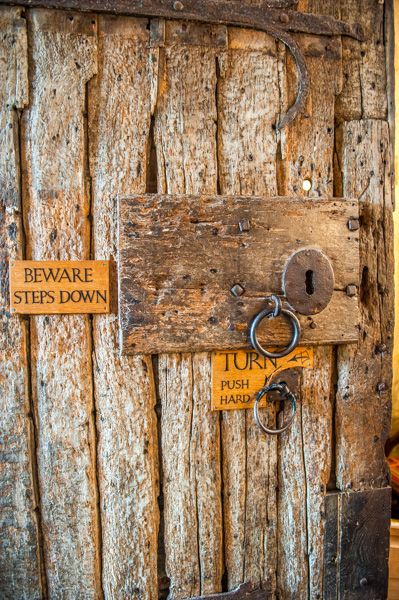
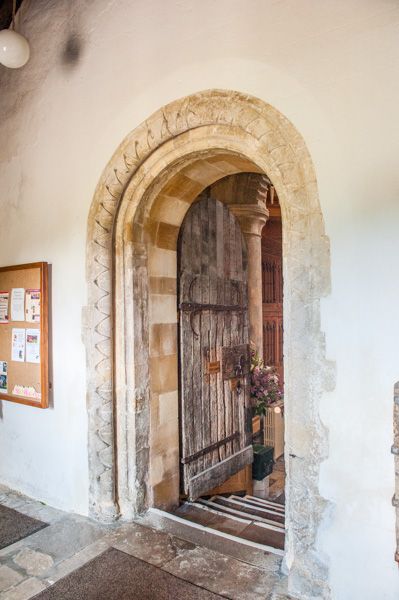
Other historical highlights include a square marble font, probably original to the 11th-century church. The south door is also original, making it probably the oldest in Sussex. The doorway moulding is decorated with traditional Norman beakhead carvings.
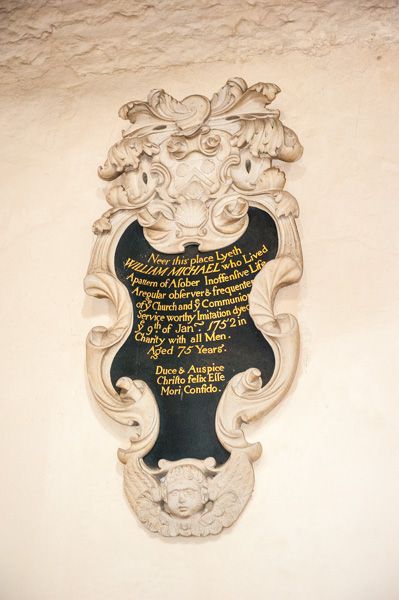
In the south aisle is a funeral hatchment to Joseph Proud, possible the same J. Proud who served as vicar of Steyning from 1684-1702.
A Saxon Coffin Cover
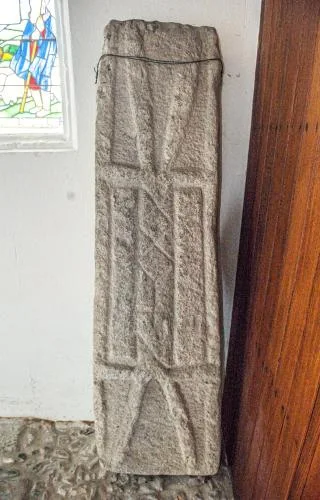
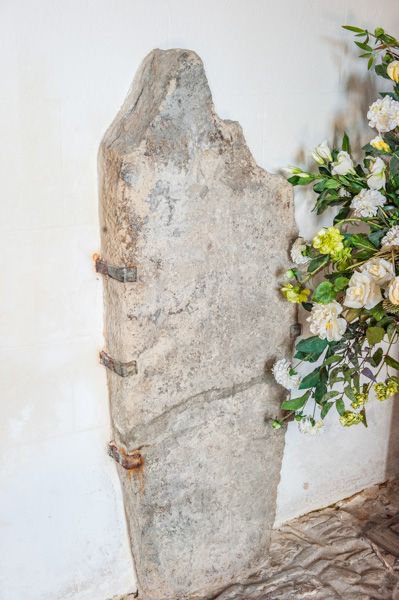
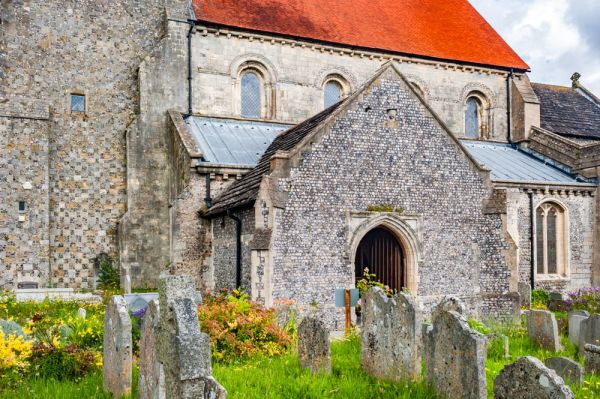
In the porch are two pre-Norman coffin covers. One is carved with two Passion crosses, and the other has a carving vaguely resembling a flattened house roof seen from above. This has been described as Viking in style.
It is well worth your time to wander around the church exterior and examine a row of small carved figures immediately under the roof line. The closest head to the tower is known as The Silent Woman of Steyning as she appears to have a hand across her mouth.
The round-headed clerestory windows date to the 12th century.
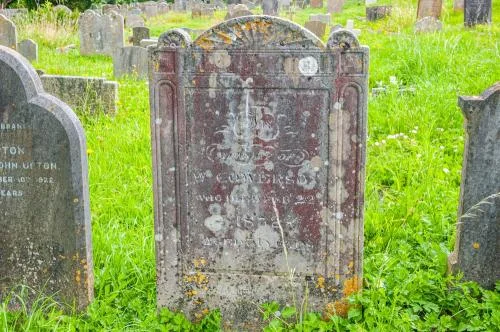
Also in the churchyard is the grave of William Cowerson, one of the last smugglers in Sussex. Cowerson, a bricklayer by trade, was shot and killed by excisemen in 1832.
Visiting
Steyning's parish church is a sumptuous feast; full of historical intertest and well worth a visit. The church stands on Vicarage Lane, in the heart of the village, and there is parking immediately outside the churchyard. The church was open when we visited and, as far as we can determine, is normally open to visitors.
More Photos
About Steyning, St Andrew & St Cuthman
Address: Vicarage Lane, Steyning, West Sussex, England, BN44 3YL
Attraction Type: Historic Church
Location: On Vicarage Lane, in the heart of the village. There is parking on the road outside the churchyard.
Website: Steyning, St Andrew & St Cuthman
Location map
OS: TQ179114
Photo Credit: David Ross and Britain Express
HERITAGE
 We've 'tagged' this attraction information to help you find related historic attractions
and learn more about major time periods mentioned.
We've 'tagged' this attraction information to help you find related historic attractions
and learn more about major time periods mentioned.
Historic Time Periods:
Find other attractions tagged with:
11th century (Time Period) - 12th century (Time Period) - 16th century (Time Period) - Norman (Architecture) - Saxon (Time Period) - Tudor (Time Period)
NEARBY HISTORIC ATTRACTIONS
Heritage Rated from 1- 5 (low to exceptional) on historic interest
Steyning Museum - 0.1 miles (Museum) 
Bramber Castle - 0.7 miles (Castle) 
Bramber, St Nicholas Church - 0.7 miles (Historic Church)
St Mary's House - 0.7 miles (Historic Building) 
Botolphs, St Botolph Church - 1.4 miles (Historic Church)
Chanctonbury Ring - 2.5 miles (Prehistoric Site)
Lancing College Chapel - 3.2 miles (Historic Church)
Cissbury Ring - 3.2 miles (Prehistoric Site)
Nearest Holiday Cottages to Steyning, St Andrew & St Cuthman:

Small Dole, West Sussex
Sleeps: 4
Stay from:£449 - £1,498