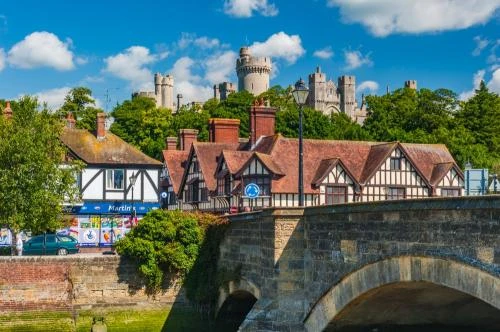
The lovely West Sussex village of Arundel packs a lot into a small space. First and foremost there is Arundel Castle, the ancestral home of the Dukes of Norfolk. The imposing castle is primarily 19th century, but is built around the remains of an authentic 12th-century castle motte, of which the keep still stands.
A stone's throw from the castle is Arundel Cathedral, a 19th-century Catholic cathedral in Victorian Gothic style. Just east of the cathedral is the ancient 14th-century parish church of St Nicholas.
Forty acres of parkland surround the castle, offering gentle walks along the River Arun through a landscape dotted with beech trees.
Just outside town is the Arundel Wetlands Centre, home of the Wildfowl and Wetlands Trust, which boasts 26 hectares of wetland habitat for native and migratory wildfowl from around the world.

Arundel History
Arundel was settled at least as early as Roman times, as an inland port at the highest point of navigation on the River Arun. A ford across the Arun made the location perfect for moving goods from the coast to the Weald, further inland.
The origin of the name 'Arundel' is subject to debate, but it seems likely that it comes from the Old English words 'harhune dell', meaning a valley where common horehound grew. another popular theory is that the town name evolved from the French 'hirondelle', for a swallow. The swallow appears on the town crest but, in fact, the town council itself has debunked the connection to swallows.
During the Saxon period, Arundel grew into an important market town, with weekly cattle markets and four fairs every year.
The first castle
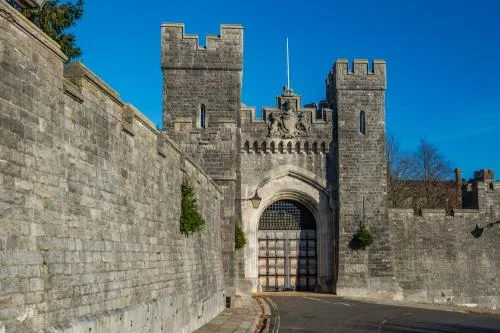
The strategic importance of Arundel was recognised by the Norman invaders after William the Conqueror's success at the Battle of Hastings in 1066. Less than a year after the battle, Roger de Montgomery, one of the most influential of the new Norman lords, erected a castle motte at Arundel to control the river crossing.
This first castle was no more than a timber palisade protecting a motte, or earthwork mound, but in 1070 the timber fortress was rebuilt in stone, making Arundel Castle one of the earliest stone castles in England.
Earls of Arundel
The first Earl of Arundel was the French baron William d'Aubigny, who gained lands in Sussex through marriage to Adeliza of Louvain, widow of Henry I. A tradition evolved whereby the holder of Arundel Castle would be considered the Earl of Arundel. The earldom has lapsed and been recreated multiple times over the centuries.
The first Fitzalan to hold the earldom was Richard Fitzalan 1267–1302, and the last was Henry Fitzalan, the 12th Earl, who died with an heir in 1580. The earldom then passed by marriage to Philip Howard, and has remained in the Howard (and later, the Fitzalan-Howard) families. The earldom is now, by tradition, given to the heir apparent to the Duke of Norfolk, another Fitzalan-Howard title.

What to See
There are over 200 listed buildings in Arundel, a testament to the town's rich history. Of these, six are listed as Grade II* and four as Grade I, the highest designation. The most important, and the one that draws the most visitors, is, of course, the superb castle.
Arundel Castle
The castle literally towers over Arundel, with picturesque turrets sprinkling the skyline. What we see today is a Gothic fantasy built around the original 11th-century castle mound.
The castle was shaped by Henry, 15th Duke of Norfolk, who oversaw a massive late-Victorian rebuilding campaign completed around 1900. Duke Henry's changes turned Arundel Castle into one of the first large English country houses with electric lighting, central heating, service lifts, advanced firefighting systems, and a gravity-fed water supply that also served the town.
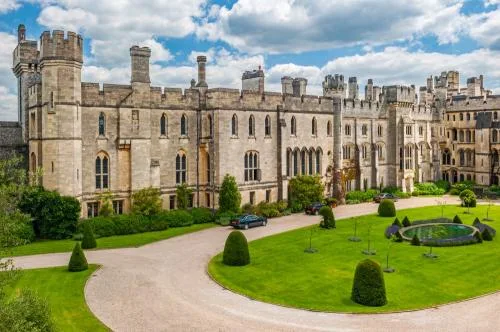
The 15th duke transformed Arundel Castle into one of the finest stately homes in England, a testament to the Fitzalan-Howard family's wealth and influence.
Aside from the castle buildings, the formal gardens that surround the castle are stunning at any time.
A stroll through the castle grounds bring you to Hiorns Tower, a striking castellated folly built around 1789 for the 11th Duke of Norfolk.
St Nicholas Church
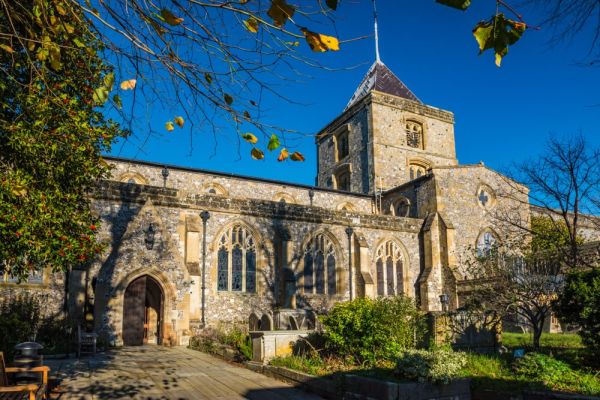
Immediately outside the castle wall stands the 14th-century parish church of St Nicholas. Highlights include restored medieval wall paintings, a medieval font of Sussex marble, and an ornate 14th-century stone pulpit thought to have been designed by Henry Yevele, the royal master mason.
Fitzalan Chapel
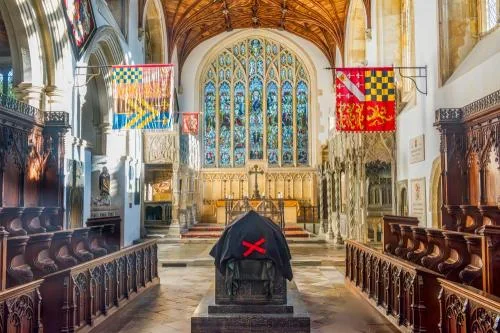
St Nicholas Church is unusual in that the nave and transepts serve as the Anglican parish church, while the chancel acts as a mausoleum for the Catholic Fitzalan and Howard families, Earls of Arundel and Dukes of Norfolk.
The chapel can only be entered from within the castle grounds, but visitors to the church can look through a beautiful 14th-century wrought-iron screen and see the sumptuous tombs of the owners of Arundel Castle and their families.
The magnificent medieval architecture and the stunning family memorials make the Fitzalan Chapel a must-see historical delight.

Arundel Cathedral
Just west of the parish church stands the Catholic cathedral, dedicated to Our Lady and St Philip Howard. It was begun by the 15th Duke of Norfolk in 1869 to serve as a parish church but raised to cathedral status in 1965.
The church was designed by Joseph Hansom, inventor of the Hansom cab, and is a superb example of 19th-century architecture. within the cathedral is the tomb of St Philip Howard, the 20th Earl of Arundel, who was reburied here in 1971.
Blackfriars
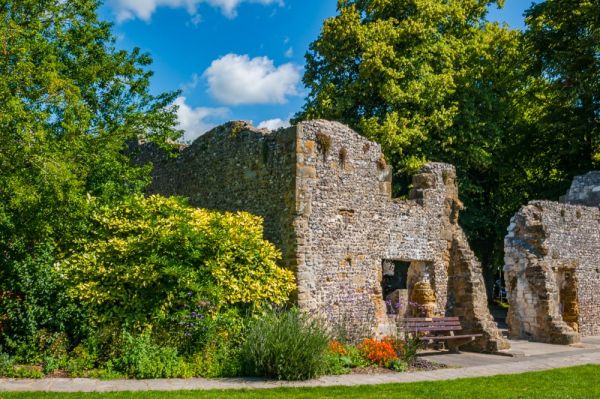
In a public park on Mill Road, beside the Museum of Arundel and almost opposite the Arundel Castle gates, stand the ruins of Blackfriars, all that remains of a 13th-century Dominican friary thought to have been founded by Isabel, Countess of Arundel, sometime before 1252.
Arundel Museum
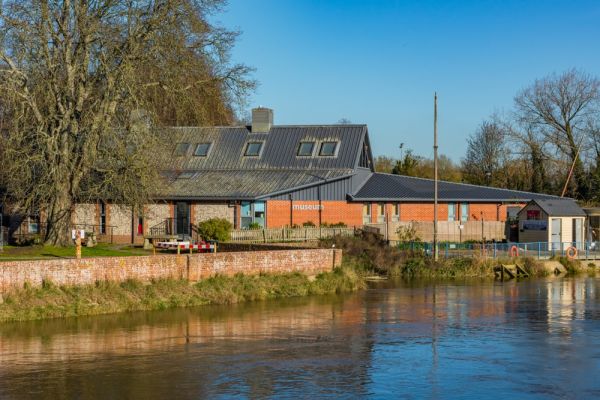
This delightful museum occupies a modern building on the north bank of the River Arun, opposite the castle gates. Here you can discover the rich history of Arundel, arranged in chronological fashion and including blacksmithing, clock-making, and horse-racing in the Arundel area.
Visiting information
Arundel is just off the A27. We recommend taking the Causeway Roundabout onto The Causeway, at the southeastern corner of the town. There is a pay and display car park on Queen Street, just before you reach the bridge. Alternatively, you can turn right after the bridge onto Mill Road and use the Mill Road car park (also pay and display).
Arundel is a delight to explore, with a huge number of attractive and historical buildings in a picturesque riverside setting.
More Photos
About Arundel
Address: Arundel, West Sussex, England
Attraction Type: Village
Location map
OS: TQ015075
Photo Credit: David Ross and Britain Express
HERITAGE
 We've 'tagged' this attraction information to help you find related historic attractions
and learn more about major time periods mentioned.
We've 'tagged' this attraction information to help you find related historic attractions
and learn more about major time periods mentioned.
Historic Time Periods:
Find other attractions tagged with:
12th century (Time Period) - 14th century (Time Period) - 19th century (Time Period) - castle (Architecture) - Victorian (Time Period) - Victorian Gothic (Architecture)
NEARBY HISTORIC ATTRACTIONS
Heritage Rated from 1- 5 (low to exceptional) on historic interest
Arundel, St Nicholas Church - 0.2 miles (Historic Church) 
Arundel Cathedral - 0.3 miles (Cathedral)
Arundel Castle - 0.3 miles (Castle)
Arundel Museum - 0.4 miles (Museum) 
Arundel Blackfriars - 0.5 miles (Abbey)
Arundel Wetland Centre - 0.9 miles (Countryside) 
Tortington, St Mary Magdalene Church - 1.6 miles (Historic Church)
North Stoke, St Mary's Church - 2.1 miles (Historic Church)
Nearest Holiday Cottages to Arundel:


Littlehampton, West Sussex
Sleeps: 5
Stay from:£398 - £1,497

Littlehampton, West Sussex
Sleeps: 6
Stay from:£391 - £1,512