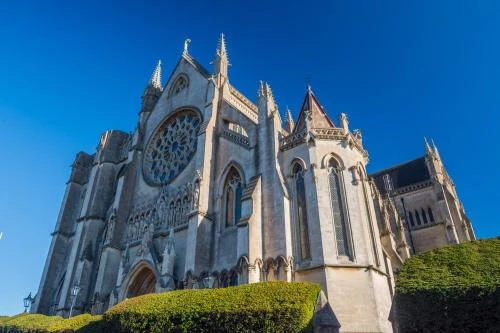
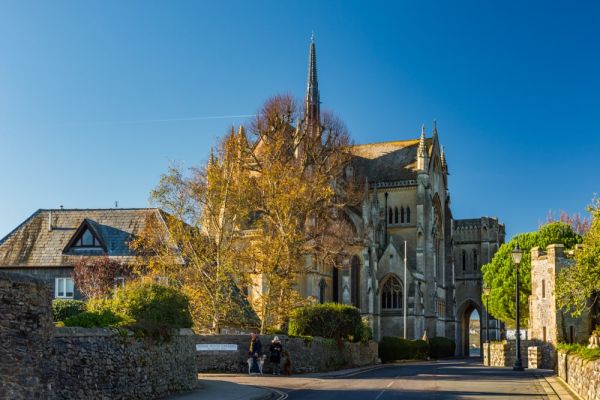
Arundel Cathedral is a Victorian Gothic (Catholic) cathedral in French Gothic style, standing outside the perimeter walls of Arundel Castle. The Cathedral was begun by Henry, 15th Duke of Norfolk, in 1869, to serve as a Catholic parish church for Arundel. It was completed in 1873.
A Gothic Revival Triumph
The Duke employed as his architect Joseph Hansom, inventor of the Hansom cab. While this might seem an odd choice, Hansom was an accomplished architect, counting among his commissions the Town Hall in Birmingham and Catholic cathedrals in Portsmouth and Plymouth. He also established The Builder, an influential architectural journal.
Hansom carried out his brief brilliantly, creating a soaring church faced with Bath stone.
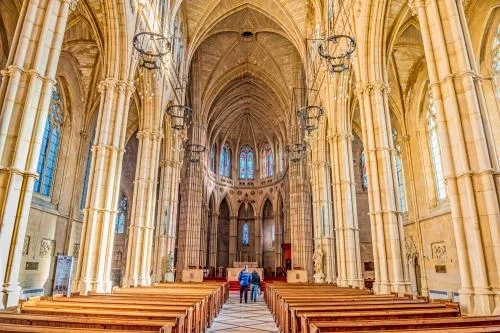
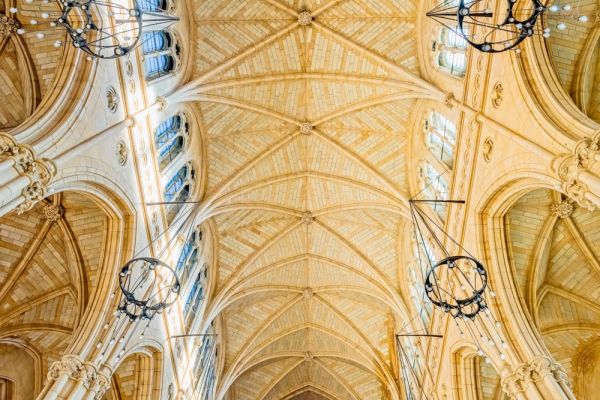
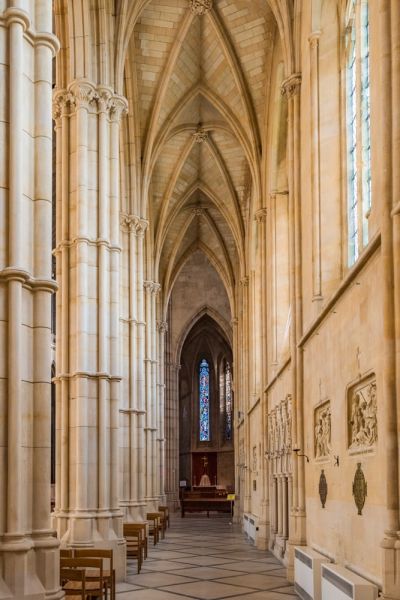
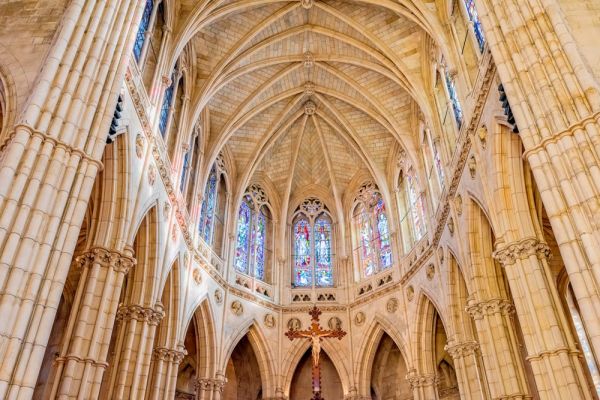
The Duke wanted a church to rival his own magnificent castle, and Hansom obliged, creating one of the finest examples of Gothic Revival style in England, with slender clusters of pillars rising to beautifully vaulted ceilings soaring high overhead. The style is reminiscent of 14th-century French architecture and bears a passing resemblance to Mont St Michel.
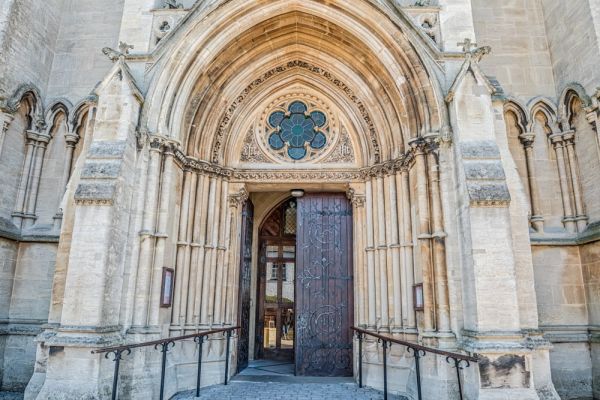
The original design called for a spire over the north porch, but this idea was never carried out, leaving the church with a rather peculiar outline. The most striking feature of the cathedral is the west front, with a huge rose window filled with colourful stained glass.
The original church was not built as a cathedral but as the parish church for the Catholic residents of Arundel. It was not until 1965 that Arundel Cathedral became the cathedral for the newly formed diocese of Arundel and Brighton. David Cashman, a former rector of the parish church, was named the first Bishop of Arundel.
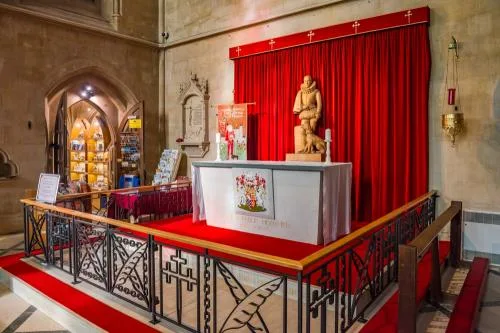
St Philip Howard
The original parish church was dedicated to St Philip Neri, then in 1965 this was extended to Our Lady and St Philip when the church was raised to cathedral status, and finally, in 1973 the recently canonised St Philip Howard was added to the dedication.
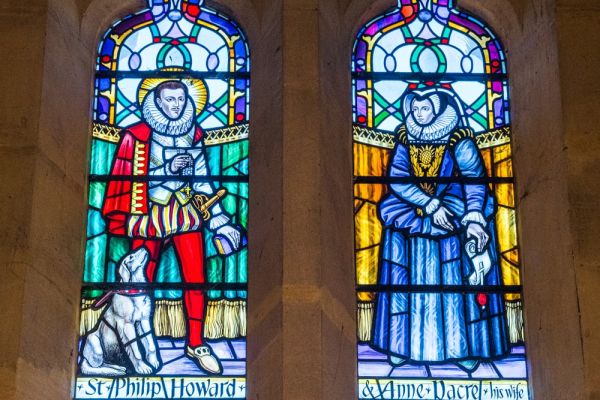
Howard was the 20th Earl of Arundel, a Catholic recusant who was imprisoned in the Tower of London by Elizabeth I and died of dysentery there in 1595.
He was buried first at the Tower, then reburied in the Fitzalan Chapel in the castle grounds. Finally, in 1971 he was reburied again, inside the cathedral, where you can see his shrine, with a sculpture of his faithful dog, who kept him company throughout his decade-long stay in the Tower.
Highlights
The impressive nave is six bays long, with slender arcaded pillars supporting the soaring ceiling high above. Between the arch spandrels are roundels holding busts of Anglo-Saxon saints, women to the north and men to the south.
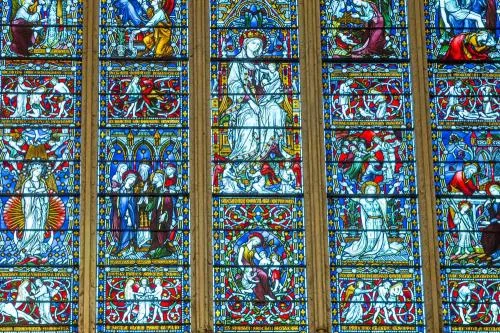
In the narthex you will see memorial windows to members of the Lisle family, including a window in honour of Lieutenant Alexander Charles Nicholas March de Lisle, who died in action in Flanders in 1917 at the age of twenty.
At the west end of the south aisle are memorial windows to St Philip Howard and to his wife, Anne Dacre.
The cathedral boasts an outstanding collection of richly-coloured Victorian stained glass, most of it designed by Nathaniel Westlake (1833-1921). Westlake was a partner in the famed design firm of Lavers and Westlake, though he is perhaps better known for his painting ceiling at St Joseph's Church, Highgate. One of the most memorable windows depicts royal saints (not all of them British).
In the north transept is a chapel dedicated to St Wilfrid (634-709). This also doubles as a war memorial chapel in honour of the men and women of Arundel who gave their lives in both world wars.
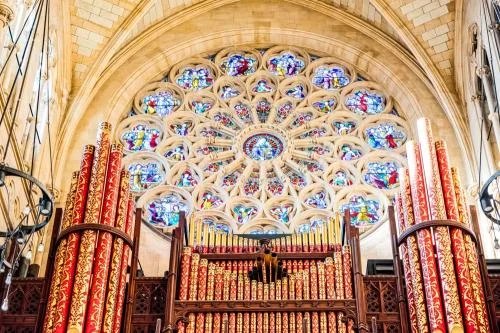
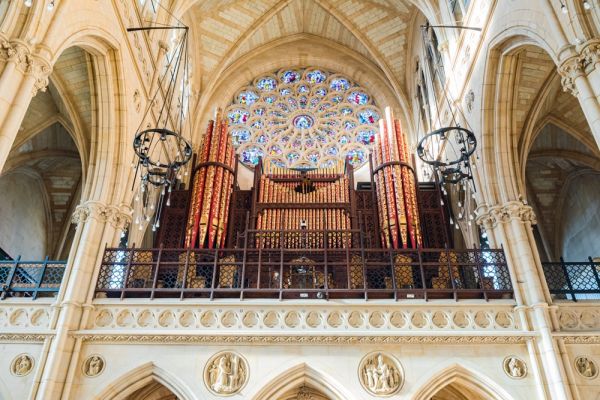
Dominating the west end of the cathedral is the stunning rose window, which overlooks a magnificent organ. The centre depicts the Blessed Virgin and the Holy Child surrounded by angels, while the outer ring of fifteen small windows depict the Mysteries of the Rosary.
The organ was built for St. John’s Catholic Church in Islington, but installed here in 1875. The organ's casework had to be altered to avoid it blocking the Rosary Window.
The result is simply superb. Arundel Cathedral is one of the finest churches in England from any era, a triumph of Victorian style, and well worth a visit.
Visiting
Arundel Cathedral is open to visitors most days and was open when we visited. There is limited parking along London Road, but there are several pay and display car parks near the river. If you park in one of these (as we did) you will face a short but steep walk uphill to reach the cathedral and parish church.
More Photos

About Arundel Cathedral
Address: London Road, Arundel, West Sussex, England, BN18 9AY
Attraction Type: Cathedral
Location: Above the junction of the A27 and A284
Website: Arundel Cathedral
Email: aruncath1@aol.com
Location map
OS: TQ015070
Photo Credit: David Ross and Britain Express
HERITAGE
 We've 'tagged' this attraction information to help you find related historic attractions
and learn more about major time periods mentioned.
We've 'tagged' this attraction information to help you find related historic attractions
and learn more about major time periods mentioned.
Historic Time Periods:
Find other attractions tagged with:
castle (Architecture) - Elizabeth I (Person) - Gothic Revival (Architecture) - Victorian (Time Period) - Victorian Gothic (Architecture)
NEARBY HISTORIC ATTRACTIONS
Heritage Rated from 1- 5 (low to exceptional) on historic interest
Arundel, St Nicholas Church - 0.1 miles (Historic Church) 
Arundel Castle - 0.2 miles (Castle)
Arundel Blackfriars - 0.3 miles (Abbey) 
Arundel Museum - 0.4 miles (Museum)
Arundel Wetland Centre - 1 miles (Countryside) 
Tortington, St Mary Magdalene Church - 1.4 miles (Historic Church)
North Stoke, St Mary's Church - 2.4 miles (Historic Church)
Yapton, St Mary's Church - 3 miles (Historic Church)
Nearest Holiday Cottages to Arundel Cathedral:

Littlehampton, West Sussex
Sleeps: 5
Stay from:£398 - £1,497

Littlehampton, West Sussex
Sleeps: 6
Stay from:£391 - £1,512

Littlehampton, West Sussex
Sleeps: 6
Stay from:£393 - £1,631