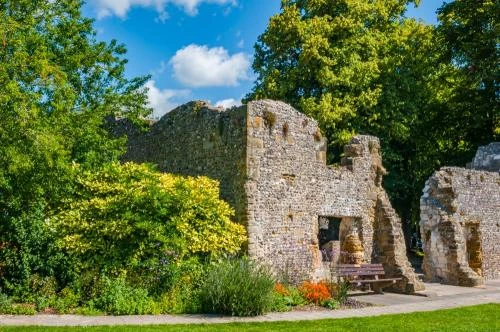
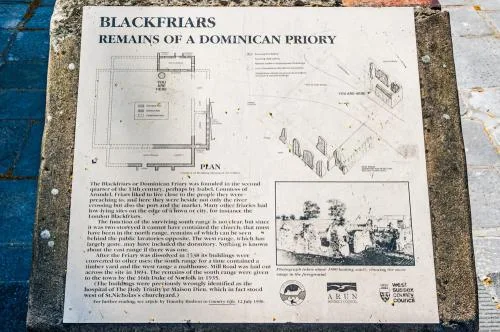
On the north bank of the River Arun, facing the gates of Arundel Castle, stand the ruins of a medieval Dominican friary, known as Blackfriars for the black colour of the robes worn by friars of the Dominican order.
History
The friary was very likely established by Isabel de Warenne, Countess of Arundel, sometime before 1253. We can be certain of the date because the friary was mentioned in the will of St Richard of Chichester in that year.
The friary was never terribly large, supporting perhaps 20 friars at its medieval height. When it was dissolved by Henry VIII in 1538, there were only 5 friars in residence.
After the Dissolution, the friary site was used as a timber yard, a storage area, a barn, and as dwellings. Historical records show that the now-vanished west range was used for many years as a malt house. In 1894, Mill Road was built across the friary site, splitting it in two. Then in 1935, the friary and the land on which it sits were given to the town of Arundel by the 16th Duke of Norfolk.
Countess Isabel
Isabel de Warenne (c. 1228–1282) was the daughter of William de Warenne, 5th Earl of Surrey, and Maud Marshal. She was also a cousin of King Henry III. At the age of just 8 she married Hugh d'Aubigny, 5th Earl of Arundel. The Earl died when Isabel was 17 and she never remarried.
Countess Isabel was a devout woman and founded the only Cistercian nunnery in England at Marham, in Norfolk, where she was buried after her death in 1282.
A Case of Mistaken Identity
In 1793 an article was published in 'The Gentleman's Magazine' which identified the medieval ruins on Mill Road as being the last vestiges of Maison Dieu (more officially, Maison Dieu of the Hospital of the Holy Trinity).
The author was wrong; Maison Dieu was built elsewhere in Arundel, but the misidentification was accepted as fact for almost two centuries. It was not until 1990 that the error was corrected. Old habits die hard, however, and local residents sometimes still call the ruins 'Maison Dieu'.
Modern research suggests that the real Maison Dieu stood near what is now the Collector Earl's Garden, just west of St Nicholas Church. Maison Dieu was established in the latter half of the 14th century and was dissolved in 1546.
What to See
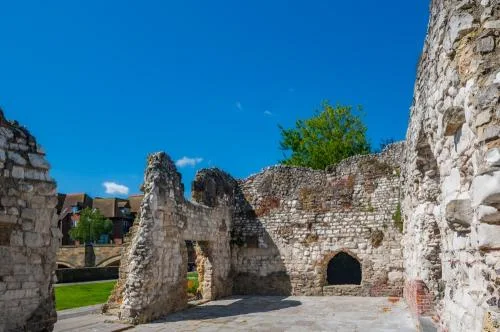
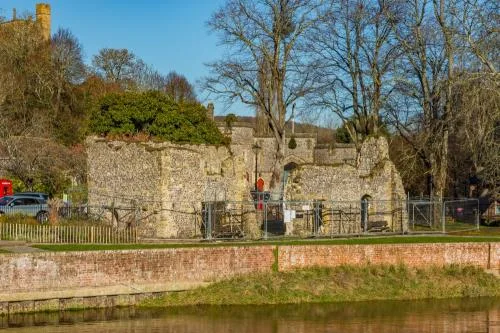
All that remains of Blackfriars today is a part of the friary's south range, which may have housed the friary's refectory, or dining hall. This stands partly within a public park on the south side of Mill Road, next to the Museum of Arundel and opposite the gates to Arundel Castle. It seems likely that this range was connected to a dormitory range to the west and faced onto a cloister to the north, where Mill Road now runs.
The ruins are built of sandstone and soft chalk (known as clunch) dressed with flint. Much of the sandstone has been robbed for use in nearby buildings, including the neighbouring 18th-century bridge across the Arun. As a result, the clunch has been left at the mercy of the weather, leaving the ruins in a precarious and unstable state.
Visiting
Blackfriars stands in Jubilee Garden, on the north bank of the River Arun and immediately east of the Queen Street Bridge. The park is open at any time, and it is extremely easy to view the ruins, at least from the outside.
In 2025, Blackfriars was placed on the Historic England 'Heritage at Risk' register, a sign of the decay that threatens the friary's survival. On our last visit, the ruins were surrounded by metal fencing to keep visitors out, but you can still get a good view of the remains from the park and from Mill Road.
About Arundel Blackfriars
Address: Mill Road, Arundel, West Sussex, England
Attraction Type: Abbey
Location: In Jubilee Park, on Mill Road, just east of the bridge. Pay and display parking immediately east on Mill Road.
Location map
OS: TQ019070
Photo Credit: David Ross and Britain Express
NEARBY HISTORIC ATTRACTIONS
Heritage Rated from 1- 5 (low to exceptional) on historic interest
Arundel Museum - 0.1 miles (Museum) 
Arundel Castle - 0.1 miles (Castle) 
Arundel, St Nicholas Church - 0.2 miles (Historic Church)
Arundel Cathedral - 0.3 miles (Cathedral)
Arundel Wetland Centre - 1 miles (Countryside) 
Tortington, St Mary Magdalene Church - 1.6 miles (Historic Church)
North Stoke, St Mary's Church - 2.4 miles (Historic Church)
Littlehampton Museum - 3.1 miles (Museum) 
Nearest Holiday Cottages to Arundel Blackfriars:

Littlehampton, West Sussex
Sleeps: 5
Stay from:£398 - £1,497

Littlehampton, West Sussex
Sleeps: 6
Stay from:£391 - £1,512

Littlehampton, West Sussex
Sleeps: 6
Stay from:£393 - £1,631