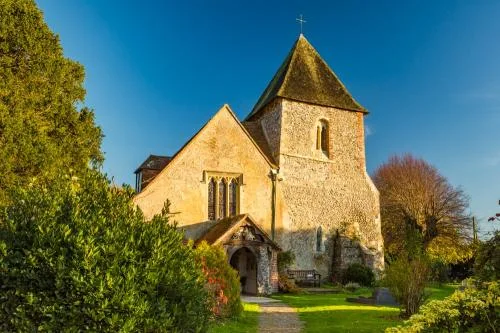
St Mary's Church, Yapton, dates to the end of the 12th century (roughly 1180-1220), but it may incorporate stonework from an earlier Saxon church on the site. The style is typical of Sussex, with very low eaves under a tiled roof.
The layout is also typical, with a chancel, aisled nave, west porch, and a south-west tower that terminates the south aisle. The nave and aisles are spanned by a single roof that slopes down to within 1 metre of ground level.
History
The original church at Yapton was a prebend of the minster church at nearby Arundel until 1255, when it passed to the Abbey of Sées in France and was connected to the abbey's priory in Arundel. In 1380 it passed to the college of priests at Arundel. We know that a vicarage existed as early as 1255, probably standing south-west of the church. This was torn down in 1757 when the living of Yapton was united with Walberton.
From 1596-1622, Yapton was served by Hugh Roberts, who held strong Puritan beliefs. Roberts refused to wear a surplice for communion and allowed communicants to stand or sit, rather than forcing them to kneel. He also refused communion to a pair of parishioners who did not know the Ten Commandments. As a result, people sympathetic with Puritan belief travelled to Yapton to attend services.
The Church Building
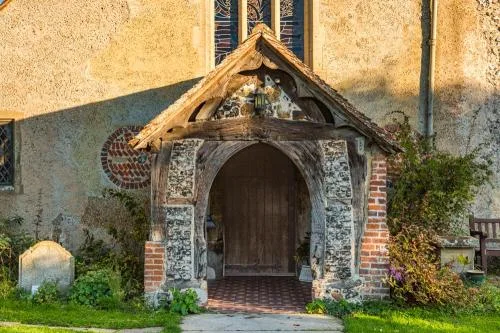
The most striking feature of the church exterior is the picturesque 14th-century west porch, built with massive timbers. The porch is infilled with local flint between the timber beams. The Norman tower, built between 1180 and 1230, is in Transitional Norman style, and its base forms the south wall of the pre-Norman church.
If you stand back from the church and look closely at the tower, you will see that it leans to one side. To stabilise the tower, sturdy stone buttresses were added in the 14th and again in the 16th century.
Inserted into the tower wall are moulded stones dating to the 13th century.
The chancel and chancel arch date to the period 1200-1220 and are excellent examples of Early English style.
Historical Highlights
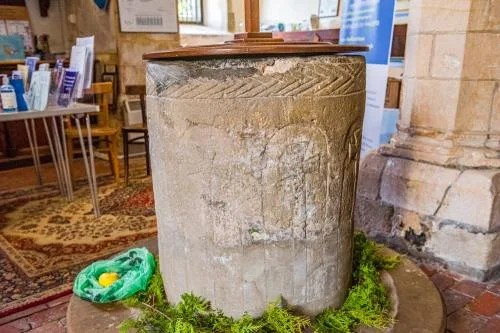
The oldest feature inside the church is the font, which is thought to date to before the Norman Conquest. This is in the shape of a large, round bowl set upon a modern base. The font bowl is carved with eight arches, each containing an elongated Maltese cross, and a band of chevron decoration encircles the bowl.
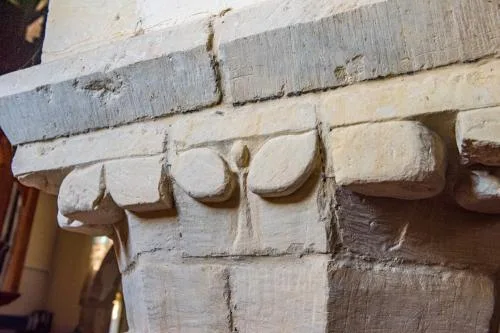
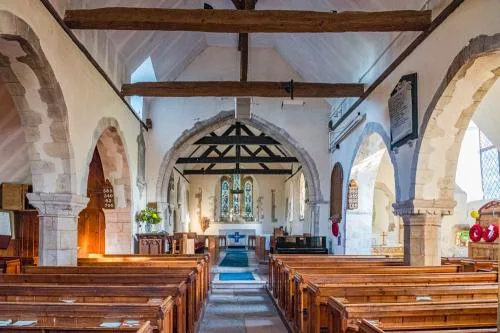
The nave arcade is worth noting; the north side has four arches, while the south side has only three. The column capitals on the south side appear unfinished. Local tradition says that the masons at work on Yapton's church were called away to help rebuild Chichester Cathedral after it was damaged by fire in 1187, and they never returned leaving the capitals incomplete.
As the church website points out, an alternative -- and totally plausible explanation -- is that the money simply ran out and the masons quit.
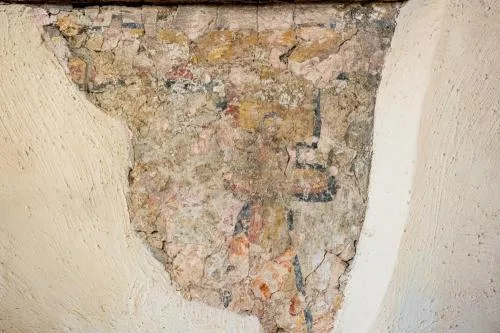
There are traces of medieval wall paintings, notably on the north nave wall. The oldest memorial is a 13th-century coffin slab, while another memorial honours Stephen Roe (d. 1766), who established the village school. He established the Roe Charity, which still exists. The charity provides education for boys and girls according to the principles of the Anglican Church, while also giving donations to people in need.
In the nave is a memorial to John Edmonds (d. 1678), owner of Yapton Place.
On the north wall of the chancel is a memorial George Thomas, who served as the Governor of Pennsylvania and of the Leeward Islands. The Thomas family lived at Yapton Place and made their considerable fortune from sugar plantations in the West Indies.
On the north wall is a monument to Margaret Thomas (d. 1763). Her florid epitaph describes her in these words:
When living eminent for her maternal care
and conjugal affection, for piety, charity,
universal goodness, now dead as extensively lamented.
In the chancel is a sedate wall tablet to Frances Thomas (d. 1807).
South of the chancel arch is a plainly-carved piscina of around 1200, while a small piscina of similar date is set into the south chancel wall.
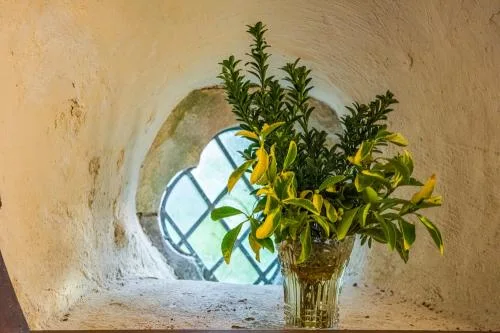
Set upon a grill at the west end of the south aisle is a wooden plaque made with timber from the only piece of oak to survive a fire in 1909. The oak was thought to have been installed in the tower around 1320.
There are two war memorials inside the church. Near the chancel arch is a WWI memorial, while in the south aisle is a second memorial to the fallen of WWII.
Visiting
St Mary's Church stands at the point where Church Lane meets Church Road, just east of North End Road (the B4232). There is limited parking along the road, but there is a free car park beside the village hall on Main Road, with a short walk across the playing fields to the church. The church is normally open to visitors and was open when we visited.
More Photos


About Yapton, St Mary's Church
Address: Church Road, Yapton, West Sussex, England, BN18 0EE
Attraction Type: Historic Church
Location: At the junction of Church Road and Church Lane. Limited parking along the verge or at the village hall.
Website: Yapton, St Mary's Church
Location map
OS: SU981035
Photo Credit: David Ross and Britain Express
NEARBY HISTORIC ATTRACTIONS
Heritage Rated from 1- 5 (low to exceptional) on historic interest
Tortington, St Mary Magdalene Church - 1.6 miles (Historic Church) 
Arundel Cathedral - 3 miles (Cathedral)
Littlehampton Museum - 3 miles (Museum) 
Arundel, St Nicholas Church - 3.2 miles (Historic Church)
Arundel Castle - 3.2 miles (Castle)
Arundel Blackfriars - 3.2 miles (Abbey) 
Arundel Museum - 3.3 miles (Museum)
Arundel Wetland Centre - 4.1 miles (Countryside) 
Nearest Holiday Cottages to Yapton, St Mary's Church:
Littlehampton, West Sussex
Sleeps: 6
Stay from:£391 - £1,512