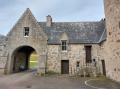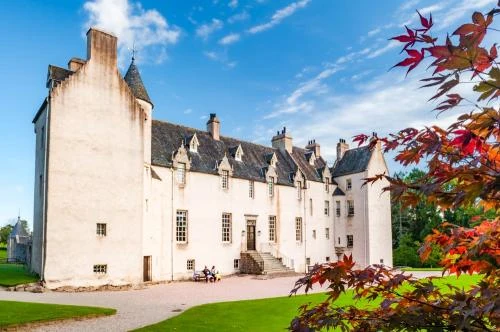
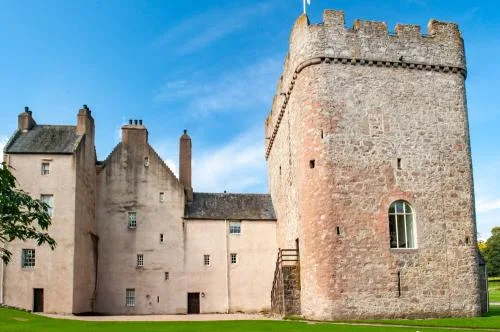
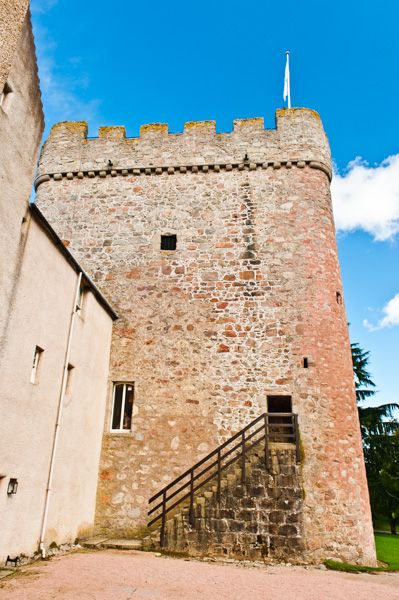
The Tower of Drum, later Drum Castle, was built as a hunting lodge by Alexander III around 1280. The king called on Richard Cementarius, Provost of Aberdeen, to oversee the building of his lodge, and Cementarius created a sturdy tower over 70 feet high, with walls fully 12 feet thick.
History
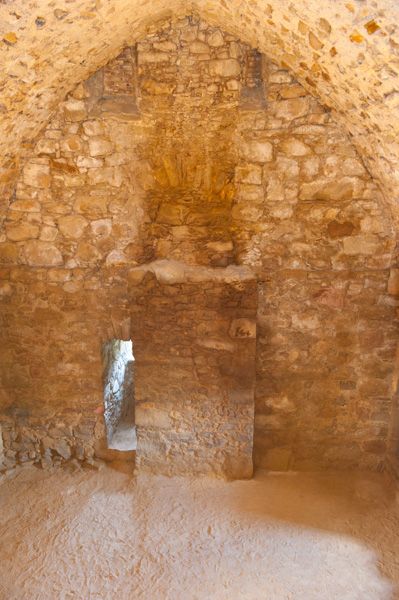
Within a secret chamber in the thickness of the wall was the castle well. That well was the scene of the darkest moment in the history of Drum Castle.
In the early 16th century, the 5th laird of Drum killed and dismembered his chaplain in the well. He claimed that his deed was the result of catching the chaplain in bed with his wife, and he was let off with a fine of 100 marks.
When Robert the Bruce defeated his great rivals for the throne, the Comyns, he gave Drum to his close friend and armour-bearer, William de Irwyn. Drum then passed in an unbroken line through 24 generations of Irvines.
It fell to an army of Covenanters during the religious struggles of the 17th century and was ransacked twice by the Marquis of Montrose.
Jacobite Drama
The Irvines supported the Stuarts in the Jacobite Risings of 1715 and 1745. Following the Battle of Culloden in 1745, the 17th laird hid from government troops in a secret chamber within the castle.
His family, fearing the worst, buried the family silver. Unfortunately, the government soldiers spotted the freshly dug earth and seized the money. The Irvines kept the castle and estate, but their days of glory on the national stage were over.
The Garden
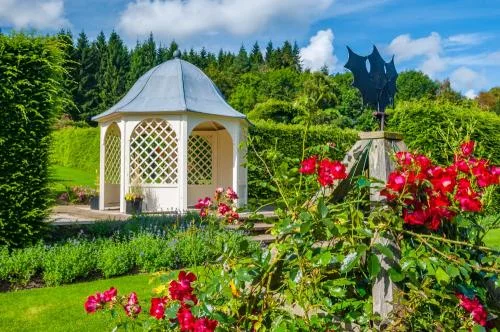
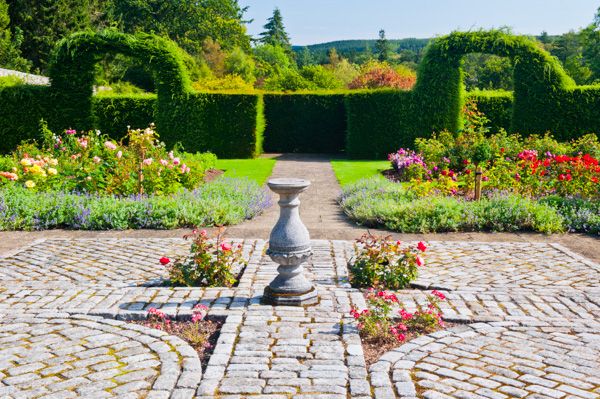
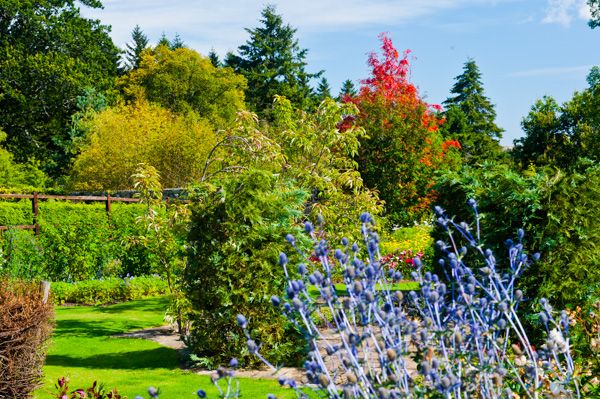
One of the special features at Drum Castle is the garden of historical roses. This delightful walled garden is divided into four different sections, each planted in the style of a different century, with authentic rose varieties where possible. And I can say from experience that the scent from the different flowers is divine!
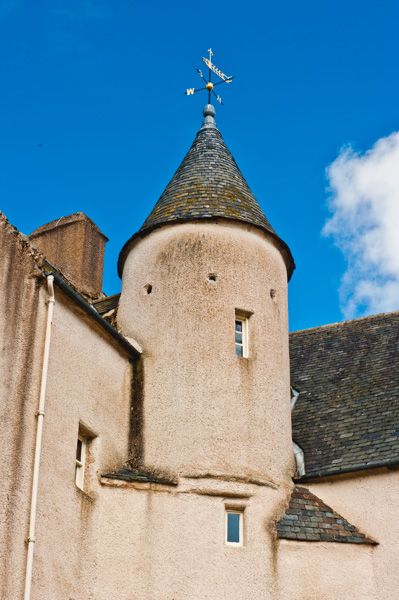
The oldest part of the castle is the High Hall, one of earliest tower houses in Scotland, dating to the late 13th or early 14th century. Part of the tower was later absorbed into the Jacobean expansion to the house. You can climb to the roof of the tower for wonderful views over the castle grounds.
The interiors are simply furnished, with exhibitions telling the story of the people who lived here over the centuries, particularly the last owners of the house.
More Photos


About Drum Castle
Address: Drumoak, Banchory, Aberdeenshire, Scotland, AB31 5EY
Attraction Type: Historic House
Location: 3 m (5 km) W Peterculter, 8 m E Banchory, off A93
Website: Drum Castle
Email: drum@nts.org.uk
National Trust for Scotland
Location map
OS: NJ796 005
Photo Credit: David Ross and Britain Express
POPULAR POSTS
HERITAGE
 We've 'tagged' this attraction information to help you find related historic attractions
and learn more about major time periods mentioned.
We've 'tagged' this attraction information to help you find related historic attractions
and learn more about major time periods mentioned.
Historic Time Periods:
Find other attractions tagged with:
13th century (Time Period) - 14th century (Time Period) - 16th century (Time Period) - 17th century (Time Period) - castle (Architecture) - Georgian (Time Period) - Jacobean () - Jacobite (Historical Reference) - Robert the Bruce (Person)
NEARBY HISTORIC ATTRACTIONS
Heritage Rated from 1- 5 (low to exceptional) on historic interest
Cullerlie Stone Circle - 2.4 miles (Prehistoric Site) 
Crathes Castle - 5.7 miles (Historic House) 
Sunhoney Stone Circle - 5.9 miles (Prehistoric Site)
Falls of Feugh - 6.8 miles (Countryside) 
Banchory Museum - 7 miles (Museum) 
Midmar Kirk Stone Circle - 7 miles (Prehistoric Site)
Nine Stanes Stone Circle - 7.4 miles (Prehistoric Site)
Rhynie Man - 8.2 miles (Prehistoric Site)
Nearest Holiday Cottages to Drum Castle: